
SKALE has repositioned itself in 2026 as a payments chain for AI agents: software that buys data, compute and API access on its own, in amounts too small for normal gas fees to make sense. Its pitch is that agents transact on SKALE without paying per-transaction gas, settle in USDC through the open x402 payment standard, and identify themselves through the ERC-8004 agent registry.
For SKALE, this is the second big bet after gaming, and it rests on the same feature. A chain where users pay nothing per transaction is a natural fit for a machine that might make ten thousand payments a day. What follows covers what SKALE has actually shipped, how an agent payment works end to end, and how much of the activity reaches the SKL token.
Why Agents Need a Different Kind of Chain
An AI agent paying for an API call might spend a tenth of a cent. On a chain where gas costs even one cent, the fee is ten times the payment, and on a busy network the fee is also unpredictable. Human users tolerate that because they transact rarely. Agents running in loops cannot.
Agents also need payments that settle instantly and finally. A bot that waits for several confirmations before receiving data, or that risks a reorganization undoing a payment, is slower and riskier to run. SKALE chains finalize a block once two thirds of the validator committee signs it, with no reorgs, which suits machine-to-machine commerce. The broader case for blockchains as payment rails for software is covered in our look at crypto payment infrastructure for AI agents.
What SKALE Has Shipped for Agents
Native x402 and ERC-8004 support
The V4 upgrade in January 2026 added native support for x402, an open standard that revives the web's old "402 Payment Required" status code so that a server can ask for payment and a client can pay inside the same HTTP request. It also added support for ERC-8004, a standard for registering agent identities and reputations onchain.
SKALE on Base and compute credits
SKALE on Base brings the gas-free model to Base and its user base. Apps prepay compute credits in USDC or SKL, and those credits cover gas, so agents never hold a gas token. The x402 Bazaar launch on SKALE on Base in March 2026 opened a directory where agents can discover and pay for APIs. The way credits replace gas is explained in more depth in our guide to SKALE gas fees.
Agent Pit and developer tooling
In August 2026 SKALE Labs launched Agent Pit, a simulated prediction market that feeds agents live event data so developers can train and test trading agents without risking funds. Partner projects such as agent launchpads have also deployed on SKALE on Base, with Khorus describing the credits model as what makes long-running agent loops economical.
Encrypted transactions for trading agents
SKALE Labs also developed BITE (Blockchain Integrated Threshold Encryption), which keeps a transaction's contents encrypted until its block is final. For a trading agent, that means bots watching the mempool cannot copy or front-run its orders. BITE is the core of FAIR, SKALE Labs' planned MEV-resistant Layer 1, and the roadmap includes bringing the same tooling to SKALE chains.
How an x402 Payment Works on SKALE
- An agent requests data or a service from an API.
- The API responds with a 402 status code and its price, for example a fraction of a cent in USDC.
- The agent signs a USDC transfer authorization, which lets a third party submit the transfer without the agent holding gas.
- A facilitator submits the transfer on SKALE, with gas covered by prepaid credits.
- The payment finalizes in about a second, and the API releases the response.
The agent never touches a gas token, never waits for confirmations and pays only the listed price. That is the full value proposition in five steps.
How Much of This Reaches SKL?
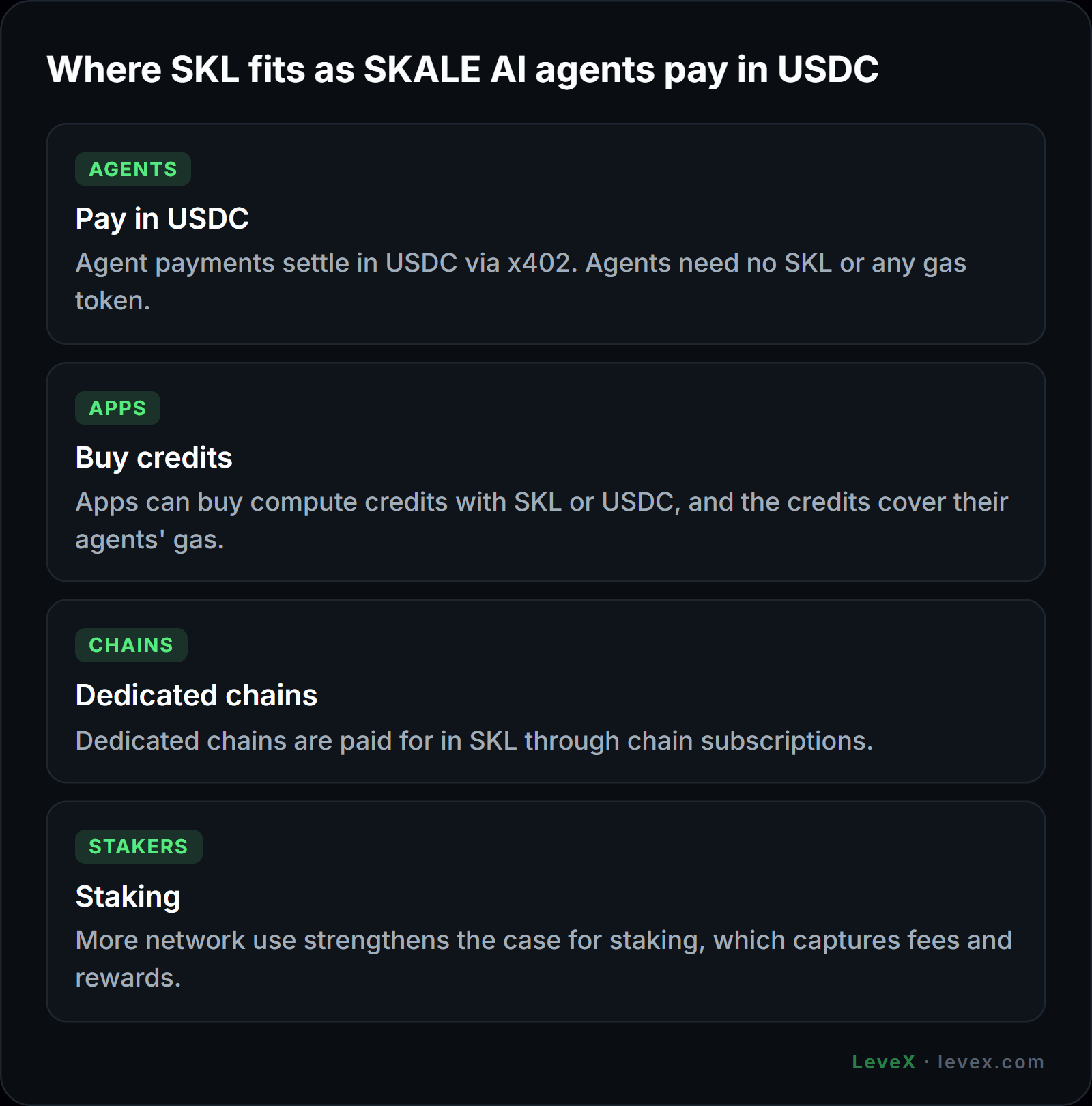
This is the question traders should focus on, because agent payments settle in USDC. SKL benefits indirectly, in three ways: apps can buy credits with SKL, dedicated chains are paid for in SKL, and greater network use strengthens the case for staking, as outlined in our SKL tokenomics breakdown.
The numbers are still early. At launch, the x402 Bazaar reported more than 170 onchain payments and three outside API providers, which shows the infrastructure works while revenue is still minimal. Agent payments could grow very quickly, and SKALE is well positioned for them, but the link between that volume and SKL demand is loose. Low-fee rivals such as Polygon and the large rollups are chasing the same market, a contrast our SKALE vs Polygon comparison explores.
For holders who want direct exposure to network growth, staking captures fees and rewards, as covered in our guide on how to stake SKL. For traders, agent adoption is one of the main swing factors in the scenarios laid out in our SKL price prediction.
SKALE AI Agent FAQ
What is x402 on SKALE?
x402 is an open payment standard that lets an API request payment through the HTTP 402 status code and lets a client, such as an AI agent, pay within the same request. SKALE supports it natively, with payments settling in USDC and gas covered by app-funded credits.
Do AI agents on SKALE need SKL?
No. Agents pay in USDC and do not need SKL or any gas token. SKL comes in at the app and network level, through credits, chain subscriptions and staking.
SKL and the Agent Economy
SKALE has built the plumbing an agent economy needs: free transactions, instant finality, x402 payments and agent identity. The open question is how much of that USDC-denominated activity turns into demand for SKL itself.
Traders can position on that question through the LeveX SKL/USDT spot pair or with SKL perpetual futures, long or short. More quick reads on crypto networks are in Crypto in a Minute.