
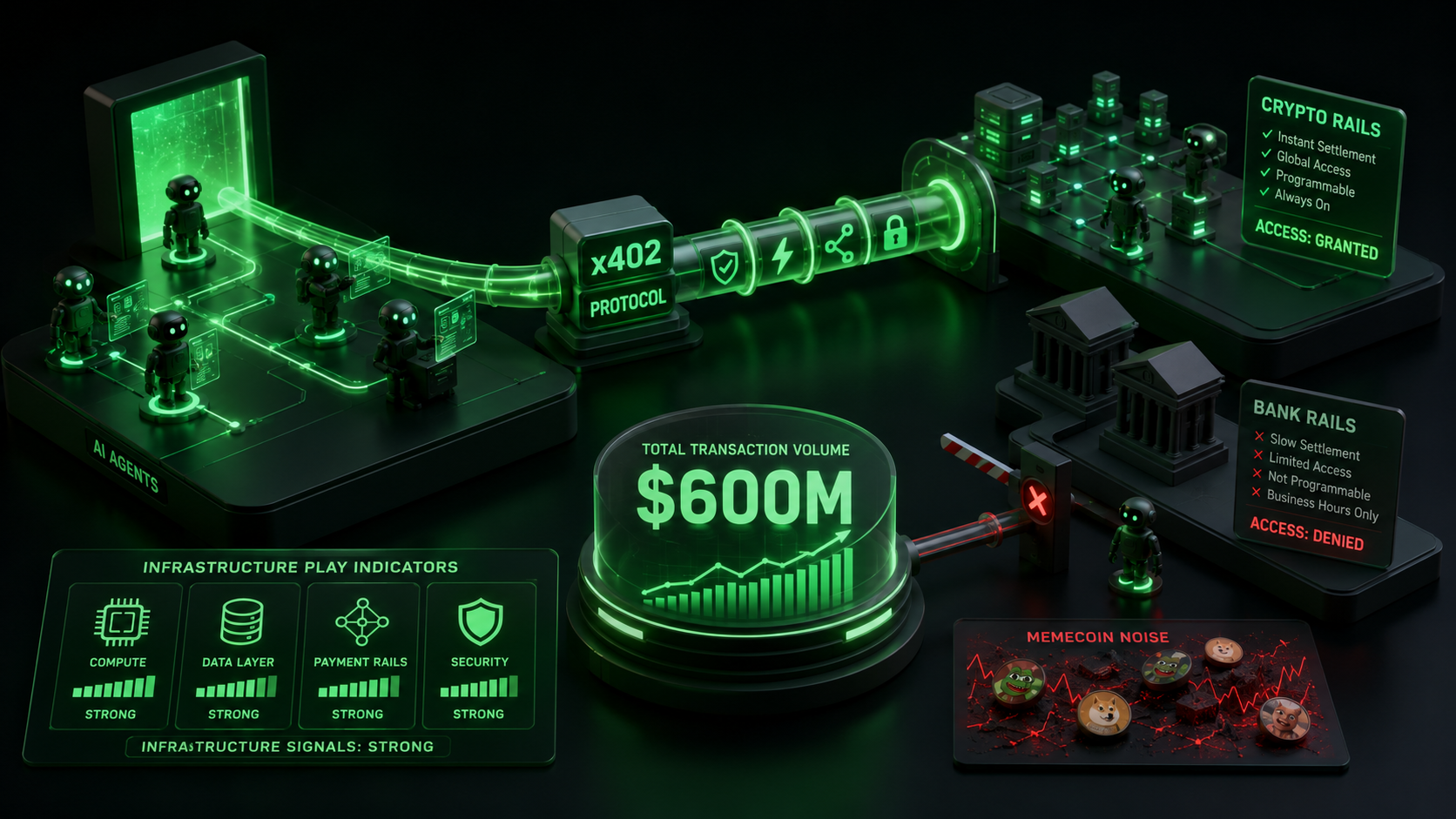
AI Agents Finally Have Money: What x402 Means for Traders
HTTP 402 sat dormant for 33 years. Web pioneers reserved the status code in 1992, anticipating that someday micropayments would work natively on the internet. They were right about the destination, just wildly optimistic about the timeline.
Coinbase dusted off that forgotten standard in May 2025 with x402, and the numbers suggest something is actually clicking. Over 75 million transactions processed, $24 million settled, annualized volume pushing past $600 million. October saw a 10,000% month-over-month surge. The CT narrative machine has noticed, spawning a wave of x402-branded tokens that mostly amount to elaborate ways to lose money.
But beneath the memecoin froth lies genuine infrastructure that solves a real problem: AI agents can't use credit cards, and they desperately need to pay for things.
The Payment Problem Nobody Talks About Correctly
Every article about AI agents eventually mentions payment friction. Few explain why the problem is structural rather than solvable with better APIs.
Credit cards authenticate humans. The entire fraud prevention stack assumes a person is making decisions, using behavioral signals like typing patterns, mouse movements, and purchase history that look nothing like an agent hammering APIs at machine speed. When Perplexity's shopping agent tries to buy toothpaste, Crossmint documented what happens: 3-8 hour processing times, canceled orders for "sold out" items still in stock, the whole experience suggesting the infrastructure is actively hostile to automation.
Which it is. That's the point. Visa spent decades building systems specifically designed to block what agents need to do.
| What Agents Need | What Cards Provide |
|---|---|
| Sub-second settlement | 2-3 day clearing |
| Fractions of a cent | 2-3% minimum viable |
| No human verification | CAPTCHAs, 2FA, CVV |
| Programmatic authorization | Account-based identity |
The mismatch is fundamental. You can't patch your way from card rails to agent commerce. You need different plumbing entirely.
How x402 Actually Solves This
The protocol is elegant enough that explaining it risks making it sound gimmicky. It's not.
When an agent requests a resource, the server responds with HTTP 402 plus payment terms: how much, what asset, which network. The agent pays in USDC, attaches cryptographic proof to the retry request, and gets access. Settlement happens in roughly two seconds on Solana or Base. Costs are negligible. No accounts required.
One line of code enables it server-side. The complexity lives in facilitators, third-party services that handle blockchain verification so applications don't need to run nodes. Coinbase operates the dominant one, which matters more than most coverage acknowledges.
The Facilitator Problem
Here's the part that gets buried under the "open standard" marketing: Coinbase processes over half of all x402 volume through its facilitator. That facilitator is currently free.
"Free" in infrastructure usually means "subsidized until network effects lock in." Coinbase has every incentive to grow the ecosystem before extracting rent, and they're executing that playbook competently. Cloudflare's involvement through the x402 Foundation provides theoretical counterweight. Google's AP2 integration adds another player. But the dependency graph remains concentrated.
Traders should understand what they're actually betting on when they position around agent infrastructure. The protocol is open. The dominant implementation is Coinbase. Those aren't the same thing.
Solana Is Winning and Nobody's Talking About It
Buried in the volume data: Solana is flipping Base in x402 transaction processing. This deserves more attention than it's getting.
The logic is straightforward. When agents make thousands of micropayments per hour, transaction costs and finality speed become binding constraints. Ethereum mainnet is obviously out. Even L2s with multi-cent fees struggle against Solana's sub-penny transactions and 400ms blocks.
For SOL positioning, this creates a fundamental bid that operates independently from the usual narrative cycles. Solana capturing machine-to-machine settlement is a different thesis than Solana winning retail speculation. Both can be true simultaneously.
The Enterprise Gap
x402 elegantly solves payment coordination. It creates a compliance nightmare for anyone trying to deploy agent fleets at scale.
Each agent needs USDC in a hot wallet. That means key custody across potentially thousands of agents, balance management, audit trails for programmatic spending decisions, and answers to questions like "who's liable when the agent buys something it shouldn't?"
Human mandates and cryptographic permissions partially address authorization. But the infrastructure gap between "protocol works" and "enterprise can deploy" remains substantial. First movers who solve custody and compliance for agent fleets will capture meaningful value.
The LeveX Take: Skip the Tokens, Trade the Infrastructure
Let's be direct about the x402 token situation: CoinGecko's x402 category hit $800 million market cap on pure speculation. Most of these projects have zero relationship to the actual protocol. They're riding a naming convention, which is a time-honored crypto tradition that rarely ends well for late buyers.
The smarter exposure isn't chasing x402-branded tokens. It's recognizing which existing assets benefit from agent infrastructure buildout.
Solana captures settlement layer value as the preferred chain for high-frequency agent payments. Chainlink provides oracle infrastructure that agents need for real-world data. ETH benefits from institutional EVM preference when enterprises eventually deploy agent systems.
The a16z projection of $30 trillion in autonomous transactions by 2030 sounds aggressive. Maybe it is. But the directional thesis holds: AI agents require payment rails that traditional finance cannot provide, and crypto infrastructure is currently the only viable solution. Positioning around the picks and shovels beats gambling on which memecoin captures the narrative this week.
Positioning Notes
Chain bets: Solana's volume lead suggests structural advantages for agent settlement. Base benefits from Coinbase integration but faces faster competition.
Infrastructure plays: Oracle providers, wallet infrastructure, and DeFi protocols enabling automated yield strategies become more valuable as agent transaction volume scales.
Timing: The 10,000% monthly surge indicates early adoption curves. Late 2025 into 2026 is infrastructure buildout phase before mainstream deployment. Early, but not too early.
The 33-year promise of internet-native payments is finally being delivered. HTTP 402 works now, and autonomous agents can participate in commerce without human intervention for every transaction. Whether this transforms digital commerce or remains crypto-native niche depends on the enterprise custody gap closing before institutional patience runs out.
For traders, the AI agent narrative provides infrastructure investment thesis with actual substance beneath it. Settlement layers and enabling infrastructure offer exposure without requiring you to guess which x402 memecoin pumps next. That's the trade.
Explore SOL and ETH on LeveX spot markets or use futures to position around infrastructure themes. For context on protocols mentioned, browse our Crypto in a Minute guides.