
SKALE is a network of Ethereum-compatible blockchains that lets users transact without paying gas, and SKL is the token that secures it through staking and pays for the chains developers run on it. Instead of charging every user a fee per transaction, SKALE charges the application a subscription, so a player clicking through an onchain game or an AI agent firing off thousands of payments never sees a gas bill.
That design has kept SKALE in a niche few networks occupy: high-volume, low-value activity that would be uneconomic on most chains. Since mainnet went live in mid-2020 it has hosted dozens of games, NFT apps and DeFi tools, and in 2026 it pushed hard into payments for autonomous AI agents. This guide covers how the network works, what SKL does, where the project is heading and what the risks look like.
How SKALE Works Under the Hood
SKALE sits beside Ethereum rather than on top of it. Its chains are independent EVM blockchains with their own validators, while the contracts that register nodes, track stake and pay rewards live on Ethereum mainnet. Developers deploy the same Solidity code they would use on Ethereum and connect with standard tools such as MetaMask.
Consensus and instant finality
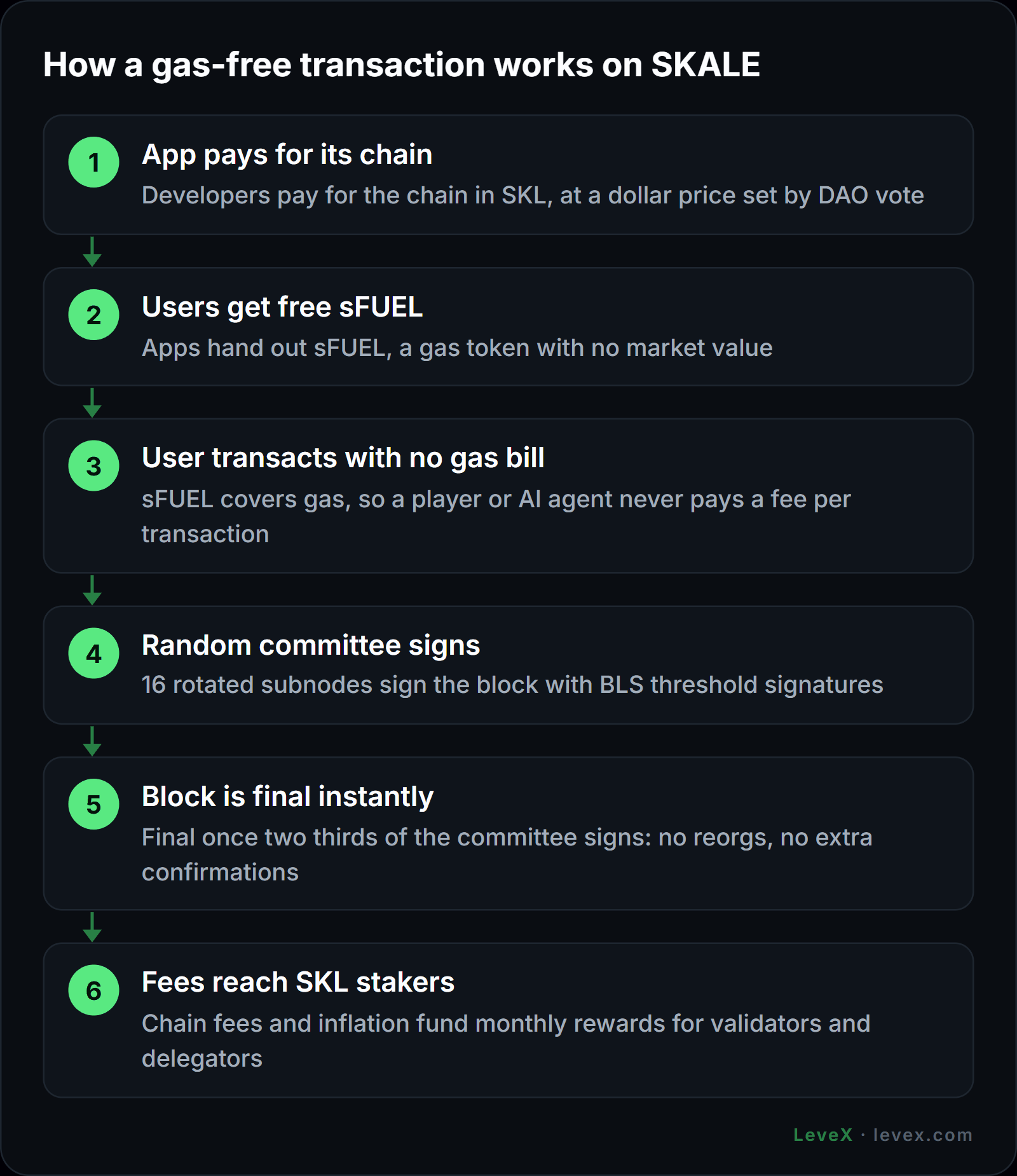
Each SKALE chain runs a leaderless, asynchronous Byzantine fault tolerant consensus protocol. Blocks are signed with BLS threshold signatures, and a block is final once two thirds of the chain's validator committee has signed it. According to the SKALE consensus documentation, that means no reorganizations and no waiting for multiple confirmations, which matters for games and payments where a user expects an action to stick the moment it happens.
Random node assignment and rotation
A SKALE chain is run by a committee of 16 virtualized subnodes drawn from the wider validator pool. Nodes are containerized, so one physical machine can serve several chains at once. Committees are assigned at random and rotated over time, a model SKALE calls Random Rotation Incentive Scaling. The idea is that colluding against one chain is hard when you cannot choose, or predict, which validators will be running it.
Three ways to use the network
- Dedicated app chains. A project rents its own chain and pays a monthly subscription.
- Shared hub chains. Groups of apps share a chain organized around a theme, which removes the cost of running a dedicated one.
- SKALE Expand chains. Newer deployments, including SKALE on Base, that bring the gas-free model to other ecosystems and run on prepaid compute credits.
On the original Ethereum chains, users pay gas in sFUEL, a token with no market value that apps hand out for free. That is how "zero gas" works in practice, and it is the main contrast with typical Ethereum gas fees, where every transaction competes for block space at a market price.
What the SKL Token Does
SKL is an ERC-20 token on Ethereum with a hard cap of 7 billion. As of October 2026, CoinGecko shows about 6.09 billion SKL in circulation, a price near $0.0044 and a market capitalization of roughly $27 million.
The token has four jobs in the network:
- Validator stake. Running a SKALE node requires staking SKL, historically 20 million tokens per node, either self-staked or delegated by others.
- Delegation rewards. Holders who do not run nodes can delegate SKL to a validator and share in monthly rewards from inflation and chain fees.
- Chain payments. Developers pay for dedicated chains in SKL, at a dollar-denominated price set by DAO vote and converted at an oracle rate.
- Governance. SKL holders vote on network parameters, including chain pricing and economic changes.
The result is a token whose demand depends on two things: how much is staked (which locks supply) and how many chains are paying for capacity (which sends fees to stakers).
The SKALE Hubs
Most activity on SKALE runs through a handful of shared hub chains. Their focus areas have shifted over the years, and SKALE's own hub documentation is the place to check the current roster.
| Hub | Focus | What lives there |
|---|---|---|
| Europa | Liquidity and DeFi | The main entry point for bridged tokens, DEXs, stablecoins and onchain finance |
| Calypso | Innovation | Started as the NFT hub, now hosts social, AI and DePIN apps |
| Nebula | Gaming | More than 50 games; in 2024 it accounted for most of SKALE's daily active addresses |
| Titan | AI and community | AI tooling, identity and community projects |
Gaming is the reason SKALE became known. A game that records every item craft or battle result onchain cannot ask players to pay even a few cents each time, and gas-free chains remove that friction. That puts SKALE in the same conversation as gaming-focused networks such as Immutable, though the two take very different technical routes.
From Gaming Chains to AI Agents
SKALE's story in 2026 has been about agents: software that pays for data, compute and APIs on its own. Several milestones mark the shift:
- January 2026: the V4 upgrade added native support for the x402 payments standard and the ERC-8004 agent identity standard.
- March 2026: the x402 Bazaar went live on SKALE on Base, letting agents pay for API calls in USDC with gas covered by credits.
- July 29, 2026: SKALE v5 deployed to the Ethereum mainnet chains with performance and operations upgrades.
- August 2026: SKALE Labs launched Agent Pit, a simulated prediction market for training AI trading agents.
The fit makes sense. An agent that makes a thousand micro-payments a day breaks on any chain where gas costs more than the payment itself. SKALE's credit model turns that per-transaction cost into a prepaid budget, which is the same reason it worked for games. For background on why agent payments are becoming their own category, see our look at crypto payment infrastructure for AI agents.
FAIR and the Road Ahead for SKL
In June 2025, SKALE Labs announced FAIR, a separate Layer 1 blockchain designed to resist maximal extractable value (MEV) by encrypting transactions until they are final. Its core technology, BITE (Blockchain Integrated Threshold Encryption), hides transaction contents from validators and bots until a block is committed, so nobody can front-run a trade they cannot read. The Block's report on the launch describes FAIR as aimed at DeFi and AI workloads.
FAIR matters to SKL holders because of how the two are meant to connect. The published plan has FAIR running its own native token, with SKL burned to operate FAIR validator nodes, about 10% of FAIR's supply airdropped to SKL holders, and SKALE's management contracts eventually migrating from Ethereum to FAIR. All of it is conditional on mainnet and on governance votes, and the original late-2025 mainnet target has slipped, so the timeline is the part to watch.
Risks Worth Weighing
SKL has fallen more than 99% from its 2021 all-time high near $1.22, and it hit new lows in 2026. Part of that is the wider altcoin market, but part is specific to SKALE: chain subscriptions have not generated enough fee demand to offset token inflation, and attention in Ethereum scaling moved to rollups.
Security is the other concern. In late August 2026 SKALE disclosed a security incident affecting its IMA Bridge, the system that moves tokens between Ethereum and SKALE chains, and published follow-up updates into October. Independent trackers such as L2BEAT had already flagged the bridge's upgradeable contracts as a risk. Bridges are a common weak point across crypto, as our overview of crypto bridge hacks shows, and anyone holding assets on SKALE chains should follow the official updates.
Finally, the FAIR transition adds execution risk. A token whose future role depends on a new chain launching and a DAO approving the terms carries more uncertainty than one with a settled design.
Frequently Asked Questions
What is SKALE used for?
SKALE is used to run Ethereum-compatible applications that need many cheap transactions, mainly blockchain games, NFT apps, DeFi tools and AI agent payments. Users do not pay gas, because applications cover network costs through subscriptions or prepaid credits.
Is SKALE a Layer 2?
SKALE is usually described as a network of EVM chains connected to Ethereum, closer to a set of sidechains than a rollup. Its chains have their own validators and consensus, while staking and node management happen on Ethereum. That differs from Ethereum Layer 2 solutions such as rollups, which post their data back to Ethereum.
Is SKALE really free to use?
For end users, transactions on SKALE chains cost nothing in practice. The gas token on the Ethereum-connected chains, sFUEL, has no market value and is distributed free, while SKALE on Base uses credits prepaid by the application.
What is the max supply of SKL?
SKL has a maximum supply of 7 billion tokens. As of October 2026 about 6.09 billion are circulating, with the remainder released over time mainly as validator and delegator rewards.
Can you stake SKL?
Yes. SKL holders can delegate tokens to a validator through the SKALE Portal on Ethereum and earn monthly rewards. Delegations follow monthly epochs, so stake activates and unlocks on a monthly cycle.
Where SKALE Fits for Traders
SKALE solved a real problem early: high-frequency onchain activity that cannot carry per-transaction fees. Its bet in 2026 is that AI agents are the next big source of exactly that activity, while FAIR is meant to give SKL a second role in MEV-resistant finance. Whether either bet translates into token demand is the open question behind SKL's price.
You can trade the token on the SKL/USDT spot market on LeveX, or take long and short positions with SKL perpetual futures. For quick primers on other networks, browse Crypto in a Minute.