

To stake SKL, you delegate your tokens to a SKALE validator through the official SKALE Portal on Ethereum mainnet, using a wallet such as MetaMask that holds both SKL and a little ETH for gas. Your stake becomes active on the first day of the following month, earns rewards that can be claimed monthly, and unlocks on a monthly cycle when you undelegate.
Staking is how SKALE secures its chains, and for holders it is also the main way to keep pace with the token's ongoing issuance. The process takes a few minutes, but the monthly timing rules catch many first-time delegators out, so this guide walks through both.
What You Need Before You Stake
- SKL on Ethereum mainnet. Staking runs through SKALE Manager contracts on Ethereum, so your SKL must be the ERC-20 version in your own wallet, not on an exchange or a SKALE chain.
- A compatible wallet. The SKALE Portal is built around MetaMask. A hardware wallet connected through MetaMask works and adds protection for larger stakes.
- ETH for gas. Approving the token and submitting the delegation are Ethereum transactions, so keep some ETH in the same wallet.
- A validator shortlist. Check fees and track records before you start, since changing validators later means waiting out a full undelegation cycle.
Staking is only available for SKALE on Ethereum. SKALE Expand chains, including SKALE on Base, do not offer staking.
How to Stake SKL Step by Step
- Go to the SKALE Portal and open the Staking page from the main menu.
- Connect your wallet and confirm it is set to Ethereum mainnet.
- Browse the validator list. Each validator has a profile showing its commission fee, the nodes it runs and its total delegated stake.
- Select a validator and enter the amount of SKL you want to delegate.
- Approve SKL spending in your wallet, then confirm the delegation transaction.
- Wait for the validator to accept the request. Accepted delegations become active at the start of the next month.
- Return each month to claim rewards from the Portal. Rewards do not compound automatically, so delegate the claimed SKL again if you want them to earn.
The official SKALE staking documentation covers the Portal screens in more detail and is the place to check if the interface has changed.
The Monthly Staking Cycle
SKALE measures time in epochs, and one epoch is one calendar month. Every staking action lines up with that calendar, which is why the date you delegate matters.
| Stage | When it happens | What it means for you |
|---|---|---|
| Delegation request | Any day of the month | Your SKL is committed but not yet earning |
| Stake becomes active | 1st of the next month | Rewards start accruing from this date |
| Initial lockup | Two months from activation | Tokens cannot be withdrawn during this period |
| Auto-renewal | Every two months | Stake rolls over unless you request undelegation |
| Rewards claim | 1st of each month | Previous month's rewards become claimable |
| Undelegation | End of the current epoch plus the next one | Tokens become transferable after this wait |
The practical takeaway: delegating on the 2nd of a month means almost four weeks without rewards, while delegating near the end of a month wastes very little time. Undelegation is slower than most chains, so treat staked SKL as unavailable for at least one to two months. Some older third-party guides describe shorter lockups, and the delegated proof of stake page in SKALE's docs is the authority if the two disagree.
Choosing a SKALE Validator
Commission is the first filter. Validators set a fee that comes off your rewards before they reach you, and a few points of commission compound over years of staking.
Node performance comes next. SKALE pays monthly bounties based on how well a validator's nodes perform, so a validator with frequent downtime earns less for everyone who delegated to it. Experienced infrastructure firms with several nodes and long operating histories tend to be the safer choice.
Concentration is the last check. Spreading stake across validators that are not already dominant helps keep the network decentralized, which in turn protects the value of every staked token.
Staking Rewards and What They Really Earn You
SKALE does not publish a fixed yield. Rewards depend on the network's monthly issuance, the total amount staked, your validator's commission and its nodes' performance. Older validator guides cited annual rates around 10%, and current estimates are available from staking calculators, but treat any single figure as a snapshot.
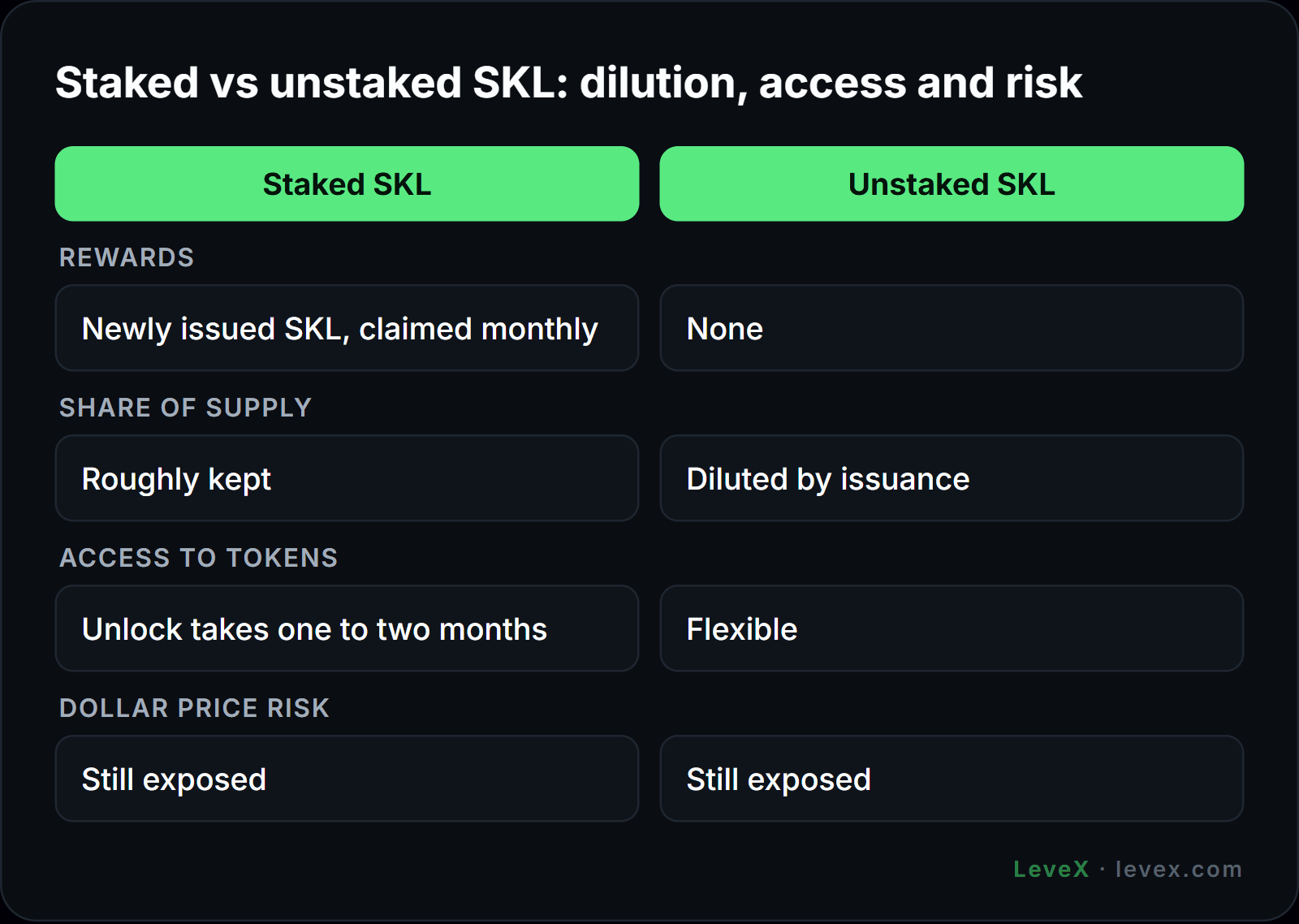
The more useful way to view the yield is against dilution. Staking rewards are paid in newly issued SKL, so a delegator collecting them roughly keeps their share of the network while a non-staker is diluted, as our SKL tokenomics breakdown explains. The yield protects your share of supply, while the token's dollar price remains a separate risk. A 10% yield on a token that falls 50% is still a loss, which is why the SKL price outlook matters as much as the staking rate.
The other risks are smart contract and validator risk. SKALE currently penalizes underperforming nodes by withholding bounties, and the design allows for slashing in future network phases.
SKL Staking FAQ
What is the minimum amount to stake SKL?
There is no meaningful minimum for delegators, though older guides mention a floor of around 100 SKL. Ethereum gas costs make very small delegations uneconomic, since approving and delegating can cost more than the rewards earned.
Can I unstake SKL at any time?
You can request undelegation at any time, but the tokens only unlock after the current monthly epoch ends plus one more full epoch. In practice, that means waiting between one and two months.
Can I stake SKL on an exchange?
SKL staking takes place on Ethereum through the SKALE Portal with a self-custody wallet. To stake, you move SKL off the exchange to your own Ethereum wallet first.
Is Staking SKL Worth It?
For holders planning to keep SKL for a year or more, staking is close to essential, because it offsets the dilution built into the token's issuance schedule. For short-term traders, the monthly activation and multi-week unlock make staked SKL too illiquid to be useful.
Traders who prefer flexibility can hold through the SKL/USDT spot market on LeveX or trade price swings both ways with SKL perpetual futures. For plain-language guides to more networks, see Crypto in a Minute.