
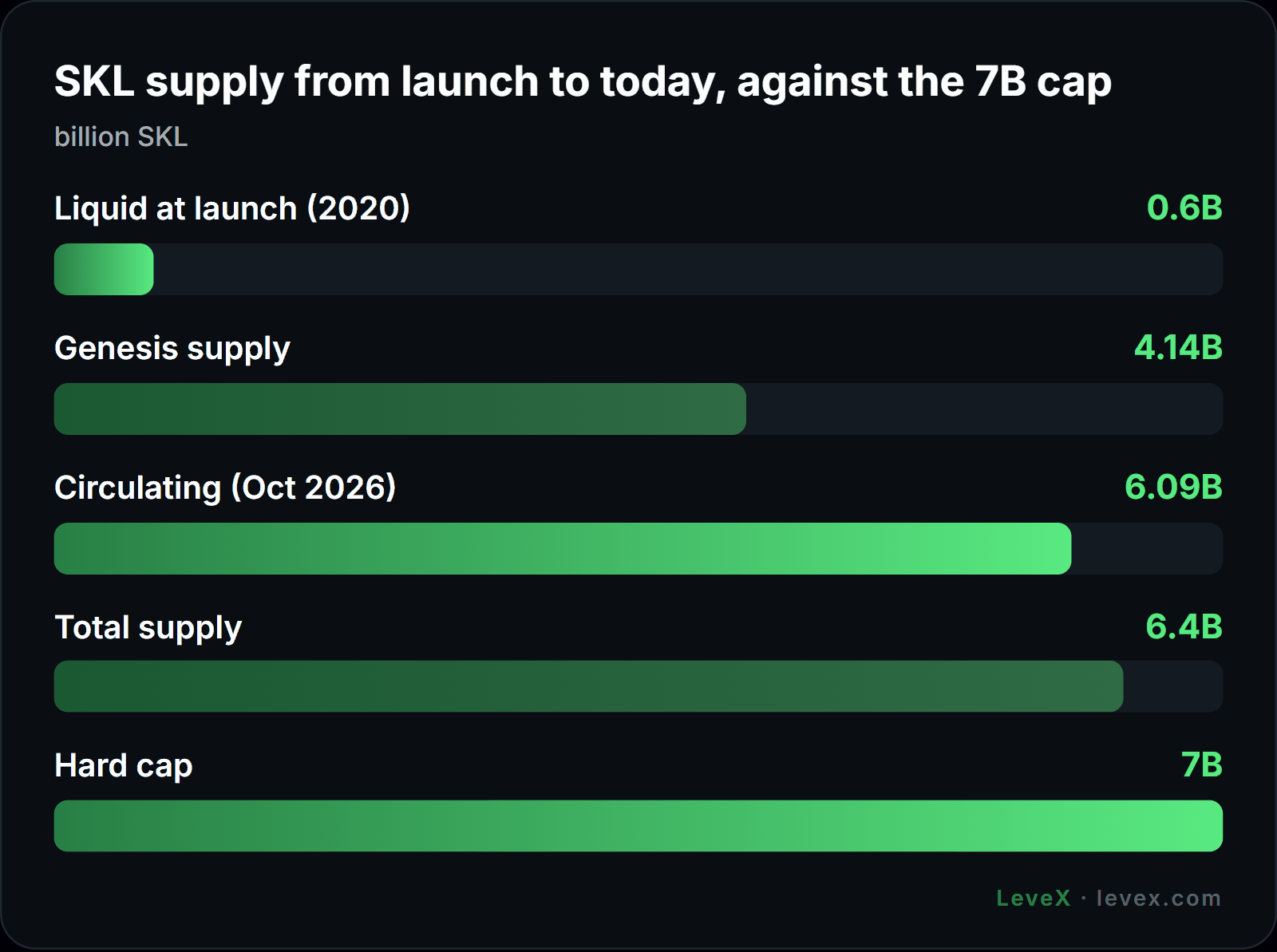
SKL has a hard cap of 7 billion tokens, about 6.09 billion of which circulate as of October 2026, and new tokens enter the market mainly as monthly staking rewards paid to validators and delegators. The token's value case rests on two demand sources: SKL locked in staking to secure the network, and SKL spent by developers on subscriptions for their own chains.
That makes SKALE unusual among scaling networks. Users never buy SKL to pay gas, so the token's economics depend on the people who run the network and the projects that rent its capacity. This article breaks down how the supply was split, how it grows, where demand comes from and why the balance between the two has favored sellers for most of SKL's life.
SKL Allocation at Launch
The SKALE network launched its token at the end of 2020 with a genesis supply of about 4.14 billion SKL, and the rest of the 7 billion cap was reserved for issuance over time. The commonly reported allocation of the full cap looks like this:
| Category | Share of 7B cap | What it funds |
|---|---|---|
| Validator rewards | ~33% | Staking rewards minted over time for validators and delegators |
| Delegators (early supporters and public sale) | ~28% | Tokens sold to early backers and the 2020 public sale, mostly subject to staking lockups |
| Founding team | ~16% | Founders and early contributors, vested |
| SKALE Foundation | ~10% | Network operations, grants and governance support |
| Protocol development fund | ~8% | Ongoing engineering of the protocol |
| Core team | ~4% | Later team members, vested |
| Ecosystem fund | ~1% | Developer incentives and partnerships |
Figures are rounded and drawn from launch-era documentation summarized by Staking Rewards. The detail that matters most for holders is the first row: a third of the total supply was set aside as future staking rewards, so dilution was built into the design from day one.
Many early allocations were released into delegation rather than straight onto the market. That choice put a large share of the early supply to work securing the network, but it also meant those tokens became liquid as their lockups ended over 2021 and 2022.
How New SKL Enters Circulation
Newly minted SKL comes from a hard-coded issuance schedule written into the token contracts at launch. Figment's analysis of SKALE economics put first-year inflation at about 9.3%, stepping down over the following years, and the schedule can only be changed through a governance vote.
Each month, the network mints that period's bounty and distributes it to validators based on their nodes' performance. Validators keep a commission they set themselves and pass the rest to their delegators. Validators running poorly performing or offline nodes receive less, which is the main way SKALE disciplines its operators today.
The effect on circulating supply has been dramatic. Roughly 0.6 billion SKL was liquid in the first weeks after launch, compared with about 6.09 billion today. Some of that growth came from unlocks and some from issuance, but the result is the same: buyers have had to absorb a supply that grew roughly tenfold in under six years. That pressure is the single biggest reason behind the long decline covered in our SKL price prediction.
Where SKL Demand Comes From
Staking locks supply. Running a SKALE node has historically required 20 million SKL per node, and delegators lock tokens on monthly cycles. Every token staked is a token not for sale, though staking also earns the rewards that add to supply.
Chain subscriptions pay stakers. Projects that rent a dedicated SKALE chain pay a monthly fee in SKL. The price is set in dollars by DAO vote and converted to SKL at an oracle rate, so a falling token price means more tokens per subscription. Those fees flow to validators and delegators alongside inflation rewards.
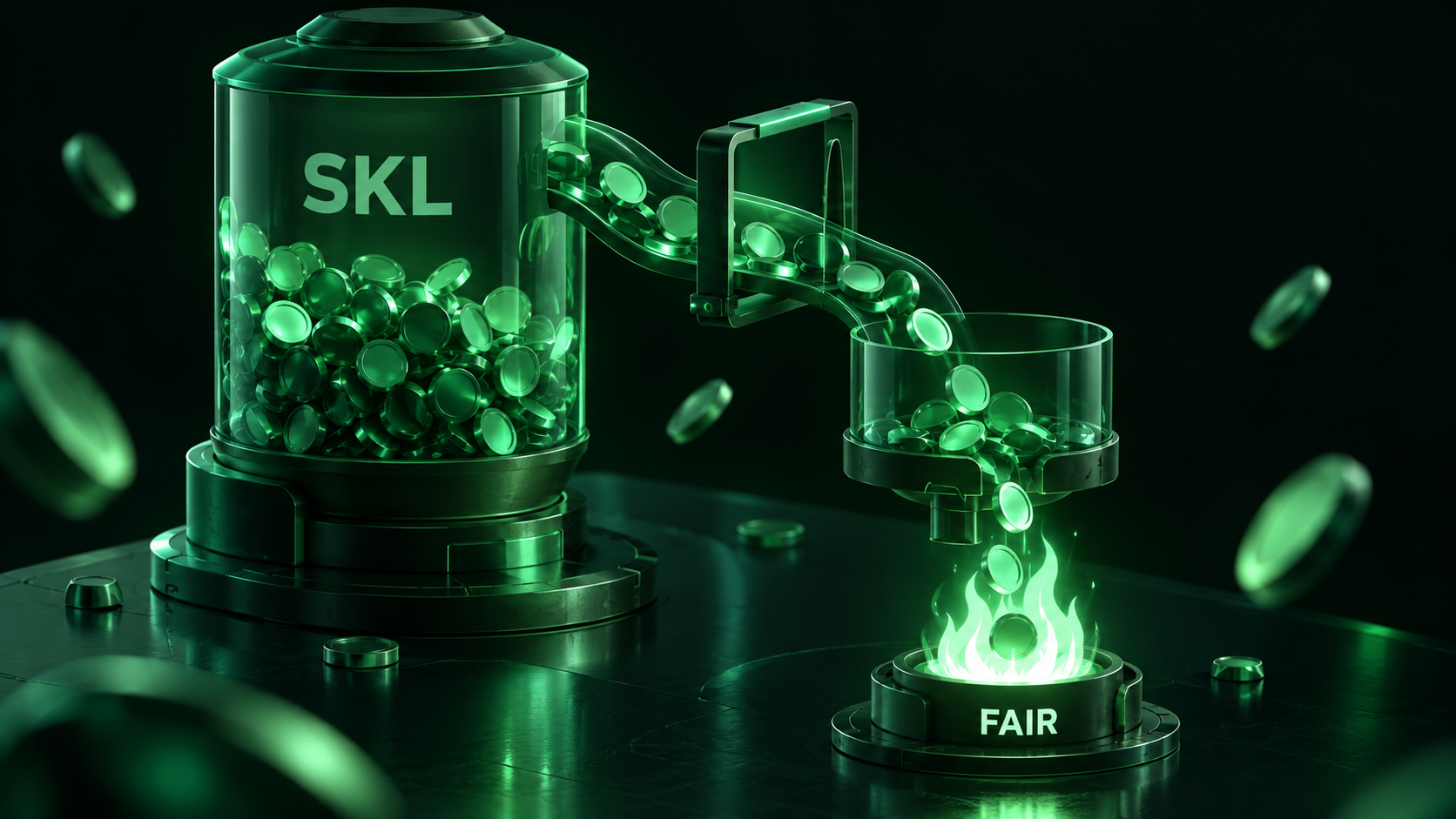
A third, newer demand source is the planned link to FAIR, SKALE Labs' MEV-resistant Layer 1. The published plan calls for SKL to be burned to run FAIR validator nodes, which would make it the first permanent sink in SKL's design. Until FAIR's mainnet and its governance terms are confirmed, that burn remains a plan.
SKALE on Base adds a fourth path. Apps there prepay for compute credits in USDC or SKL, so SKL is one of two payment options rather than a requirement.
Is SKL Inflationary?
Yes, SKL is inflationary, and it will stay that way until issuance reaches the 7 billion cap or a burn mechanism outweighs new supply. With about 6.09 billion circulating and roughly 6.4 billion in total supply, a little under 1 billion SKL remains to be issued, and the yearly rate has fallen well below its launch level.
Whether that inflation hurts holders depends on who receives it. A delegator who stakes collects the new tokens, so their share of the network stays roughly constant. A holder who keeps SKL in a wallet without staking is diluted every month. For most long-term holders, staking is the practical answer to SKL's issuance schedule.
SKL Tokenomics FAQ
What is the max supply of SKL?
The maximum supply of SKL is 7 billion tokens, fixed in the token contract. As of October 2026 about 6.09 billion are in circulation and around 6.4 billion exist in total.
Does SKALE burn SKL?
SKALE has no permanent burn in its current design. The planned FAIR Layer 1 would introduce one by requiring SKL to be burned to run FAIR validator nodes, subject to mainnet launch and governance approval.
Who pays fees on SKALE?
Applications pay, users do not. Developers pay subscriptions in SKL for dedicated chains, or prepay credits on SKALE on Base, and users transact with a free gas token or none at all.
What SKL's Design Means for Holders
SKL's tokenomics reward participation and penalize passive holding. A third of the supply was always destined for stakers, demand depends on chain subscriptions that have stayed modest, and the only planned burn hinges on FAIR.
To trade around those dynamics, LeveX lists the SKL/USDT spot pair for direct holdings and SKL perpetual futures for positions in either direction. You can read more project explainers in Crypto in a Minute.