
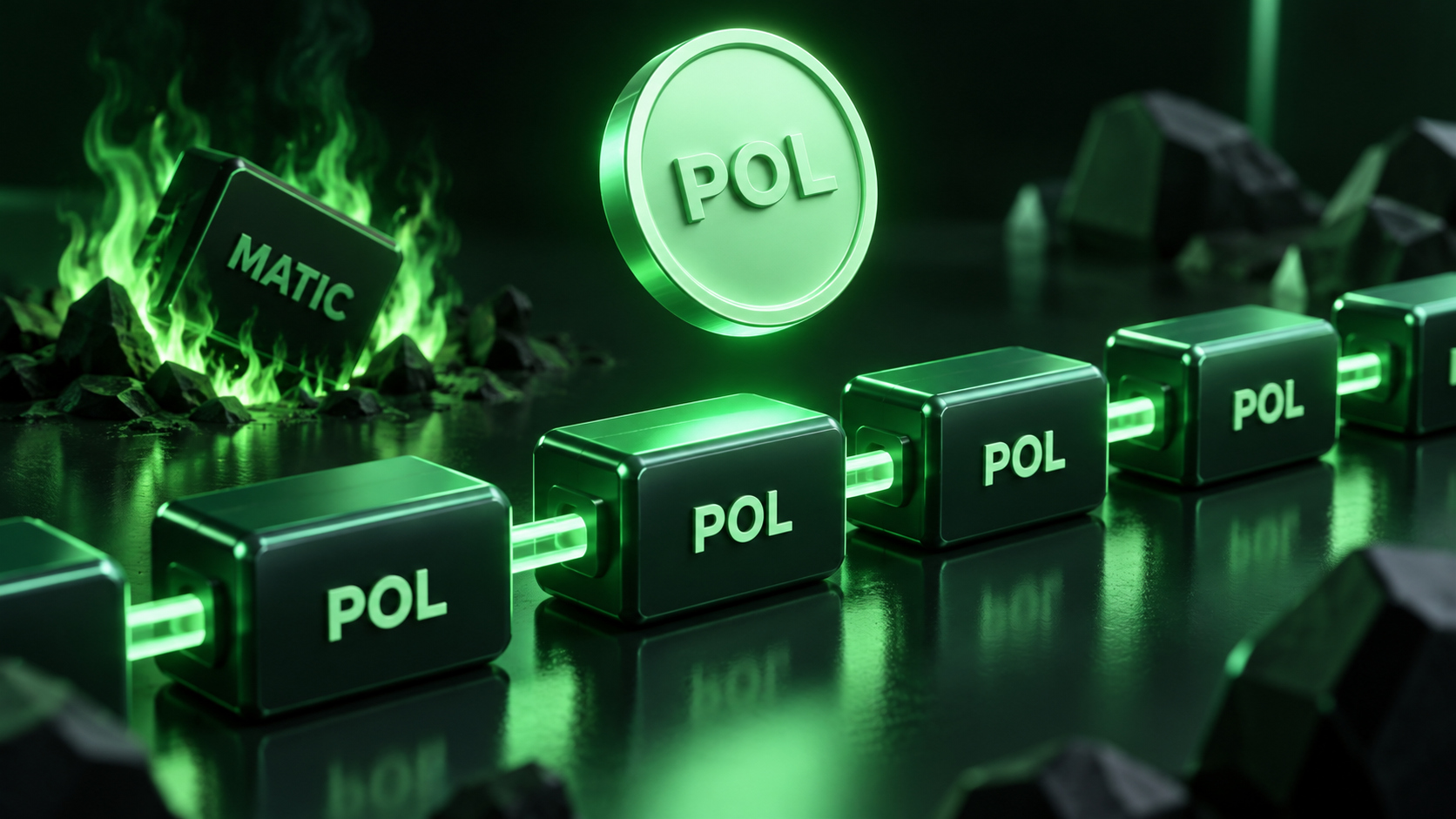
POL is the native token of Polygon, where it pays gas on Polygon PoS, secures the network through staking, and carries governance rights across the chains connected to AggLayer. It replaced MATIC in a migration that began on 4 September 2024 and is now over 99% complete, so the ticker traders watch today is POL and the contract behind it is the same asset with a wider job description.
What makes Polygon worth understanding in 2026 is how narrow its ambition has become. The project spent years positioning itself as general-purpose Ethereum scaling. It now spends most of its engineering budget on one number: how many payments per second the chain can settle without falling over. Everything below follows from that decision.
What POL Actually Does
POL carries three jobs, and they are worth separating because traders often price only the first one.
The token pays transaction fees on Polygon PoS. Fees are denominated in POL and burned in part under the EIP-1559 mechanism the chain inherited from Ethereum, which ties fee revenue directly to supply.
It secures the chain through staking. Validators lock POL in contracts on Ethereum mainnet, produce and attest to blocks on Polygon, and periodically submit checkpoints back to Ethereum. Delegators who do not run infrastructure can assign their POL to a validator and take a share of the rewards.
It functions as the coordination asset across the wider Polygon ecosystem, including CDK-built chains and the AggLayer interoperability protocol. A single staked position is designed to secure multiple chains rather than one, which is the structural difference between POL and the MATIC design it replaced.
From MATIC to POL
The migration was a rename with real mechanics underneath it. MATIC holders received POL at a 1:1 ratio, and the base supply stayed at 10 billion. What changed was the emission schedule and the scope of what the token secures.
| MATIC (pre-2024) | POL (current) | |
|---|---|---|
| Base supply | 10 billion, fixed | 10 billion, plus 2% annual emission |
| Secures | Polygon PoS only | PoS plus CDK chains via AggLayer |
| Staking reward source | Finite 5-year reserve | Ongoing emission plus protocol fees |
| Governance scope | Polygon PoS | Ecosystem-wide, including treasury |
LeveX handled the swap for users during the transition, and the exchange's notes on the POL listing cover how balances were converted. Anyone still holding MATIC in self-custody can migrate through Polygon's official portal, and there is no deadline attached.
How Polygon PoS Works After Rio
Polygon PoS runs two clients side by side. Heimdall handles consensus and validator coordination. Bor produces the EVM blocks users actually transact on. Checkpoints written to Ethereum give the chain a settlement anchor that a standalone sidechain would lack.
The Rio upgrade, live on mainnet on 8 October 2025, rewrote how blocks get produced. Three changes matter for anyone holding or trading POL.
Validator-Elected Block Producers
Instead of rotating production across the full validator set, validators elect a small pool of producers that hold the slot for extended stretches. With one producer at a time, block times shorten and chain reorganisations are, in Polygon's description, essentially eliminated. For a payments chain, a transaction that can be reverted minutes later is a product defect, so removing reorgs was the prerequisite for everything else.
Stateless Validation
Nodes verify blocks using witness data rather than storing the full chain state. Hardware requirements drop, which keeps the validator set from collapsing into a handful of well-funded operators as throughput climbs.
Throughput Headroom
Rio laid the groundwork for roughly 5,000 transactions per second, about triple the prior capacity. The stated destination is the Gigagas roadmap target of 100,000 TPS, which the team frames as card-network speed at a fraction of card-network cost.
AggLayer and the Multi-Chain Thesis
AggLayer is Polygon's answer to a problem that got worse as the number of rollups grew: liquidity fragments, bridges multiply, and each new bridge is a new place to lose money.
It works as a shared interoperability protocol with a unified bridge, so assets moving between connected chains keep their original identity rather than arriving as wrapped derivatives. Security comes from pessimistic proofs, a design where a compromised chain cannot withdraw more than it deposited. The official documentation states the containment principle plainly: damage from a broken chain stays inside that chain's deposits.
Chains built with Polygon CDK connect automatically. Immutable's zkEVM is one production example of a CDK chain serving a specific vertical, and the protocol has extended to non-EVM environments as well. If you want the broader context for why this category exists at all, LeveX's overview of Ethereum layer-2 solutions covers the competing approaches.
Where the Activity Comes From
Polygon's usage profile looks different from a typical DeFi chain, and the numbers explain why the team pivoted toward payments.
| Metric (as of September 2026) | Figure |
|---|---|
| POL price | ~$0.109 |
| Market capitalisation | ~$1.17 billion |
| Circulating supply | ~10.72 billion POL |
| DeFi TVL | ~$787 million |
| Stablecoin supply on chain | ~$2.9 billion |
| Cumulative transactions | 8 billion+ |
Source figures come from CoinGecko and DefiLlama. The ratio worth noting is the last two rows against the fourth: Polygon holds roughly 3.7 times more stablecoin value than DeFi TVL. Capital sits on the chain to move, rather than to farm. That is an unusual shape, and it is the evidence behind the payments positioning.
The trade-off is visible in the price. POL set an all-time low of $0.0677 on 1 July 2026 and trades far below the $1.29 peak from March 2024. Payment rails generate modest fees per transaction by design, and a chain optimised for sub-cent transfers has to process enormous volume before fee revenue moves a $1.17 billion market cap.
Supply, Emissions, and Burns
POL emits 2% annually, split evenly: 1% funds validator rewards, 1% funds the community treasury. Both rates are fixed for ten years from the Polygon 2.0 design and can be lowered by governance but never raised above 1% each.
Against that, EIP-1559 burns a portion of every fee. In September 2026 Polygon announced a permissionless burn of 100 million POL, roughly 1% of circulating supply, drawn from a base-fee collector contract holding about 121 million tokens, with quarterly burns to follow. Whether POL ends up net deflationary depends on whether fee burn out-earns the 200 million tokens issued each year, which in turn depends on transaction volume rather than price.
Common Questions About POL
Is POL the same as MATIC?
Yes, in the sense that POL replaced MATIC at a 1:1 ratio and represents the same network. The migration started in September 2024 and is over 99% complete. MATIC no longer exists as an active ticker on major venues, though unmigrated tokens can still be swapped through Polygon's official portal.
What is POL used for?
POL pays gas fees on Polygon PoS, is staked by validators and delegators to secure the network, and carries governance weight over the protocol and its community treasury. Staked POL is designed to secure multiple connected chains from a single position.
Does POL have a maximum supply?
No fixed cap exists. The base supply is 10 billion with a 2% annual emission, so supply grows unless burns offset issuance. The September 2026 burn programme is the first structured attempt to push net supply the other way.
Is Polygon a layer 2 or a sidechain?
Polygon PoS is best described as a commit chain: it runs its own validator set and consensus but posts checkpoints to Ethereum for settlement. Polygon also operates zk-based layer-2 infrastructure and the CDK stack, so the full ecosystem spans both categories.
How fast is Polygon?
Polygon PoS supports roughly 5,000 transactions per second following the Rio upgrade, with near-instant finality and reorgs effectively removed. The published roadmap targets 100,000 TPS.
Polygon's Bet on Boring Infrastructure
Polygon made a choice most layer-2 projects have avoided: it stopped competing for DeFi mindshare and started competing for payment volume. That decision costs it narrative attention, because stablecoin settlement produces no memorable charts, and it shows in a token that trades near its all-time low while the chain processes record throughput.
The open question for holders is whether transactional infrastructure captures value for its token, or merely for its users. The burn programme is management's answer, and the next few quarters of fee data will show whether it is arithmetic or theatre. Traders who want exposure to that question should size it against a real possibility that high usage and a low token price coexist for a long time.
POL trades on LeveX on spot and as a perpetual contract for anyone positioning around the burn schedule, and the difference between those two venues is worth understanding before you pick one. More token breakdowns live in Crypto in a Minute.