
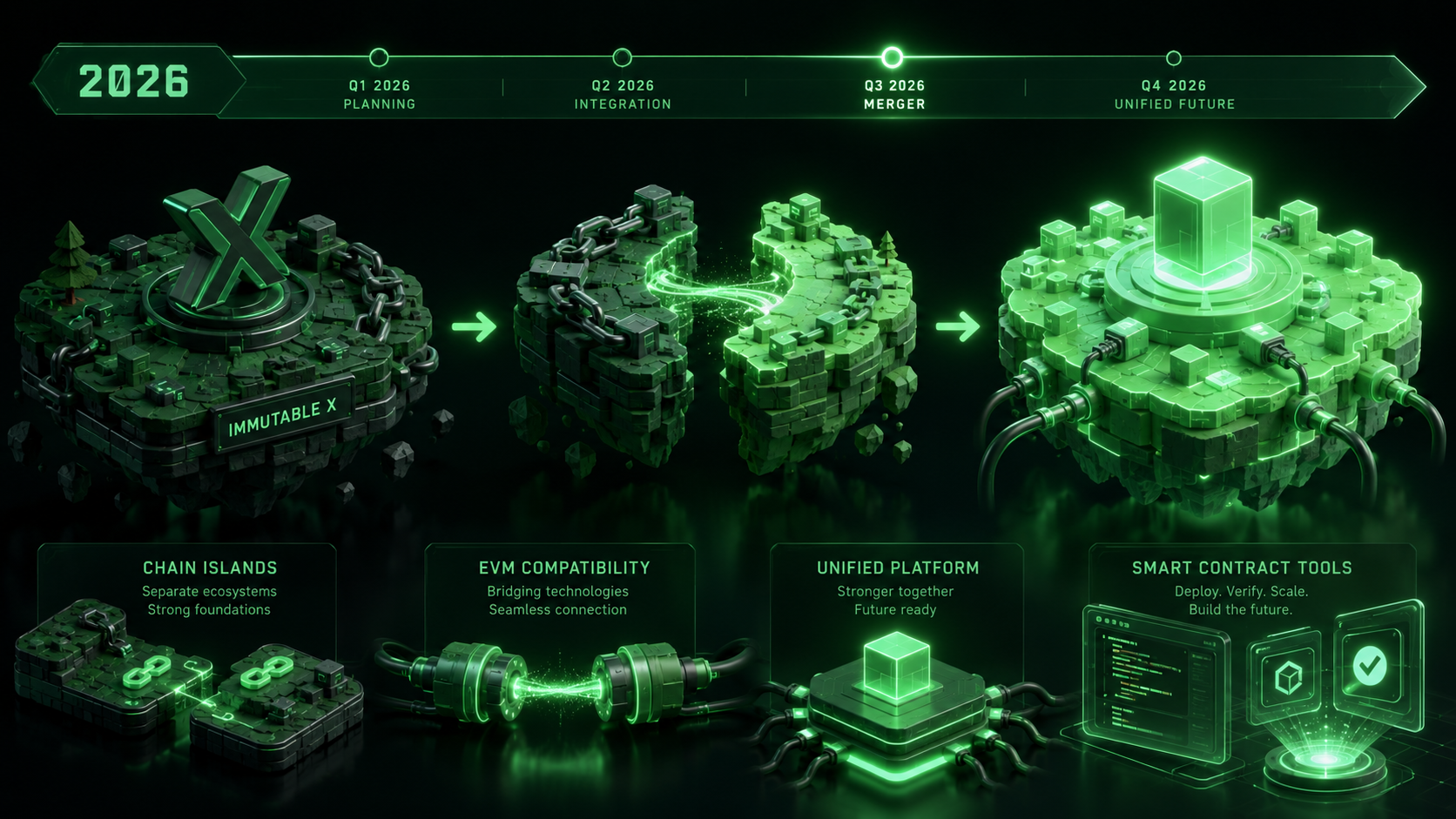
Immutable zkEVM is an Ethereum Layer 2 chain built for Web3 games that offers full Ethereum Virtual Machine compatibility, letting developers deploy standard smart contracts while settling securely on Ethereum. It launched in early 2024 using Polygon's Chain Development Kit, and through 2026 it became the foundation for a merged network that absorbed Immutable's original NFT-focused chain. For anyone following Immutable (IMX), the zkEVM chain is now the single environment where games, trading, and staking all live.
The short version: Immutable used to run two separate chains with different strengths, and in 2026 it consolidated them into one. The zkEVM chain won out as the base because its EVM compatibility gives game studios the flexibility they need to build complex on-chain logic.
Immutable zkEVM Explained
Immutable zkEVM is a zero-knowledge rollup, one of many Ethereum Layer 2 solutions that process transactions off the main chain and post cryptographic proofs back to it. What sets zkEVM apart from Immutable's older chain is the "EVM" part: it runs the same virtual machine as Ethereum itself, so any Solidity smart contract that works on Ethereum works here with minimal changes.
That compatibility is a big deal for game developers. A studio can bring existing Ethereum tooling, wallets, and contract patterns straight over, rather than learning a specialized system. Built with Polygon's Chain Development Kit, the chain uses IMX as its gas token and inherits Ethereum's security through the proofs it submits, giving games low fees and fast confirmation without giving up the settlement guarantees that make on-chain ownership meaningful.
Why Immutable Ran Two Chains
To understand the merger, it helps to see why two chains existed in the first place. Immutable X, the original network, launched in 2021 on StarkWare's StarkEx engine and was purpose-built for one job: minting and trading NFTs at high speed with zero gas fees. It did that job well, but it was not a general smart contract platform, so games that needed richer on-chain logic hit its limits.
Immutable zkEVM arrived in 2024 to fill that gap with full programmability. For a stretch, both chains ran in parallel, which created friction. Assets could live on either chain, players sometimes needed special tools to move between them, and studios had to decide which network fit their game. Running two environments split liquidity and attention, which is the problem the merger set out to solve.
The 2026 Merger
Through 2026 Immutable unified the two chains into a single network, with the zkEVM chain as the base. The migration moved in stages rather than all at once, prioritizing security over speed. Games and staking contracts were relocated first, then the Sandbox and Testnet environments were combined, and finally the asset bridge from the older chain was upgraded and migrated. Coverage from esports and gaming press framed it as a simplification play aimed at making Web3 onboarding feel closer to traditional gaming.
The rollout followed a clear sequence:
- Games and staking contracts migrated to the unified chain ahead of the bridge work.
- Bridge contract upgrades began around February 11, 2026.
- Asset migration from the original Immutable X chain followed roughly two weeks later, after a deliberate security delay.
That measured pace reflects how much value sits in game assets and staked tokens, where a rushed bridge upgrade could be catastrophic. Additional context on the chain's design is available through DappRadar's Immutable overview.
What the Merger Means for IMX Holders
For token holders, consolidation concentrates activity in one place, and that has direct consequences for value capture. All trading fees, all staking, and all game activity now flow through a single chain, which strengthens the link between platform usage and demand for IMX described in its tokenomics. A unified chain also makes the pitch to new studios cleaner, since a developer no longer weighs which Immutable network to build on.
The flip side is that the merger removes friction rather than adding new demand by itself. Adoption still has to arrive through games attracting players, and that remains the swing factor in IMX's price outlook. The merger improves the foundation, and the market will judge it on whether stronger foundations translate into more players and more on-chain trading.
Frequently Asked Questions
Is Immutable zkEVM the same as Immutable X?
No, they were originally two separate chains. Immutable X launched in 2021 on StarkEx for zero-gas NFT trading, while Immutable zkEVM launched in 2024 with full EVM compatibility. Through 2026 the two were merged into one unified network built on the zkEVM chain.
What token does Immutable zkEVM use for gas?
Immutable zkEVM uses IMX as its native gas token. Transactions on the chain pay fees in IMX, which ties network usage directly to demand for the token.
Why did Immutable merge its two chains?
Running two chains split liquidity, confused asset location, and forced studios to choose between networks. Merging them into one unified chain simplifies the developer decision, concentrates activity and fees, and makes onboarding smoother for mainstream gamers.
Why the Unified Chain Matters
Immutable spent years running parallel networks that each solved part of the gaming problem, and the 2026 merger finally puts everything on one foundation. The zkEVM chain brings EVM compatibility that studios want, IMX powers gas and staking across it, and the consolidation removes the friction that came with moving assets between two systems. It is the cleanest version of Immutable's architecture to date.
Whether that foundation pays off still depends on games pulling in players at scale, the variable that has always governed this ecosystem. The technology is now aligned behind a single chain, and the next chapter is about adoption.
Trade IMX on the spot market or take a position with IMX perpetual futures on LeveX. Explore the Crypto in a Minute series for more chain and token guides.