
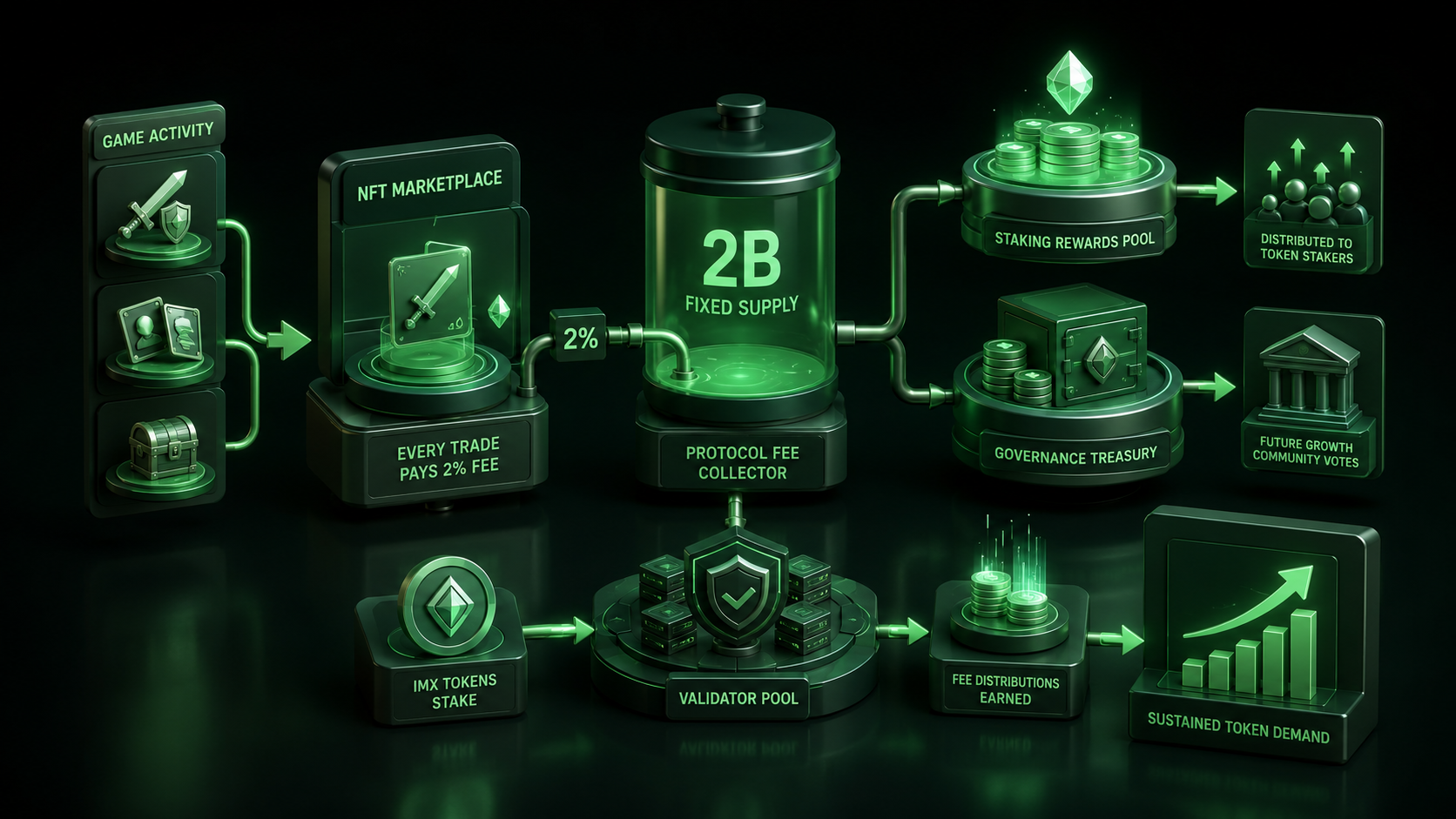
Immutable (IMX) has a fixed maximum supply of 2 billion tokens and captures value through a 2% fee charged on every trade across its network, a portion of which flows to stakers. Governance rights round out the design, letting holders vote on treasury spending, developer grants, and reward programs. The result is a token whose demand scales with on-chain activity rather than with speculation alone.
Understanding IMX tokenomics means looking at three things: how the supply was allocated, how the fee turns platform usage into token demand, and how staking distributes that demand back to holders. Each one shapes whether IMX accrues value as the gaming ecosystem grows.
Supply and Allocation
IMX is an ERC-20 token on Ethereum with a hard cap of 2 billion units, so no new tokens can be minted beyond that ceiling. The original distribution weighted over half the supply toward growing the ecosystem, a deliberate choice to fund the games and developer grants the network depends on, as covered in Messari's Immutable overview.
| Allocation | Share | Purpose |
|---|---|---|
| Ecosystem development | 51.74% | User rewards, developer grants, adoption |
| Project development | 25.00% | Team, contributors, operations |
| Public and private sales | 19.26% | Early investors and community rounds |
| Foundation reserve | 4.00% | Long-term treasury |
The heavy ecosystem weighting is the signal worth reading here. Immutable structured its token to subsidize the supply side of its marketplace, paying studios and rewarding players to bootstrap activity before organic demand could carry it. That approach front-loads spending and creates unlock schedules that periodically add tokens to circulation, a dynamic that has weighed on IMX's price outlook at points in its history.
How the 2% Fee Turns Usage Into Demand
Every trade settled on Immutable pays a 2% protocol fee, and this is the mechanism that ties token value to real activity. The fee is collected and a share is denominated in IMX and recycled to stakers, so as trading volume on the network climbs, the demand to hold and stake IMX climbs with it. According to the official Immutable documentation, this fee model is the core of the token's value capture.
The design gives IMX a cleaner value-accrual story than tokens that rely purely on governance or speculation. When a game on Immutable generates heavy NFT trading, the fee pool grows, and stakers earn a larger reward stream. The 2026 merger of Immutable X and zkEVM into a single chain concentrates all of that fee-generating activity in one place, strengthening the link between platform growth and token demand.
Staking Mechanics and the 14-Day Cycle
Staking IMX earns a proportional share of the reward pool, funded by a 20% slice of the protocol fee allocation and distributed at the end of each 14-day cycle. The math is direct: a wallet holding 1% of all staked IMX earns 1% of that cycle's rewards. The larger the total pool of staked tokens, the smaller each holder's slice, so returns depend on both fee volume and how many others are staking.
Eligibility carries an activity requirement designed to reward genuine participants. To qualify for a cycle's rewards, a staker must vote on an active governance proposal and either hold an NFT on the network or have completed a trade within the last 30 days. This filters out passive holders and channels rewards toward users who actually engage with the platform, aligning the incentive with Immutable's goal of a live, active ecosystem.
Governance and What Holders Control
IMX holders steer meaningful parts of the protocol through on-chain voting. Proposals can direct how treasury reserves are allocated, award developer grants, activate reward programs, and even adjust parameters around token supply and distribution. Because voting is also a precondition for staking rewards, governance participation is baked into the economic incentive rather than left as an optional civic gesture.
This coupling of voting and rewards is one of the more thoughtful pieces of the design. It pushes the people earning from the network to also make decisions about its direction, which keeps governance from being dominated purely by the largest passive wallets.
Frequently Asked Questions
How many IMX tokens are in circulation?
IMX has a fixed maximum supply of 2 billion tokens, with a large share already circulating as of 2026 following years of vesting and ecosystem distribution, as tracked on CoinGecko. Because more than half the supply was allocated to ecosystem development, ongoing grants and rewards continue to move tokens into circulation.
Does staking IMX earn passive income?
Staking IMX earns a share of protocol fees, but it is not fully passive. To qualify for rewards each 14-day cycle, a staker must vote on a governance proposal and either hold an NFT or have traded within the last 30 days. Rewards scale with total fee volume and the size of the staking pool.
Is IMX inflationary?
IMX has a fixed 2 billion maximum supply, so it is not inflationary in the sense of uncapped issuance. Supply pressure instead comes from scheduled unlocks of previously allocated tokens, which gradually enter circulation rather than being newly minted beyond the cap.
Why IMX Tokenomics Reward Real Activity
The strength of IMX tokenomics is the tight link between platform usage and token demand. A 2% fee on every trade, a staking system funded by that fee, and governance rights that require active participation all point demand toward holders who use the network. As the merged chain concentrates activity and games mature, that structure gives IMX a direct way to capture the value it helps create.
The counterweight is supply. The ecosystem-heavy allocation and its unlock schedules mean dilution is a recurring factor, and token demand still depends on gaming adoption actually arriving. Weighing the value-capture design against the supply dynamics is the core of any IMX thesis.
Put the mechanics to work and trade IMX on the spot market or open a leveraged position with IMX perpetual futures on LeveX. Browse the Crypto in a Minute series for more token breakdowns.