
Transactions on SKALE cost users nothing because the application pays for network capacity in advance, either through a monthly chain subscription in SKL or through prepaid compute credits. Users still technically spend gas, but on SKALE's Ethereum-connected chains that gas is sFUEL, a token with no market value that apps hand out for free.
That model is the core idea behind SKALE, and it is easy to misread. The network still has real running costs, and "zero gas" describes where they land: the cost moves from the person clicking a button to the business running the app, much like a website pays for its servers while visitors browse at no charge.
Who Actually Pays for a SKALE Transaction
On most EVM chains, every transaction carries a fee set by demand for block space. When the network is busy, fees rise, and users pay them in the chain's native token. Our explainer on Ethereum gas fees covers how that auction works.
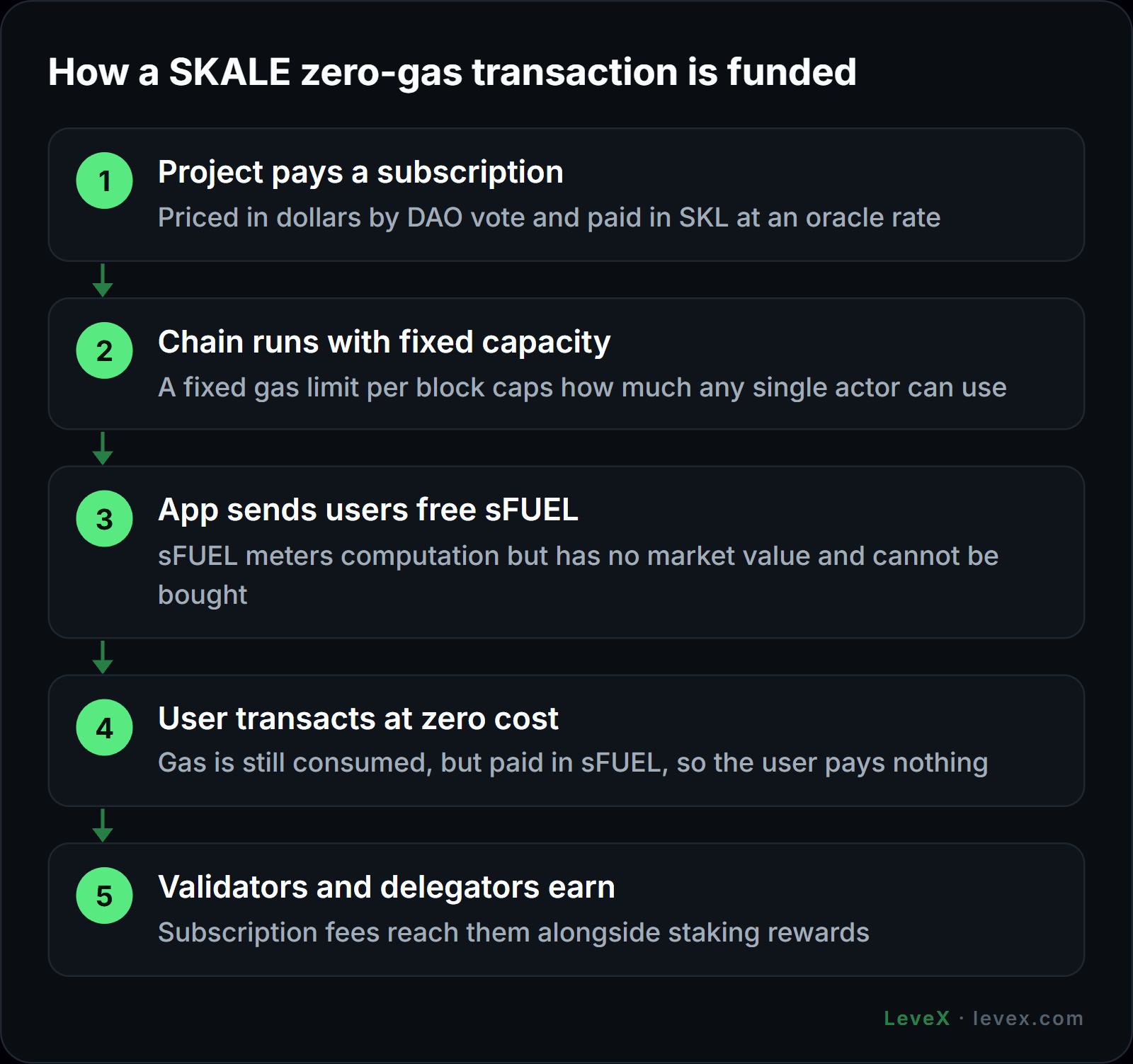
SKALE replaces the auction with a rental. A project that wants its own chain pays a subscription, priced in dollars by DAO vote and paid in SKL at an oracle rate, and in return gets a chain with fixed capacity. A Blockworks Research review of SKALE's subscription model describes this as the network's defining economic choice. Projects that do not need a whole chain can deploy on a shared hub such as Europa or Nebula instead.
The money flows to the people securing the network. Subscription fees go to validators and delegators alongside staking rewards, which is the link between free transactions and SKL demand discussed in our SKL tokenomics breakdown.
sFUEL: The Gas Token With No Price
Every EVM chain needs gas to meter computation and stop spam, so SKALE kept gas but stripped it of value. Its Ethereum-connected chains use sFUEL, which cannot be bought on markets and has no price. Users get it in one of three ways:
- The app sends it automatically. Most SKALE apps top up a new user's wallet with sFUEL in the background, so the user never sees it.
- A faucet. Developers and testers can claim sFUEL from hub faucets in a few clicks.
- Proof-of-work distribution. SKALE supports a mechanism where a wallet with no sFUEL performs a small computation in the browser to earn enough gas for its transaction, which lets brand new wallets transact without any prior balance.
Because sFUEL still meters computation, a spammer cannot flood a chain for free. They would need to keep acquiring sFUEL, and each chain has a fixed gas limit per block that caps how much any single actor can use.
Compute Credits on SKALE on Base
SKALE on Base, part of the SKALE Expand program, uses a different model built for AI agents and payments apps. Instead of sFUEL, apps and operators prepay for compute credits in USDC or SKL, and those credits cover gas for their users. In SKALE's announcement of the Ultravioleta DAO deployment, payments settle in bridged USDC while gas is paid in CREDIT tokens, so neither developers nor users touch gas directly.
The practical effect is the same as on the original chains: the user pays nothing per transaction. The difference is who funds it and how. On SKALE on Base, a project tops up a credit balance as it would a cloud computing account, rather than committing to a monthly chain subscription. For agents that make thousands of small payments, that turns an unpredictable stream of gas costs into a budget line. Our article on SKALE vs Polygon shows how that compares with a low-fee chain where users still pay.
The Trade-Offs Behind Free Transactions
Someone still has to fund the chain
If a project stops paying its subscription or runs out of credits, its users cannot transact on its terms. That ties the user experience to the app's finances in a way that pay-per-use chains do not.
Fee revenue depends on adoption
Because users do not bid for block space, SKALE's revenue does not rise during periods of heavy demand the way fee-market chains do. Revenue grows only when more projects rent chains or buy credits, which is why subscription growth matters so much for SKL. This is one reason staking rewards, funded largely by issuance, have done most of the work of paying validators, a theme covered in our guide on how to stake SKL.
The flip side is that a gas-free chain makes certain products possible at all: onchain games with every action recorded, social apps with free posting and AI agents paying per API call. Whether those markets grow large enough to support SKL's valuation is the central question in our SKL price prediction.
SKALE Gas Fee FAQ
Is SKALE really gas free?
SKALE is gas free for users. Transactions still consume gas, but users pay it with sFUEL that has no market value or with credits their app has prepaid, so the cost to the user is zero.
What is sFUEL on SKALE?
sFUEL is the gas token on SKALE's Ethereum-connected chains. It has no price, cannot be traded and is distributed free by apps, faucets or a small proof-of-work computation.
Do I need SKL to use SKALE apps?
No. Users of SKALE apps do not need SKL, because gas is paid with free sFUEL or app-funded credits. SKL is needed by developers paying for chains and by anyone who wants to stake.
Why Zero Gas Matters for SKL
SKALE's zero-gas design shifts costs from users to applications, which removes the biggest barrier for games and agent payments and ties SKL's demand to how many projects pay for capacity.
To take a view on whether that model wins, buy SKL on the LeveX SKL/USDT spot market or open a long or short on SKL perpetual futures. For short explainers on other projects, explore Crypto in a Minute.