

SKALE suits applications that want transactions to cost users nothing, while Polygon suits applications that want one large shared chain with deep liquidity and very low, but non-zero, fees. Both are Ethereum-compatible and both started as alternatives to expensive Ethereum gas, yet they made opposite choices about who pays and how many chains there should be.
For traders, the comparison also explains why the two tokens behave so differently. SKALE is a small-cap token tied to subscriptions and staking, while Polygon is a much larger network whose POL token pays gas on one of the busiest EVM chains in crypto.
Two Answers to Ethereum's Fee Problem
Polygon's main network, Polygon PoS, is a single high-throughput chain. Every app shares the same block space, every user pays gas in POL, and the chain periodically checkpoints its state to Ethereum. Polygon's broader roadmap connects that chain with others through the AggLayer, a system for sharing liquidity and messages across Polygon-connected chains. The Polygon documentation describes the stack in detail.
SKALE went the other way. Instead of one shared chain, it runs many separate chains, each validated by a randomly assigned and rotating committee of 16 nodes. A game, a DeFi app or an agent marketplace can rent its own chain or join a themed hub, and the app pays a subscription so its users pay no gas at all. SKALE's chains reach finality as soon as two thirds of the committee signs a block, according to the SKALE consensus documentation.
Neither is a rollup in the strict sense. Both rely on their own validator sets for security rather than inheriting it fully from Ethereum, which separates them from the optimistic and zero-knowledge rollups covered in our explainer on Ethereum Layer 2 solutions.
SKALE and Polygon Side by Side
| SKALE | Polygon PoS | |
|---|---|---|
| Chain model | Many independent EVM chains and hubs | One shared EVM chain, linked to others through the AggLayer |
| Who pays gas | The app, through subscriptions or prepaid credits | The user, in POL |
| Typical user fee | Zero | A fraction of a cent |
| Finality | Instant once two thirds of the committee signs | Fast block finality, with checkpoints to Ethereum |
| Validators | Pooled, randomly assigned to chains and rotated | A single validator set staking POL on Ethereum |
| Native token role | Staking, chain subscriptions, governance | Gas, staking, governance |
| Main use cases | Gaming, NFTs, AI agent payments | Payments, stablecoins, DeFi, tokenized assets |
| Market size (Oct 2026) | Micro-cap, around $27M | Multi-billion-dollar network |
Where Each Network Wins
Cost for end users
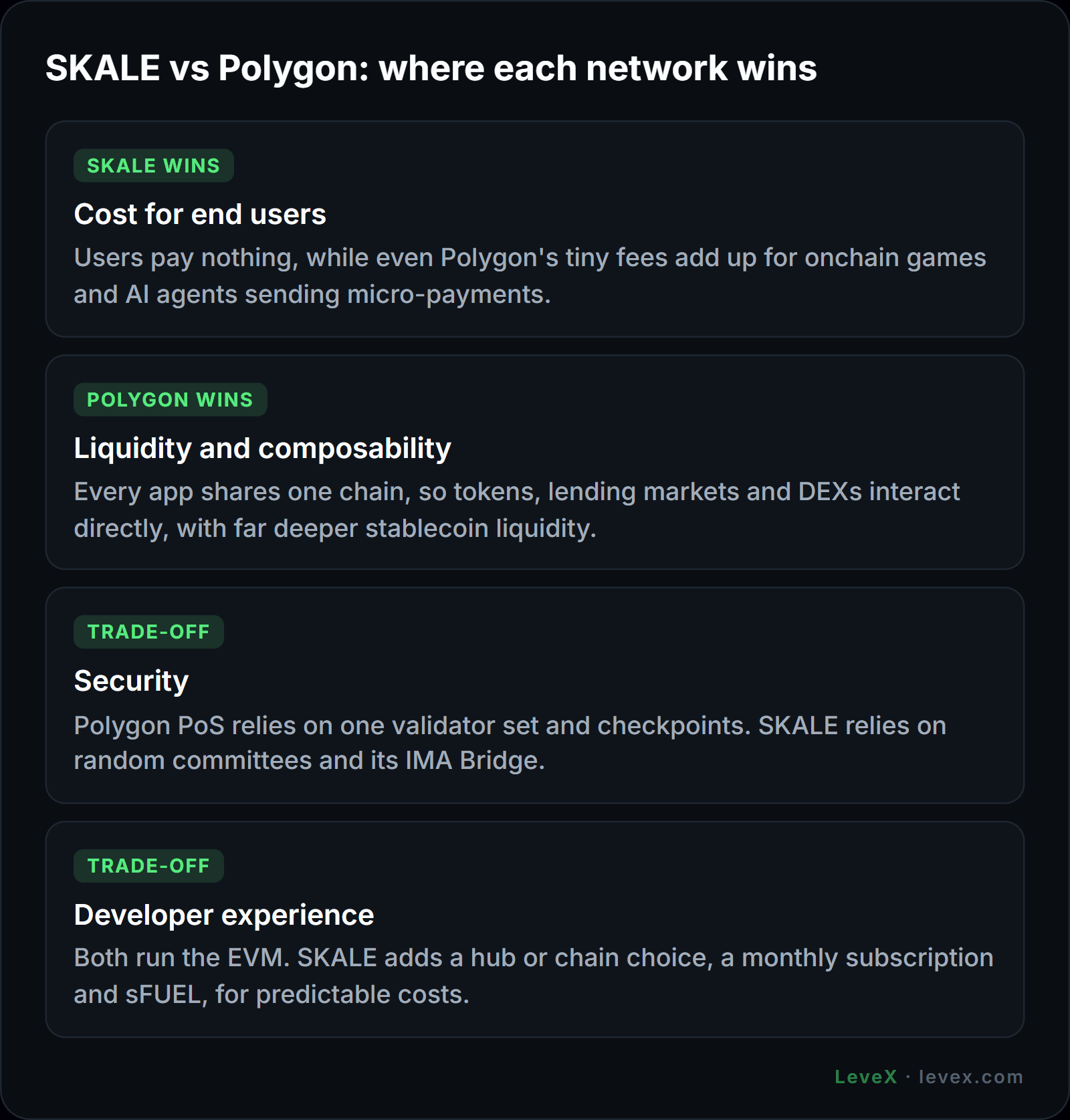
SKALE wins outright on user cost, because users pay nothing. For a game that writes every move onchain or an AI agent sending thousands of micro-payments, even Polygon's tiny fees add up and require users to hold POL. Polygon's fees are low enough for most payments and DeFi activity, and its users accept a small charge in exchange for a busy, liquid chain.
Liquidity and composability
Polygon has the clear edge here. With every app on one chain, a token, a lending market and a DEX can interact directly, and stablecoin liquidity is far deeper than anything on SKALE. SKALE's multichain design splits activity across chains, and the Europa hub exists partly to pull liquidity back into one place.
Security trade-offs
Each model carries its own risks. Polygon PoS depends on a single validator set and its checkpoint system, while SKALE depends on random committee selection and its IMA Bridge to move assets in and out. SKALE disclosed a security incident affecting that bridge in late August 2026, a reminder that bridges remain a weak point for any network outside Ethereum's own security.
Developer experience
Both networks run the EVM, so a Solidity contract deploys to either with little or no change, and both work with standard wallets and tooling. The differences show up in operations. On Polygon, a developer deploys to a public chain and is done. On SKALE, the developer chooses between a shared hub and a dedicated chain, and a dedicated chain means paying a monthly subscription and, on the Ethereum-connected chains, distributing the free sFUEL gas token to users. That extra setup buys a predictable monthly cost instead of fees that rise when the network gets busy.
Which Token Has the Stronger Case?
POL captures value from user activity directly, since every transaction on Polygon PoS burns or pays POL as gas. That gives it a demand source that scales with usage. SKL's demand depends on how many apps buy subscriptions or credits and how much is locked in staking, which has stayed small relative to the token's issuance, as detailed in our SKL tokenomics breakdown.
The two tokens are also at different stages. Polygon is a large-cap network competing for payments and real-world assets, with the size and liquidity that brings. SKL is a micro-cap with more volatility and more room to move in either direction, which shows up in the wide scenario ranges in our SKL price prediction. SKL holders can also earn staking rewards through delegation, which our guide on how to stake SKL walks through.
SKALE vs Polygon FAQ
Is SKALE better than Polygon?
SKALE is better for apps that need free transactions for users, such as games and AI agents. Polygon is better for apps that need shared liquidity, stablecoin depth and a large existing user base.
Are SKALE and Polygon Layer 2 networks?
Both are commonly grouped with Ethereum scaling networks, but neither is a pure rollup. Each runs its own validator set, with SKALE managing staking on Ethereum and Polygon PoS checkpointing its state to Ethereum.
The Bottom Line on SKALE and Polygon
Polygon built a busy shared highway with cheap tolls, and SKALE built many private roads with no tolls at all. Developers choose based on whether their users need liquidity or zero fees, and traders should see SKL as the smaller, higher-risk bet of the two.
On LeveX, SKL trades on the SKL/USDT spot pair and as SKL perpetual futures with long and short exposure. Catch up on other networks in Crypto in a Minute.