
The best wallet for SSV depends on what you plan to do with it: a hardware wallet such as Ledger or Trezor paired with MetaMask or Rabby is the strongest choice for long-term holders who want to stake, a browser wallet alone suits smaller balances, and an exchange account fits active traders. SSV is a standard ERC-20 token on Ethereum, so any Ethereum wallet can hold it.
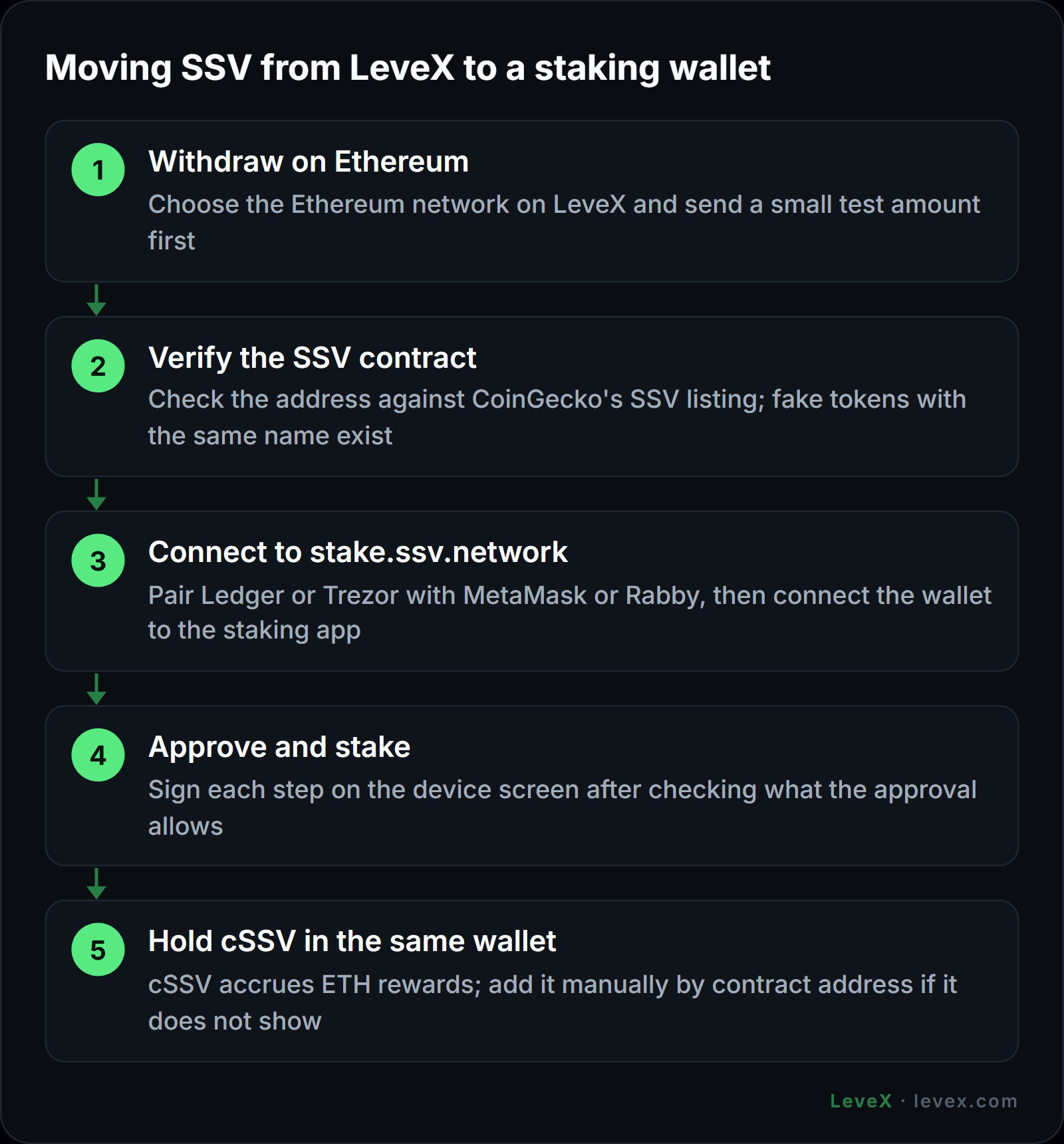
The choice matters more since April 2026, when SSV staking launched. Staking requires connecting a self-custody wallet to the official app, and the resulting cSSV token sits in that same wallet.
What an SSV Wallet Needs
Four features separate a good SSV wallet from one that only stores tokens:
- Ethereum mainnet support. SSV and its staking contract live on Ethereum, so withdraw and hold SSV on the ERC-20 network.
- dApp connection. To stake, you connect to stake.ssv.network and sign transactions, which our guide on how to stake SSV walks through.
- Custom token display. cSSV may need to be added manually using its contract address before it shows in your balance.
- Clear transaction previews. Approvals give contracts permission to move your tokens, so a wallet that explains what you are signing reduces the risk of approving a malicious contract.
SSV Wallets Compared
| Wallet | Type | Can stake SSV | Best for |
|---|---|---|---|
| Ledger | Hardware | Yes, through MetaMask or Rabby | Long-term holders with larger balances |
| Trezor | Hardware | Yes, through MetaMask or Rabby | Holders who prefer open-source firmware |
| MetaMask | Browser and mobile | Yes | Everyday use and staking from a laptop |
| Rabby | Browser | Yes | Users who want detailed transaction checks |
| Safe | Smart contract multisig | Yes | DAOs, funds and shared treasuries |
| LeveX account | Exchange | No | Active spot and futures traders |
The full list of Ethereum wallets is long, and ethereum.org's wallet finder filters options by features such as hardware support and dApp connection.
Wallet-by-Wallet Notes
Hardware wallets for long-term SSV
Ledger and Trezor keep your private keys offline and require a physical button press to approve each transaction. Neither runs SSV staking on its own, so you connect the device to MetaMask or Rabby and sign each staking step on the device screen. Buy hardware directly from the maker, since devices bought from resellers have been tampered with in the past, a risk our report on a Ledger reseller implant describes. Our broader guide to cold wallets covers backup and recovery.
MetaMask and Rabby for staking
Browser wallets make staking simple: connect, approve, stake, claim. MetaMask is the most widely supported, while Rabby shows a plain-language preview of what each transaction will do and flags risky approvals. Both are hot wallets, meaning the keys live on an internet-connected device, so they suit smaller balances unless paired with hardware.
Once you hold cSSV, the token keeps your staking position and accrues ETH rewards. How those rewards are calculated is explained in our SSV tokenomics breakdown.
Safe for shared control
Safe is a smart contract wallet that requires several signers to approve each transaction, such as three out of five team members. It spreads control of a treasury across people in the same way that Distributed Validator Technology spreads control of a validator across operators. Safe works with SSV staking through its dApp connection, which makes it a sensible home for a DAO's SSV.
If you later want to delegate capital to Based Applications on SSV, a self-custody wallet is also required, a process our article on SSV bApps explains.
Keeping SSV on an Exchange
Holding SSV on LeveX trades self-custody for speed. You cannot stake from an exchange account, but you can buy, sell or open a futures position in seconds, which matters for a small-cap token that can move 10% or more in a day. Traders working with the scenarios in our SSV price prediction often keep a trading balance on the exchange and a staked balance in a hardware wallet.
When moving SSV off LeveX, choose the Ethereum network on the withdrawal screen and send a small test amount first. The deposits and withdrawals FAQ covers fees and processing times. Check the SSV token contract address against CoinGecko's SSV listing before adding it to a new wallet, since fake tokens with the same name do exist.
SSV Wallet FAQ
Can I store SSV in MetaMask?
Yes. SSV is an ERC-20 token, so MetaMask holds it on Ethereum mainnet. If the balance does not appear, add the token manually using its verified contract address.
Which wallet is safest for SSV?
A hardware wallet such as Ledger or Trezor is the safest option for most individuals, because the keys never touch an internet-connected device. For shared funds, a Safe multisig adds protection by requiring several approvals.
Do I need a special wallet for cSSV?
No. cSSV is a standard ERC-20 token that lives in the same Ethereum wallet you used to stake. You may need to add its contract address so the wallet displays it, and the SSV staking documentation lists the official addresses.
Matching the Wallet to Your Plan
Stakers should pair a hardware wallet with MetaMask or Rabby, small holders can rely on a browser wallet alone, and organizations should use Safe. Whatever you choose, the risk in holding SSV is mostly market and competitive risk, including the rivalry described in our SSV vs Obol comparison, more than the wallet itself.
To get SSV into your wallet, buy it on the LeveX SSV/USDT spot market and withdraw on Ethereum, or keep it on the exchange to trade SSVUSDT perpetual futures. For more token guides, explore Crypto in a Minute.