

SSV Network (SSV) is an open protocol that splits a single Ethereum validator across several independent node operators, so the validator keeps working even if one of those machines fails or misbehaves. SSV is its governance and staking token, and since April 2026 holders who stake it receive a share of the network's fees in ETH. With more than 7 million ETH running through it, SSV has become one of the largest pieces of staking infrastructure on Ethereum that most stakers have never heard of.
The name comes from "Secret Shared Validators," the cryptographic technique at its core. This guide covers how the technology works, who uses it, what the token does after its 2026 redesign, and the risks a trader should weigh.
The Problem SSV Solves
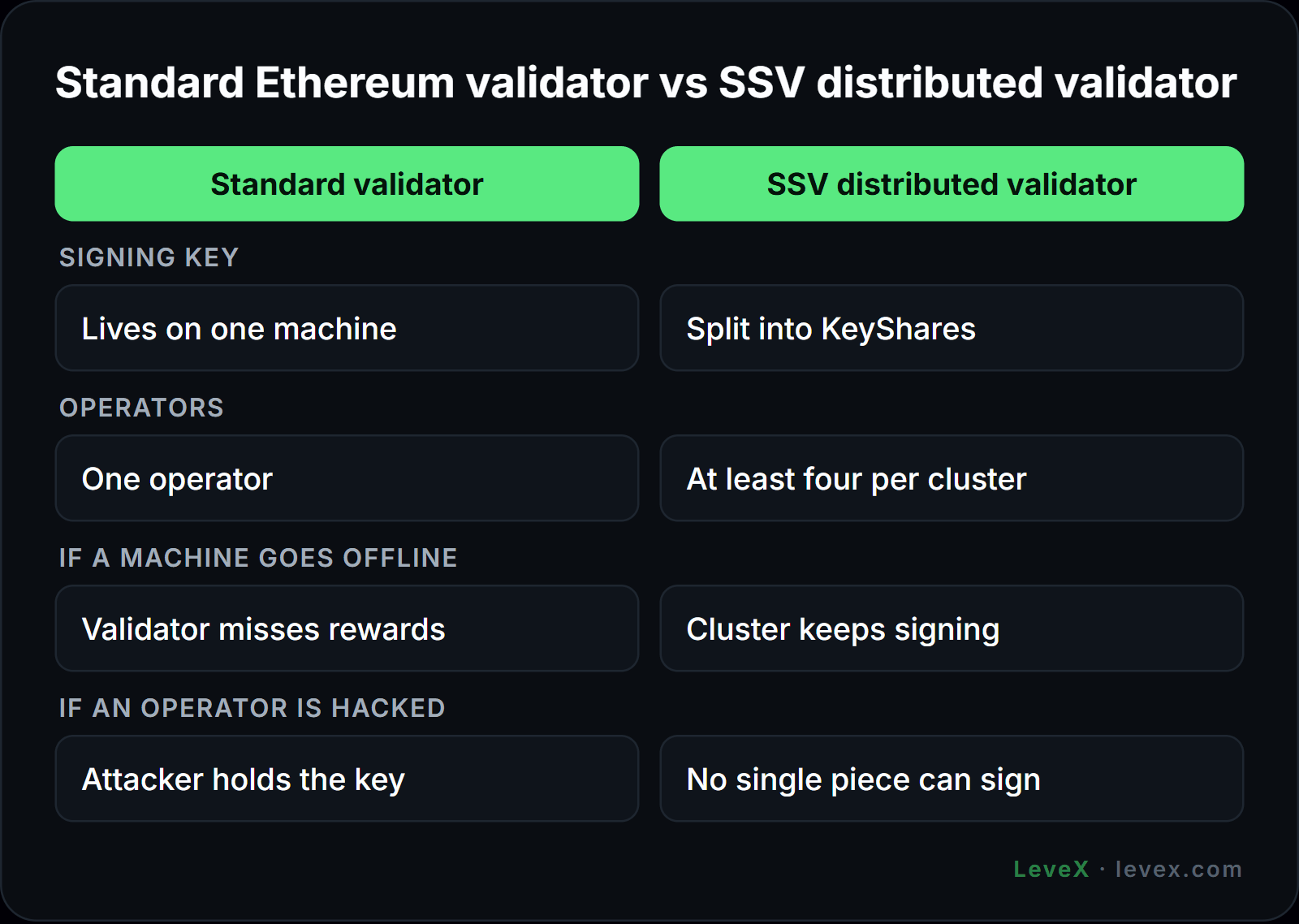
Every Ethereum validator is controlled by a single signing key, and in a standard setup that key lives on one machine run by one operator. If the machine goes offline, the validator misses rewards. If the key is copied to a backup machine and both sign at once, the network punishes the validator through slashing. If the operator is hacked, the attacker holds the key. Staking at scale has therefore leaned on a few large operators with the budget for elaborate redundancy.
That concentration worries Ethereum researchers, and the Ethereum Foundation backed early research into Distributed Validator Technology (DVT) for this reason. DVT removes the single point of failure by never letting the full key exist in one place. SSV is the most widely deployed implementation of that idea, and it matters most to the liquid staking protocols that manage millions of ETH for depositors who never run hardware themselves.
How a Distributed Validator Works
A validator registered on SSV goes through the same handful of steps, whether it belongs to a solo staker or a large staking protocol:
- The key is split. The validator key is divided into encrypted pieces called KeyShares using Shamir secret sharing. No single piece can sign anything.
- Shares go to a cluster. Each piece is assigned to a different operator. A cluster has at least four operators, and the staker chooses them from a public, permissionless list of roughly 1,800 operators.
- Operators agree before signing. When the validator has a duty, such as proposing or attesting to a block, the operators reach agreement through a consensus round (QBFT) on what to sign.
- Partial signatures combine. Each operator signs with its share, and once a threshold of shares has signed, the pieces combine into one valid signature that the Ethereum network accepts as normal.
- Fees flow in ETH. The staker pays each operator its own fee, plus a network fee set by the SSV DAO, all in ETH since the 2026 fee migration.
Because only a threshold of operators is needed, a four-operator cluster keeps signing while one member is offline or faulty. The staker also keeps the withdrawal credentials, so operators can sign duties but can never move the staked ETH.
A second independent client for operators, called Anchor and written in Rust by Sigma Prime, went live on mainnet alongside the original Go client. Running two client codebases reduces the chance that one software bug takes down a large share of the network at once.
Who Runs on SSV
SSV's growth came mostly from staking protocols that adopted it as plumbing. In May 2026 the project grouped five of them under a campaign it called "The Syndicate," and its official announcement lists how each one uses the network.
| Protocol | Token | How it uses SSV |
|---|---|---|
| Lido | stETH | Simple DVT module, run alongside Obol clusters |
| ether.fi | eETH / weETH | DVT as a base layer for its staking validators |
| Puffer | pufETH | Anti-slashing architecture built on SSV |
| Mantle | mETH | Validator distribution for its staked ETH product |
| Origin | OETH | Validator infrastructure for its ETH yield token |
Lido's Simple DVT module is the best-documented case. Lido reported in mid-2025 that the module had grown to 261 operators running about 9,500 validators, split between SSV and its main rival Obol. Those small operators include home stakers and community groups that would never qualify as standalone Lido node operators.
According to an April 2026 release carried by The Block, SSV then secured more than 7.4 million ETH across about 118,000 validators, which a DAO contributor described as almost one-fifth of all staked ETH. The project's own dashboards in later months show figures in the same range, though independent estimates of actively secured ETH run lower.
What the SSV Token Does
SSV is an ERC-20 token on Ethereum. Its role changed sharply in 2026, and anyone reading older guides will find descriptions that no longer apply.
Paying for the network (before and after)
Until 2026, stakers paid operator and network fees in SSV, which gave the token direct demand from every validator on the network. The DAO voted to move those payments to ETH, and fees now scale with a validator's effective balance. That change followed Ethereum's Pectra upgrade, which lets a single validator hold up to 2,048 ETH and made flat per-validator pricing outdated.
Staking SSV for ETH rewards
Since the switch, holders can lock SSV and receive cSSV at a 1:1 ratio. The SSV staking documentation says cSSV holders earn a pro-rata share of network fees in ETH, claimable at any time, with a 7-day cooldown to unstake. Demand for the token now depends on staking appeal and on how much fee revenue the network produces.
Governance
The SSV DAO sets the network fee, funds development grants such as the Anchor client, and elects the oracles that report validator balances to the protocol. cSSV keeps its voting weight, so staking does not mean giving up a say.
As of October 2026, data aggregators show roughly 14.7 million SSV in circulation and a price near $3, according to CoinGecko. That puts the market value under $50 million, a small figure next to the billions of dollars of ETH the network secures.
From Blox to Based Applications
SSV started as research funded by the Ethereum Foundation in 2019 and was built by Blox, a staking company. Blox's original CDT token was redenominated into SSV in October 2021 at 100 CDT per SSV. The network went permissionless on mainnet in stages through late 2023, with the final phase completed in January 2024.
In January 2025 the team, now operating as SSV Labs, launched SSV 2.0 and its "Based Applications" (bApps) framework. bApps let validators opt in to secure extra services, similar in spirit to restaking on EigenLayer, while keeping the validator's 32 ETH principal out of reach of the new service's penalties. Adoption of bApps has been slow, and the wider market cooled on restaking through 2026 as large protocols pulled back from it.
The cSSV staking launch on April 29, 2026 came with a Genesis Boost incentive, followed by a Syndicate Boost in June and July that rewarded holders of the partner protocols' tokens for staking SSV.
Risks Worth Knowing
Fee revenue is the core question. The token now captures value only to the extent that the DAO's network fee generates meaningful ETH income for stakers, and early promotional reward rates may not reflect what stakers earn once incentive campaigns end.
Concentration risk also runs in an unusual direction. A few large protocols supply most of the ETH on SSV, so a decision by one of them to change providers would move the network's numbers sharply. Obol competes directly for the same customers, and some staking protocols use both.
Price history is the third consideration. SSV trades more than 90% below the highs it set in 2024, and its small market cap means modest buying or selling can move it quickly. Smart contract bugs, oracle failures in the new staking system, and the general ETH staking yield environment add further layers of risk.
Frequently Asked Questions
What is SSV Network used for?
SSV Network is used to run Ethereum validators across several independent operators instead of one. Staking protocols, institutions and solo stakers use it to cut downtime and reduce the damage a single hacked or failed machine can cause.
Is SSV a good investment?
SSV is a high-risk, small-cap token whose value now depends on how much ETH fee revenue reaches stakers. Its infrastructure is widely used, but the token has fallen heavily since 2024, so any position should be sized for large swings.
How do SSV holders earn rewards?
Holders earn by staking SSV into cSSV, which pays a share of the network's ETH-denominated fees. Rewards can be claimed at any time, and unstaking takes seven days.
What is the difference between SSV and Obol?
Both provide Distributed Validator Technology for Ethereum and both power parts of Lido's Simple DVT module. SSV runs as an on-chain network where stakers pick operators and pay fees through smart contracts, while Obol focuses on clusters that operator groups coordinate themselves.
Does SSV control my staked ETH?
No. Operators on SSV only hold key shares that allow them to sign validator duties together, and the staker keeps the withdrawal credentials that control the ETH itself.
Why SSV Matters to Ethereum Staking
SSV has quietly become part of the base layer of Ethereum staking, carrying a large slice of the validators behind the biggest liquid staking tokens. The 2026 redesign turned SSV from a fee-payment token into a claim on that activity's ETH revenue, which makes the token easier to value and puts the burden on the network to keep growing its fee base.
You can buy SSV on the LeveX spot market or take a long or short view on the SSVUSDT perpetual contract from the same account. For more quick explainers on the tokens behind Ethereum's infrastructure, visit Crypto in a Minute.