
Based Applications, or bApps, are services that borrow security from Ethereum validators running on SSV Network, without putting those validators' staked ETH at risk. SSV Labs introduced the framework with SSV 2.0 in January 2025 as its answer to restaking, and as of late 2026 it remains more blueprint than busy marketplace.
For SSV holders, bApps are the main growth story beyond the core validator business. This article explains how they work, how they differ from restaking, and why their progress has been slow.
What a Based Application Is
A bApp is any service that needs a group of trustworthy, staked participants to do a job: run an oracle, sequence a rollup, check data, or confirm messages between chains. Normally, such a service would have to recruit and pay its own set of operators and convince them to post collateral.
SSV offers a shortcut. The network already has well over 100,000 Ethereum validators run by roughly 1,800 operators, all coordinated through Distributed Validator Technology. A bApp can ask those validators to opt in and perform its tasks, paying them for the work. The word "based" refers to building directly on Ethereum's own validator set, the same idea behind "based rollups."
How a bApp Gets Secured
- The bApp registers. A project deploys its service and defines what it needs from validators, including which assets it accepts as security and how it penalizes failure.
- It sets a risk profile. Under SSV's Risk Expressive Model, each bApp states its own rules, so a low-risk data service and a high-stakes bridge can ask for different terms.
- Validators opt in. Operators choose which bApps to serve using separate participation keys. Their main validator keys stay focused on Ethereum duties.
- Capital is delegated if needed. A bApp can also ask for extra security in ETH or ERC-20 tokens, which holders can delegate to the validators serving it. Only that delegated capital is exposed to the bApp's penalties.
- Fees flow back. The bApp pays participating validators, and the plan is for SSV Network to take a fee on that activity as well.
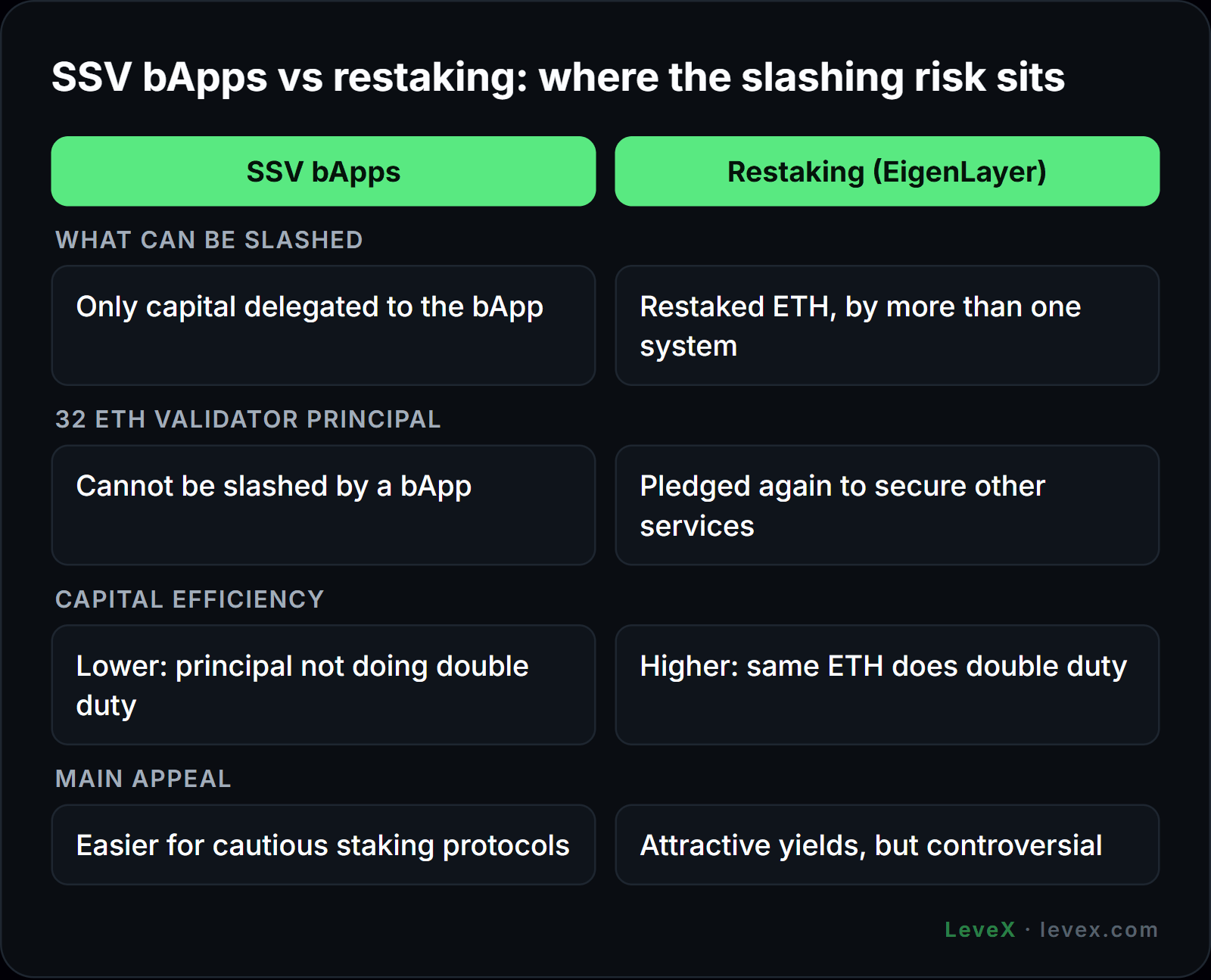
The key design choice sits in step 4. A validator's 32 ETH principal cannot be slashed by a bApp, so a staker can join without adding risk to the core stake.
How bApps Differ From Restaking
Restaking, popularized by EigenLayer, lets staked ETH be pledged again to secure other services, which means the same ETH can be slashed by more than one system. That stacking of risk is what made restaking yields attractive and also what made it controversial. Our EigenLayer vs Symbiotic comparison covers how the two main restaking platforms handle it.
bApps keep the validator's stake out of reach and ask services to bring their own risk capital through delegation. The model is less capital-efficient, because the ETH principal is not doing double duty, but it is easier for a cautious staking protocol to accept. SSV Labs CEO Alon Muroch has called bApps the company's most ambitious project and predicted they would change the restaking market.
Did the 2026 Restaking Pullback Hurt bApps?
The wider market moved away from restaking in 2026. In August, ether.fi removed restaking from its main weETH token and moved it to a separate opt-in product, a major shift for a protocol built around liquid restaking on ether.fi. Yields from restaking had fallen, and many depositors decided the extra risk was no longer worth it. The move did not touch ether.fi's use of SSV for its validators, which SSV's Syndicate announcement describes as a foundational part of the protocol.
That shift cuts two ways for SSV. bApps were designed to avoid the very risk that drove depositors away, which could make them the safer option if demand for shared security returns. Yet the same cooling also means fewer services are looking to rent validator security at all, and the external bApp marketplace remained thin through late 2026.
Competition adds a further layer. Obol, the other main DVT provider, competes with SSV for the same validator base, as our SSV vs Obol comparison explains, and restaking platforms continue to court the same services that bApps target.
What bApps Could Mean for the SSV Token
SSV's fee model already sends a share of ETH network fees to holders who stake the token as cSSV. The roadmap describes three possible layers of fees: the existing cut of validator activity, a fee on each bApp, and eventually transaction fees on an SSV-based chain. Our SSV tokenomics breakdown explains the current split.
If bApp fees materialize, they would flow into the same staking contract, raising rewards per staked token without requiring more validators. Holders who want to be positioned for that can follow our guide on how to stake SSV. Until meaningful bApp revenue appears, however, nearly all staking income comes from the core validator business.
The SSV Network site reports more than 130,000 validators as of September 2026, a large base for any bApp to tap. Conversion of that base into paying services is the number to watch.
bApps FAQ
Are bApps live on SSV Network?
Yes. The bApps framework launched with SSV 2.0 in January 2025. Adoption has been slow, and the marketplace of external services was still small in late 2026.
Can a bApp slash my staked ETH?
No. A validator's 32 ETH principal cannot be slashed by a bApp. Only extra capital that holders choose to delegate to a bApp is exposed to its penalties.
How are bApps different from AVSs on EigenLayer?
Both are services secured by Ethereum stakers. EigenLayer's actively validated services can slash restaked ETH, while bApps leave the core stake untouched and rely on separately delegated capital.
The Long Bet Inside SSV
bApps are SSV's attempt to turn a large validator network into a security marketplace, built with a safer risk model than restaking. The idea is sound, and the validator base is there, but the revenue has not arrived yet. That gap is why bApps sit in the bull case of our SSV price prediction and not the base case.
Follow how the market prices that bet on the SSV/USDT spot pair, or trade announcements around new bApps through SSV perpetual futures on LeveX. More guides to crypto infrastructure are collected in Crypto in a Minute.