

To stake SSV, connect an Ethereum wallet holding SSV to the official staking app at stake.ssv.network, approve the token, and lock it to receive cSSV at a 1:1 ratio. From that moment you earn a share of the SSV Network fees, paid in ETH and claimable whenever you like, and you can unstake later with a seven-day cooldown.
Staking went live on mainnet in April 2026. This guide covers what you need beforehand, each step in order, how rewards are calculated, and the risks that come with cSSV.
What You Need Before You Start
Staking happens on Ethereum mainnet, so three things must be in place first:
- SSV tokens in a self-custody wallet. Exchange balances cannot be staked directly. Withdraw SSV to an Ethereum address you control, using the ERC-20 network.
- A small amount of ETH for gas. Approving the token and staking are two separate transactions, and claiming rewards later is a third.
- A wallet that connects to web apps. Browser and mobile wallets work, and a hardware wallet adds protection for larger amounts. Our overview of cold wallets explains the trade-offs.
The 2026 incentive campaigns set a minimum of 50 SSV and a 90-day lock for boosted rewards. Standard staking outside those campaigns follows the terms shown in the app, so read them before confirming.
Staking SSV Step by Step
- Open the official app. Go to stake.ssv.network by typing the address directly or using a link from the ssv.network site. Staking scams copy popular dApps, so avoid links from direct messages.
- Connect your wallet. Choose your wallet provider and confirm the connection on Ethereum mainnet.
- Enter the amount. Type how much SSV you want to stake. The app shows the cSSV you will receive, always the same number.
- Approve SSV. Sign the approval transaction that lets the staking contract move your SSV.
- Stake. Sign the staking transaction. Once it confirms, cSSV appears in your wallet. Add the token contract to your wallet if it does not show automatically, using the address listed in the app.
- Check delegation. Staking automatically delegates your weight to the network's Effective Balance oracles, which report how much ETH each cluster secures. You do not need to choose an oracle yourself in the current phase.
The SSV staking documentation lists the contract addresses and explains each screen, which is worth checking before your first transaction.
How cSSV Rewards Are Paid
Rewards come from fees. Stakers who run validators on SSV pay their operators and a DAO-set network fee in ETH, and a portion of those fees goes to the staking contract. Each cSSV holder's cut equals their share of all staked SSV. The full fee flow, and how it differs from the pre-2026 model, is covered in our SSV tokenomics breakdown.
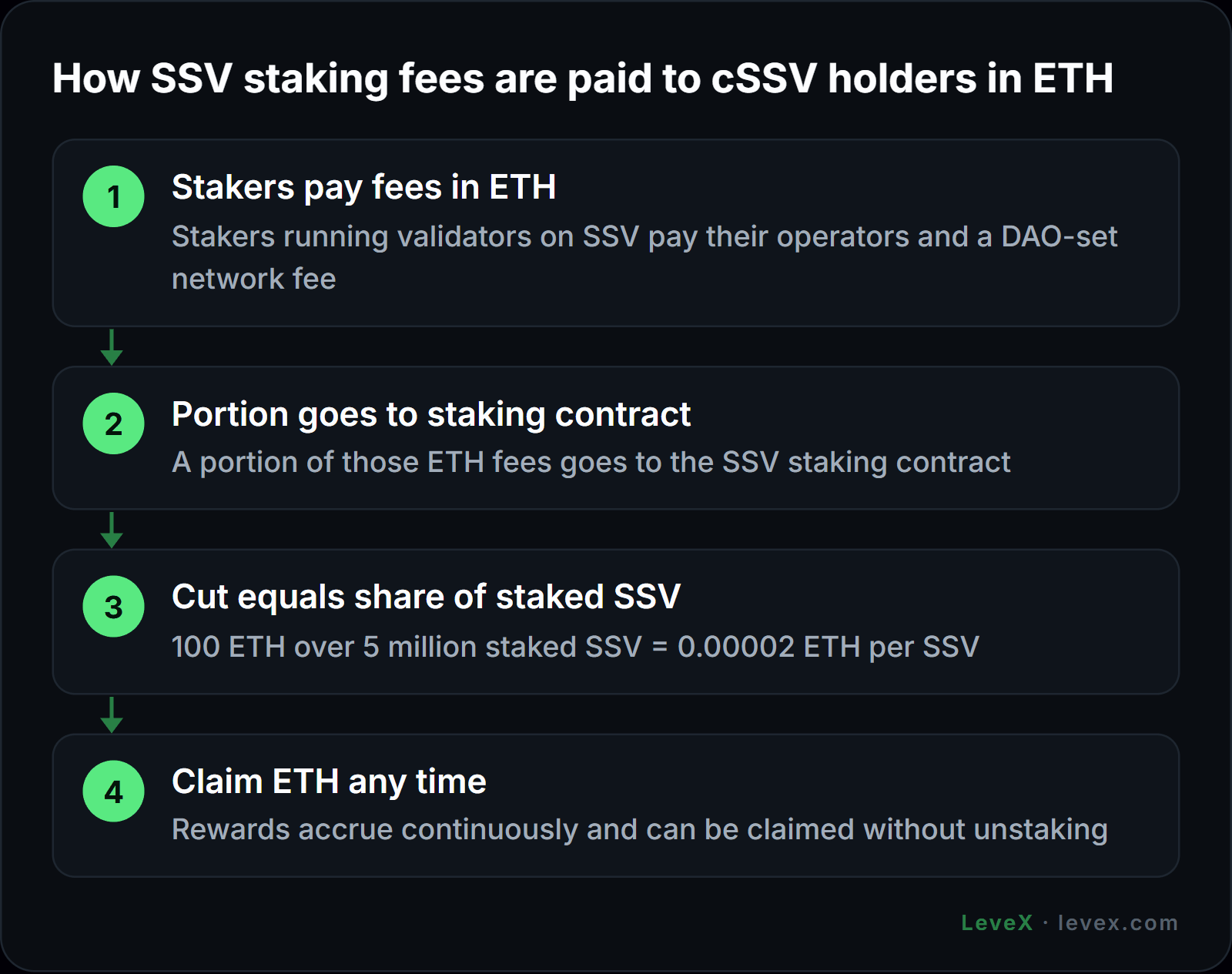
A simple illustration with round numbers shows the math. If stakers collectively received 100 ETH in a year and 5 million SSV were staked, each SSV would earn 0.00002 ETH, so a holder of 1,000 SSV would receive 0.02 ETH over that year. Real figures change with fee volume, the network fee rate, and how much SSV others stake.
Rewards accrue continuously and can be claimed at any time without unstaking. Because cSSV is a transferable token, the contract settles accrued rewards for both sides whenever cSSV moves between wallets, so selling or sending cSSV does not lose earned ETH.
Early reward rates were lifted by the Genesis Boost in April and May 2026 and the Syndicate Boost in June and July, which rewarded new and existing holders with extra SSV. Promotional APR figures from those periods may run well above what stakers earn once campaigns end.
Unstaking and the Seven-Day Cooldown
To exit, request an unstake in the same app. Your stake enters a seven-day cooldown, during which it keeps counting toward rewards. After the cooldown, withdraw your SSV along with any rewards you have not yet claimed, and the matching cSSV is burned.
If you staked during a boost campaign, the campaign's lock applies first. The Syndicate Boost, for example, required holding until October 7, 2026, and unstaking or transferring cSSV early forfeited the boost.
Risks of Holding cSSV
Smart contract risk comes first, since your SSV sits in a staking contract. According to the launch announcement published by The Block, the system passed a Quantstamp audit and has an Immunefi bug bounty of up to $250,000, which reduces the risk without removing it. Oracle risk is specific to this design: if the oracles reporting effective balances fail or misreport, fee calculations could be wrong.
Price risk matters more than either for most holders. Rewards are paid in ETH, but your principal is SSV, and a fall in the token can erase a year of yield quickly. Our SSV price prediction lays out the downside scenarios. cSSV also works like other liquid staking tokens in one respect: it may trade below the value of the SSV behind it if few buyers exist on secondary markets.
SSV Staking FAQ
Can I stake SSV on an exchange?
No. SSV staking runs through the official staking contract on Ethereum, so you must withdraw SSV to your own wallet first and stake from there.
Is cSSV the same as SSV?
cSSV represents staked SSV one-for-one and can be redeemed for it after a seven-day cooldown. The difference is that cSSV earns ETH fee rewards while plain SSV does not.
How often are SSV staking rewards paid?
Rewards accrue continuously as fees flow into the staking contract. You decide when to claim them, and each claim is an Ethereum transaction that costs gas.
Is Staking SSV Worth It?
For holders who plan to keep SSV for months, staking is the only way the token produces income, and the ETH-denominated rewards add a second asset to the position. The seven-day exit and the gas costs make it a poor fit for small balances or for traders who move in and out often.
If you would rather trade SSV than stake it, the LeveX SSV/USDT spot market handles buying and selling, and SSVUSDT perpetual futures let you go long or short with leverage. Short explainers on other networks live in Crypto in a Minute.