

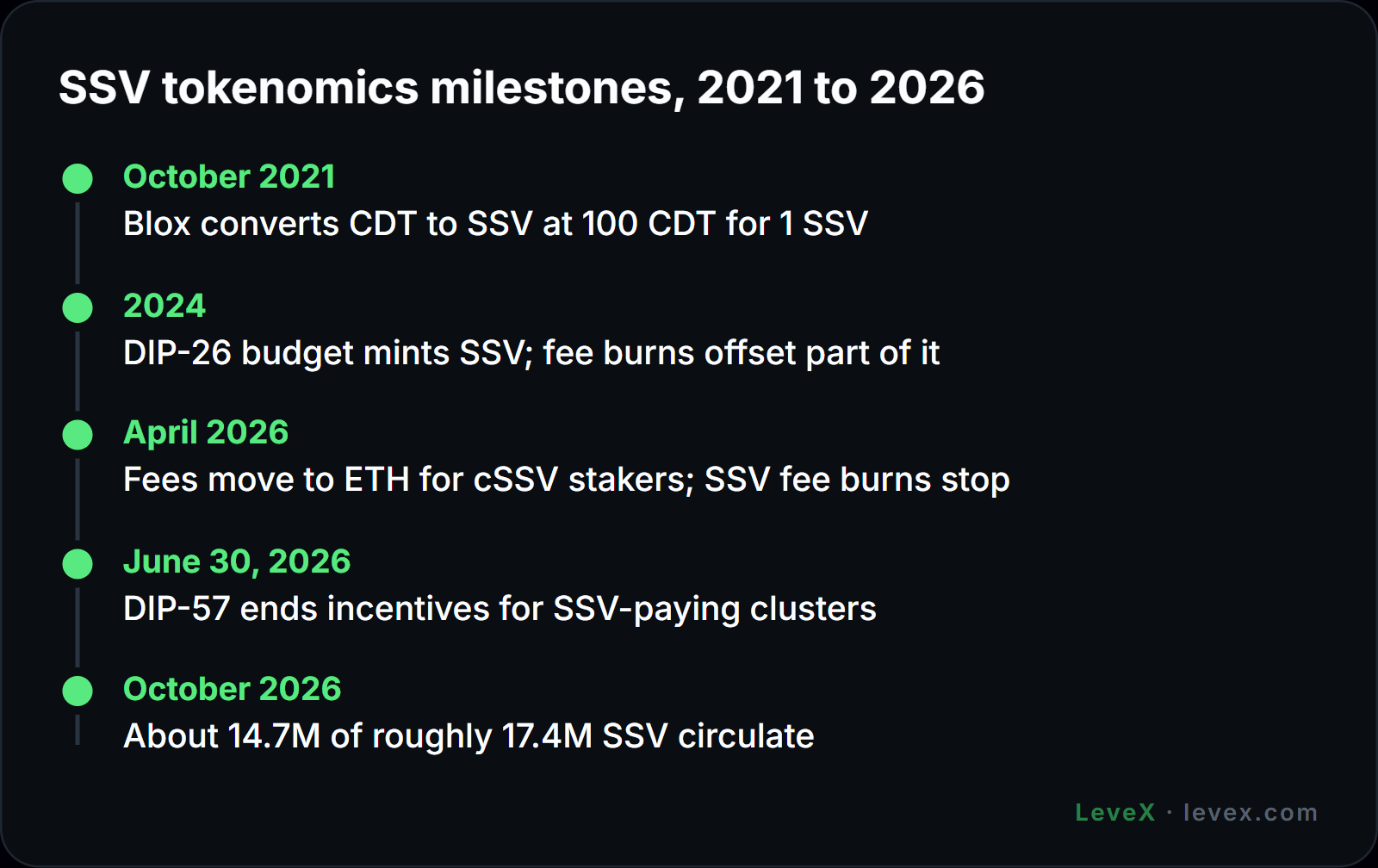
About 14.7 million SSV tokens circulate as of October 2026, out of a total supply of roughly 17.4 million, and the token's job changed completely in April 2026. Before that date, SSV was the currency stakers used to pay for distributed validators. Since then, those fees are paid in ETH and passed to holders who lock SSV as cSSV, which makes the token a claim on network revenue rather than a payment method.
That switch is the most important fact in SSV's tokenomics, and it changes how supply, demand and value capture should be read.
How Much SSV Exists
SSV was born from a redenomination. In October 2021, Blox converted its earlier CDT token into SSV at a rate of 100 CDT for 1 SSV, which is why the supply is measured in millions rather than billions.
Supply has not been fixed since then. The DAO's four-year budget for 2024 to 2028, proposed as DIP-26 on the SSV governance forum, funded grants and operations partly through newly minted tokens, with network fees burned to offset the new supply. The proposal projected that fee burns could eventually outpace minting. The fee migration of 2026 changed that equation, because fees paid in ETH can no longer be burned as SSV.
Data trackers disagree on the exact figures. Most report a circulating supply between 14.7 million and 16.1 million and a total near 17.36 million, the figure SSV's own staking page uses. Treat any single number as approximate and check a live tracker before relying on it for a calculation.
Before and After the Fee Migration
The cleanest way to understand SSV's economics is to compare the two models side by side.
| Before April 2026 | After April 2026 | |
|---|---|---|
| Currency for operator fees | SSV | ETH |
| Currency for network fee | SSV | ETH |
| Who received the network fee | DAO treasury | cSSV stakers |
| Fee basis | Flat per validator | Scaled to effective balance |
| Main source of token demand | Stakers buying SSV to pay fees | Holders seeking ETH yield |
| Effect on supply | Fees could be burned | Staked SSV leaves the liquid float |
The shift to effective-balance pricing followed Ethereum's Pectra upgrade, which allows a single validator to hold up to 2,048 ETH. A flat per-validator fee would have let large consolidated validators pay the same as a 32 ETH one, so the DAO tied fees to the amount of ETH actually secured.
The old model had a structural weakness. Stakers needed SSV only briefly to pay their fees, and many bought it just before paying, which created little lasting demand. The new model asks holders to keep the token locked to earn.
Where Network Fees Go Now
Fees now move through the protocol in a set order, as described in the SSV staking documentation:
- A staker or staking protocol funds its cluster with ETH.
- The cluster pays each chosen operator its own fee, set by the operator in an open market.
- The cluster also pays the network fee, set by the DAO, scaled to the validators' effective balance.
- A portion of these fees flows into the staking contract.
- cSSV holders accrue rewards pro rata to their share of total staked SSV and can claim the ETH at any time.
Unstaking takes seven days, and staked weight keeps earning during the cooldown. Because cSSV is a transferable ERC-20, accrued rewards settle for both sender and receiver whenever the token changes hands.
This structure means the dollar value of SSV staking rewards depends on three variables: the network fee rate, the amount of ETH on the network, and the price of ETH. Our SSV price prediction builds its scenarios around those same inputs.
Governance, Oracles and the Treasury
SSV holders govern the protocol through the SSV DAO, voting on DAO Improvement Proposals that set the network fee, approve budgets and fund development. Two recent examples show what that power covers: DIP-56 committed about $2.5 million over 24 months to Sigma Prime for the Anchor client, and DIP-57 ended the older incentive program for SSV-paying clusters on June 30, 2026.
Staking adds a second governance duty. The new system needs oracles to report each cluster's effective balance so fees can be calculated, and cSSV holders' voting weight is delegated to those oracles. The first oracle set was elected by the DAO, with a move toward stake-weighted, permissionless selection planned. cSSV keeps its governance weight, so locking tokens does not cost holders their vote.
The DAO treasury still holds SSV and stablecoins to pay for grants and programs. With network fees now flowing to stakers, future treasury funding depends more on existing holdings and on any share of fees the DAO decides to retain.
SSV Tokenomics FAQ
Is SSV inflationary?
SSV supply has grown through DAO-approved minting for budgets, while burns of SSV-paid fees offset part of it before 2026. Since fees moved to ETH, that burn offset no longer applies, so any further minting would add net supply unless the DAO changes course.
What is cSSV?
cSSV is the receipt token you get when you stake SSV, issued 1:1 and redeemable after a seven-day cooldown. It earns a share of network fees paid in ETH and keeps its governance weight.
Do I still need SSV to run a validator on SSV Network?
No. Since the 2026 migration, stakers pay operator and network fees in ETH, so SSV is only needed by those who want staking rewards or a vote in the DAO.
Why the cSSV Model Matters for Holders
SSV's tokenomics now look more like a revenue-sharing design than a utility token, and that makes the numbers worth watching closely: how much ETH the network fee produces, how much SSV is staked to share it, and whether the DAO adds new supply. Holders who believe the fee base will grow have a clearer reason to own the token than they did before 2026.
Buy SSV on the SSV/USDT spot pair if you plan to stake, or trade its moves around DAO votes through SSV perpetual futures. For quick reads on other tokens, browse Crypto in a Minute.