
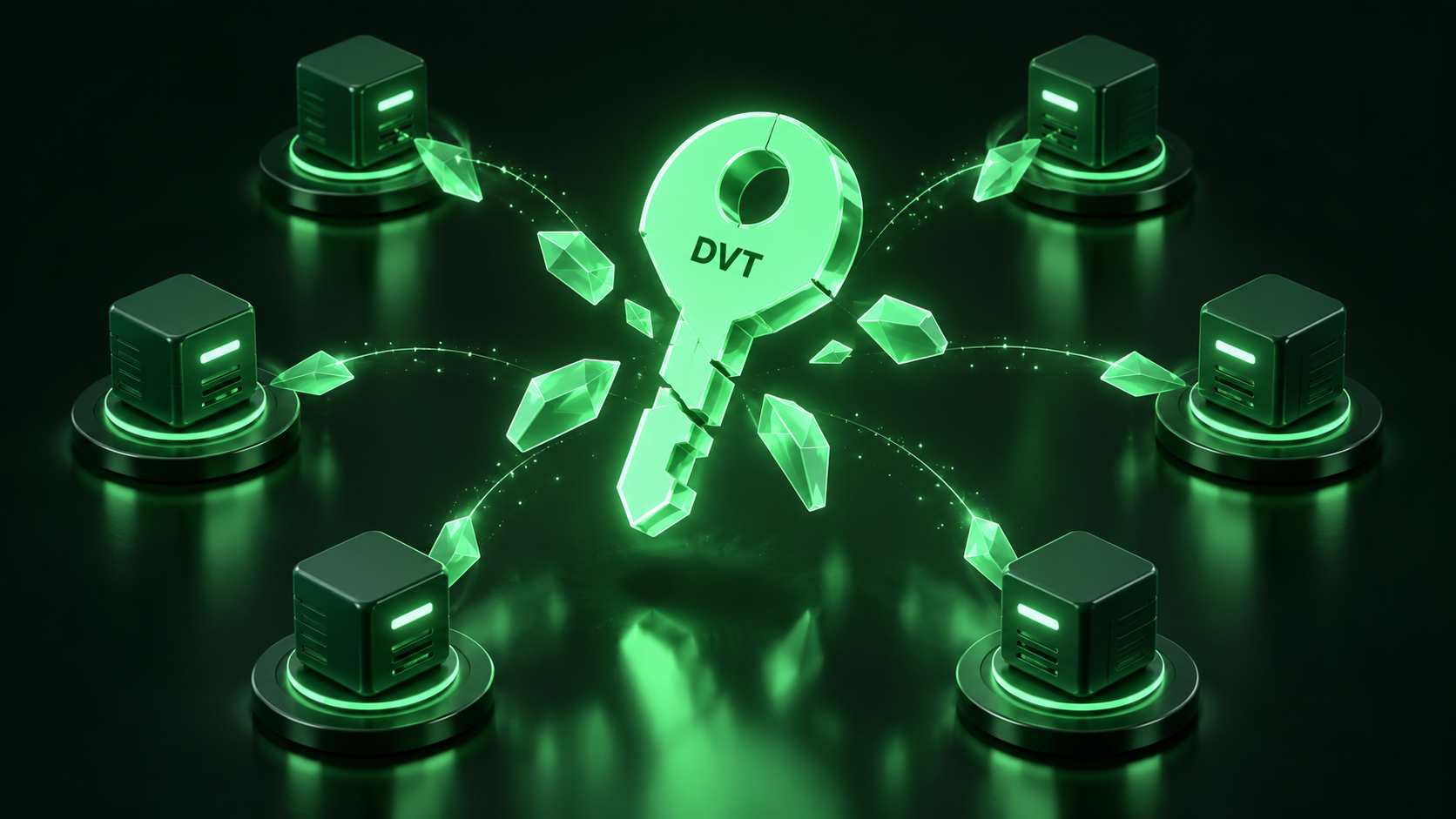
Distributed Validator Technology (DVT) is a way of running one Ethereum validator on several independent machines, so that no single machine holds the full signing key and the validator keeps working when one of them fails. The key is split into shares, each operator signs with its share, and the pieces combine into one valid signature. SSV Network is the largest DVT deployment on Ethereum, and its token SSV is the most direct way to trade the technology's adoption.
DVT sounds abstract until you look at what goes wrong without it. That is where this explainer starts.
Why Single-Key Validators Are Fragile
A standard Ethereum validator is one key on one machine. Three things can go wrong with that setup:
- Downtime. If the machine loses power, internet or disk, the validator stops attesting and loses rewards until someone fixes it.
- Slashing from bad redundancy. Copying the key to a backup machine seems safe, but if both machines sign different messages at the same time, the protocol treats it as an attack and burns part of the stake.
- Theft or compromise. Anyone who breaks into the machine gets the key and can sign whatever they want.
Large staking companies manage these risks with expensive infrastructure, which pushes stake toward a few big operators. The Ethereum community sees that concentration as a long-term threat, and ethereum.org's DVT overview describes the technology as a direct answer to it.
The Four Building Blocks of DVT
Shamir secret sharing
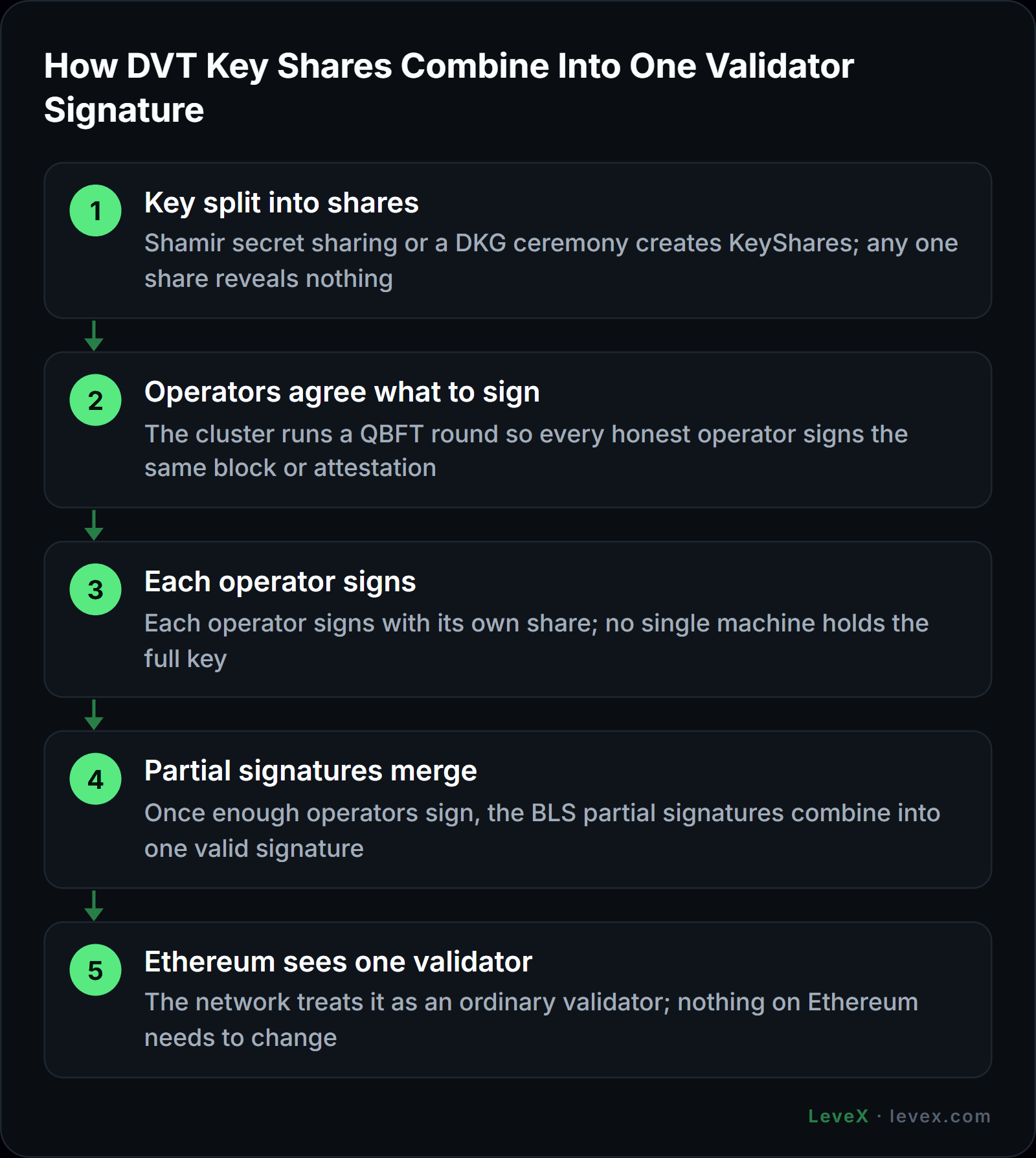
The validator key is mathematically divided into shares. Any share on its own reveals nothing, and only a threshold number of shares can produce a valid signature. On SSV, these encrypted pieces are called KeyShares.
Distributed key generation
Instead of creating a full key and then splitting it, operators can run a distributed key generation (DKG) ceremony that produces the shares directly. With DKG, the complete key never exists anywhere, which removes the moment of risk when one party holds it.
Consensus among operators
Before signing, the operators in a cluster must agree on exactly what to sign. They run a short consensus round, using QBFT on SSV, so every honest operator signs the same block or attestation.
Threshold signatures
Ethereum uses BLS signatures, which can be combined. Once enough operators sign with their shares, the partial signatures merge into one signature that the network treats as coming from an ordinary validator. Nothing on Ethereum needs to change for DVT to work.
Fault Tolerance in Numbers
DVT clusters follow the classic Byzantine fault tolerance rule: a cluster of 3f+1 operators keeps working with up to f of them offline or malicious. SSV offers clusters in these sizes:
| Operators in cluster | Faulty operators tolerated | Signatures needed |
|---|---|---|
| 4 | 1 | 3 |
| 7 | 2 | 5 |
| 10 | 3 | 7 |
| 13 | 4 | 9 |
Larger clusters buy more resilience at the cost of more operator fees and more coordination traffic. Most stakers on SSV use four-operator clusters, while large protocols sometimes choose seven, the size Lido uses in its DVT module.
Who Uses DVT Today
The biggest users are liquid staking protocols, which manage ETH on behalf of thousands of depositors and cannot afford a single operator failure. Lido runs a Simple DVT module that, according to Lido's one-year review, had grown to about 9,500 validators and 261 operators by mid-2025, many of them small and home operators. The module is split between SSV and Obol, the two main DVT networks, and our SSV vs Obol comparison covers how their designs differ.
Restaking and yield protocols such as ether.fi, Puffer, Mantle and Origin also run validators through SSV. Institutional stakers use DVT to spread their own validators across data centers and cloud providers, which protects them against a single provider outage.
Solo stakers can benefit too. A home staker can join a cluster with other operators, gaining resilience without buying redundant hardware.
Trade-offs and Costs
DVT is not free. Every operator in a cluster charges a fee, so a four-operator validator pays four fees plus, on SSV, a network fee set by the DAO. Those payments now go in ETH, and part of them reaches holders who stake SSV, a design our SSV tokenomics breakdown explains in detail. Holders who want that share can follow our walkthrough on how to stake SSV.
Coordination adds a little latency, because operators must reach consensus before signing. In practice, well-run clusters perform close to a single-machine validator, though a cluster with poorly connected operators can miss more duties. Operator selection therefore matters, and public performance data helps stakers choose.
There is also software risk. A bug in the DVT client could affect many validators at once, which is why SSV added a second, independent client called Anchor, written in Rust by Sigma Prime.
DVT FAQ
Is DVT the same as restaking?
No. DVT changes how a validator is operated by splitting its key across machines, while restaking reuses staked ETH to secure extra services. SSV supports both ideas, since its Based Applications let DVT validators opt in to additional services.
Can DVT operators steal my ETH?
No. Operators only hold key shares that let them sign validator duties together. Withdrawal credentials stay with the staker, so operators cannot move the staked ETH.
Do I need DVT to stake ETH?
No. A standard validator works without it. DVT is an optional layer that adds resilience, and it is used mostly by liquid staking protocols, institutions and stakers who want to remove single points of failure.
Why DVT Shapes the SSV Investment Case
DVT has moved from an Ethereum Foundation research project to infrastructure behind a large share of staked ETH, and SSV is its biggest network. Because SSV stakers now earn part of the fees DVT generates, the technology's adoption curve feeds directly into the scenarios in our SSV price prediction.
Get exposure to that adoption through the SSV/USDT spot market on LeveX, or take a leveraged long or short with SSVUSDT perpetual futures. For more short reads on how crypto infrastructure works, see Crypto in a Minute.