
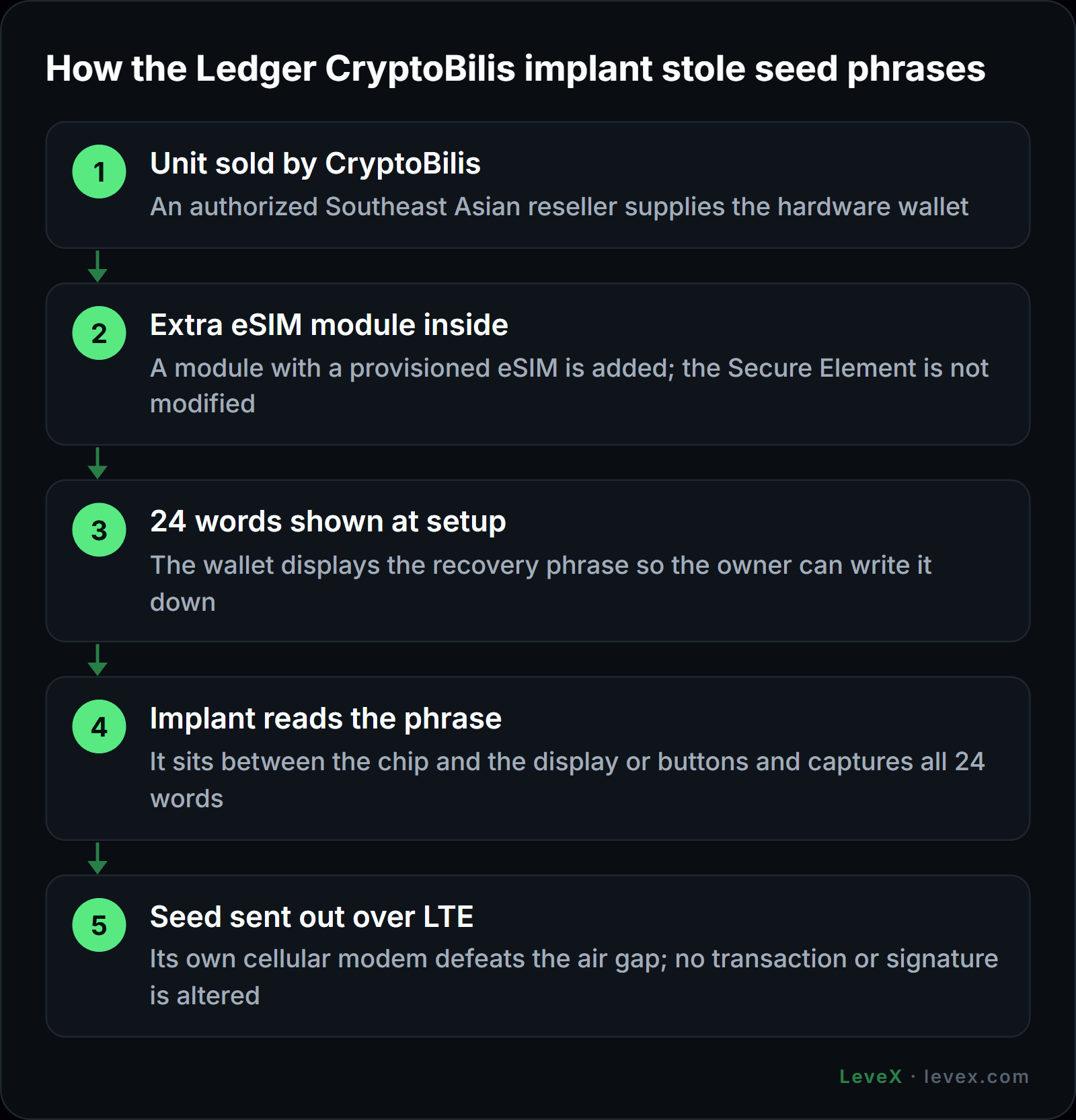
Somewhere in Ledger's Donjon lab last week, a security engineer opened a hardware wallet bought from an authorized Southeast Asian reseller called CryptoBilis and found something that had no business being there: an extra module with a provisioned eSIM. During setup it captured the owner's 24-word recovery phrase and sent it out over LTE, the same mobile network your phone uses.
The part that should keep hardware wallet owners up at night is what the implant left alone. According to Ledger's findings, reported by The Block, it did not modify the Secure Element, did not touch the Ledger operating system, and did not alter a single transaction or signature. Every defense the device was built around held up perfectly. The attacker simply waited beside it for the one moment the secret existed in plain form, and brought their own phone line.
How a Perfect Chip Still Leaks a Seed
Hardware wallet security is usually explained as a vault: keys are generated inside a certified chip and never leave it. That is true for signing, and it is the reason every past debate about these devices has focused on firmware and chip extraction. The recovery phrase breaks the vault metaphor, because its whole purpose is to leave the device. At setup, the wallet shows those 24 words on screen so a human can write them down, and anything sitting between the chip and the display or buttons can read them.
An air-gapped device that never connects to a computer offers no protection here either. Air-gap advice assumes the threat arrives through a cable or a radio the device already has. This one shipped with its own cellular modem, which makes "never plug it in" about as useful as locking the front door of a house with a tunnel in the basement.
The losses are large and still being counted. Bitquery traced about $93.2 million from 315 wallets across six chains, mostly USDT and Tron assets, and YFarmX put the figure at $94.5 million across 521 addresses, as CoinDesk reported. Ledger has confirmed neither number and has not addressed reimbursement. Then the story stopped being about one reseller. MediaMarkt Saturn pulled Ledger devices from its stores and website across Europe on October 13 after a German customer reported an implant, and former Mt. Gox CEO Mark Karpelès said he found one inside a Ledger Flex bought at Singapore's airport. Ledger says every confirmed fund loss still traces to CryptoBilis, and neither of the other reports has been tied to the same campaign.
Trezor and OneKey both cut CryptoBilis loose, and Trezor is trimming its wider reseller network from January 1, 2027. The industry has quietly conceded that the shop is now part of the threat model.
What Actually Protects You Now
This incident changes the practical checklist more than any firmware bug has in years, because the attack sits outside anything a software update can patch.
- If your device came from CryptoBilis, act on Ledger's guidance. Do not set up an unused unit. If you already use one, move funds to a different device with a freshly generated recovery phrase. OneKey is offering free replacements for its devices bought through CryptoBilis between March 1 and October 13.
- Buy from the manufacturer where you can. The MediaMarkt and airport reports, if confirmed, show that a big retail name is no guarantee, so treat every intermediary as a link in a chain you cannot inspect.
- Split control across devices from different channels. A 2-of-3 multisig built from wallets bought in different places means one implanted unit leaks one key, and one key moves nothing. Of everything on this list, this is the defense that contains a tampered device instead of hoping to spot one.
- Treat a passphrase as partial help. An optional extra word added to the recovery phrase blocks an attacker who only has the 24 words, but an implant that can watch setup can plausibly watch you type that word on the same device.
- If you lost funds, keep the device closed. Ledger asks victims to coordinate with law enforcement before opening the hardware, because the implant is evidence.
For a wider grounding in how offline storage works, LeveX's guide to cold wallet crypto covers the basics, and our earlier piece on the hardware wallet data breach showed how buyer lists became a physical risk. This week's attack is the logical next step from that one.
The LeveX Take
The detail almost nobody has dwelled on is which part of the loot came back. Tether froze $10 million of the stolen USDT, and that was possible only because most of the haul sat in a centrally issued dollar token on Tron, while the slice that moved through Tornado Cash and Zcash is far harder to follow. Self-custody purists tend to treat issuer freeze powers as the enemy. In the one theft where the purist's own tool failed, those freeze powers were the only recovery mechanism that worked at all, while any bitcoin or ether taken from the same wallets is simply gone. The uncomfortable conclusion is that every way of holding crypto has a trust point you cannot remove, and the sensible question is whether you can check that trust point yourself or have to take someone's word for it.
That is the test exchanges should face too, and it is why LeveX publishes Proof of Reserves as a Merkle tree that any user can check against their own balance, with the September 30 snapshot showing BTC at 112%, ETH at 132% and USDT at 105% of customer liabilities. A hardware wallet asks you to trust a supply chain you will never see. A reserve attestation asks you to trust arithmetic you can run. Neither is risk free, and anyone who has lived through an exchange collapse knows why the arithmetic has to be repeated every snapshot, so the habit worth building is comparing consecutive attestations rather than reading one.
A Seed Phrase Is Only as Safe as Its Shop
The cleanest summary of this week is that the most secure chip in consumer crypto worked exactly as designed and still lost nearly $100 million, because the weakest component turned out to be the store receipt.
Tron trades on LeveX spot and perpetual futures, and Crypto in a Minute explains wallets, recovery phrases and custody in short reads.