
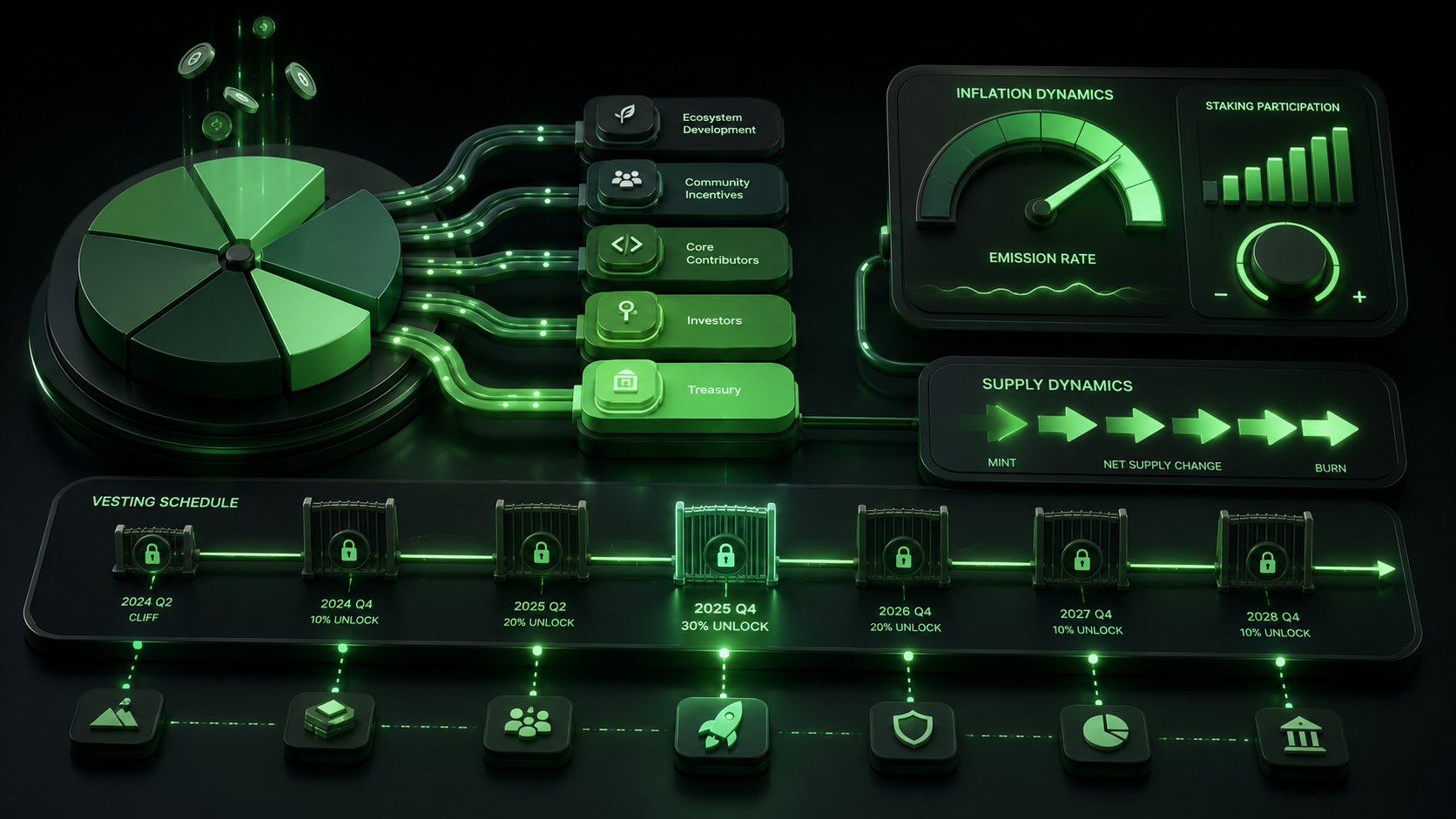
SEI has a fixed maximum supply of 10 billion tokens, with no mechanism to mint beyond that cap. As of March 2026, roughly 6.7 billion SEI are in circulation, representing 67% of the total supply. The remaining 3.3 billion tokens will vest according to a predetermined schedule through August 2027, after which all SEI will be fully distributed.
Understanding this supply schedule matters for traders and holders because token unlocks create predictable sell pressure, and knowing when that pressure peaks and subsides directly informs position timing.
Initial Token Distribution
The 10 billion SEI supply was allocated across six categories at launch:
| Allocation | Percentage | Tokens | Purpose |
|---|---|---|---|
| Ecosystem Reserve | 48% | 4.8B | Grants, incentives, protocol development |
| Private Sale | 20% | 2.0B | Early investors (Jump, Multicoin, Coinbase Ventures) |
| Team | 20% | 2.0B | Founders, employees, advisors |
| Foundation | 9% | 900M | Long-term network stewardship |
| Launchpool/Airdrop | 3% | 300M | Initial distribution to early users |
Source: Sei Labs tokenomics documentation
The ecosystem reserve at 48% is the largest single allocation, deliberately weighted toward long-term network growth rather than immediate insider enrichment. Private sale and team allocations each received 20%, with multi-year vesting schedules attached to both.
Current Vesting Phase
The most relevant detail for anyone trading or holding SEI right now: monthly token unlocks are running between 112 million and 132 million SEI per month through mid-2027.
Foundation and early investor vesting is approaching completion in 2026. This means the categories that have been contributing the most sell pressure are winding down. The remaining vesting falls primarily into two buckets: team allocations and ecosystem reserve distributions.
What this means in practice
Each monthly unlock adds roughly 1.3% to 1.5% of current circulating supply. For a token with SEI's market cap ($470M as of March 2026), that translates to $5 to $7 million worth of new supply entering the market per month at current prices. Whether this supply gets absorbed by buyer demand or pushes prices lower depends on broader market conditions and ecosystem growth.
The positive framing: unlock rates are declining and will stabilize at lower levels through 2027. The cautious framing: even declining unlocks represent persistent dilution until the full supply is released.
How SEI Generates Value
SEI captures value through four mechanisms, each creating demand that partially offsets supply expansion.
Transaction fees are the most direct value driver. Every operation on Sei requires SEI for gas. As the network's transaction volume grows (currently processing thousands of transactions per second across 90+ million wallets), cumulative fee demand increases. The Giga upgrade targeting 200,000+ TPS could dramatically expand this demand source if it attracts new applications and users.
Staking locks supply. When SEI is staked with validators, it's removed from liquid circulation for the staking duration plus the 21-day unbonding period. Higher staking participation reduces effective circulating supply, which can support price at given demand levels.
DeFi collateral creates additional demand sinks. SEI used as collateral in lending markets, liquidity pools, and perpetual futures protocols on-chain represents tokens that are economically committed and unlikely to be sold. As Sei's DeFi ecosystem matures, this locked-up supply should grow.
Governance participation provides a softer demand driver. Token holders who want influence over protocol direction need to hold and often stake SEI to vote.
Comparing SEI's Tokenomics to Peers
SEI's fixed supply with no tail emission places it in a different category than chains with perpetual inflation.
Ethereum has no hard cap but has become deflationary at times post-merge, depending on gas fee burn rates. Solana's inflation and price outlook started with high emission that decreases over time, targeting a long-term rate around 1.5%. Cosmos (ATOM) adjusts inflation dynamically between 7% and 20% based on staking participation.
SEI's approach is simpler: finite supply, predetermined vesting, no inflation after full distribution. This means that after August 2027, the only new sell pressure comes from existing holders choosing to sell, not from protocol-level dilution. For long-term holders, this creates a progressively cleaner supply picture.
The tradeoff is that without ongoing inflation, the network relies entirely on transaction fees to incentivize validators after the ecosystem reserve is depleted. Whether Sei generates enough fee revenue to sustain validator economics at scale is an open question that depends on the network's DeFi ecosystem growth.
Tracking Unlock Events
Significant unlock events can create short-term trading opportunities. Large vesting releases tend to increase selling pressure in the days surrounding the unlock, though the effect is often front-run by sophisticated traders who sell in anticipation. Sources for tracking SEI's vesting schedule include CoinMarketCap, Token Unlocks trackers, and the Sei Foundation's official communications.
The most impactful remaining unlock category is the team allocation, which carries both the largest remaining locked balance and the highest probability of being sold (as team members diversify their holdings). Ecosystem reserve tokens, by contrast, are typically distributed as grants and incentives rather than sold on the open market, making their price impact less predictable.
For wallet setup to manage your SEI positions alongside tracking these events, the best SEI wallets guide covers the leading options. And for how Sei compares to Solana on economic design and performance, the dedicated comparison article explores the tradeoffs.
Supply Dynamics and Long-Term Outlook
SEI's tokenomics tell a clear story: declining unlock pressure through 2027, a fixed cap that eliminates post-distribution inflation, and value capture mechanisms that scale with network usage. The near-term reality is that monthly unlocks continue to add supply, creating headwinds for price appreciation in weak markets.
The longer-term picture is more favorable. Once full distribution completes, SEI becomes a fixed-supply asset in a growing ecosystem. Whether the ecosystem growth materializes fast enough to support the token's value during the remaining vesting period is the central investment question.
Trade SEI on LeveX through spot markets or perpetual futures with leverage. Browse the full Crypto in a Minute series for more token analysis.