
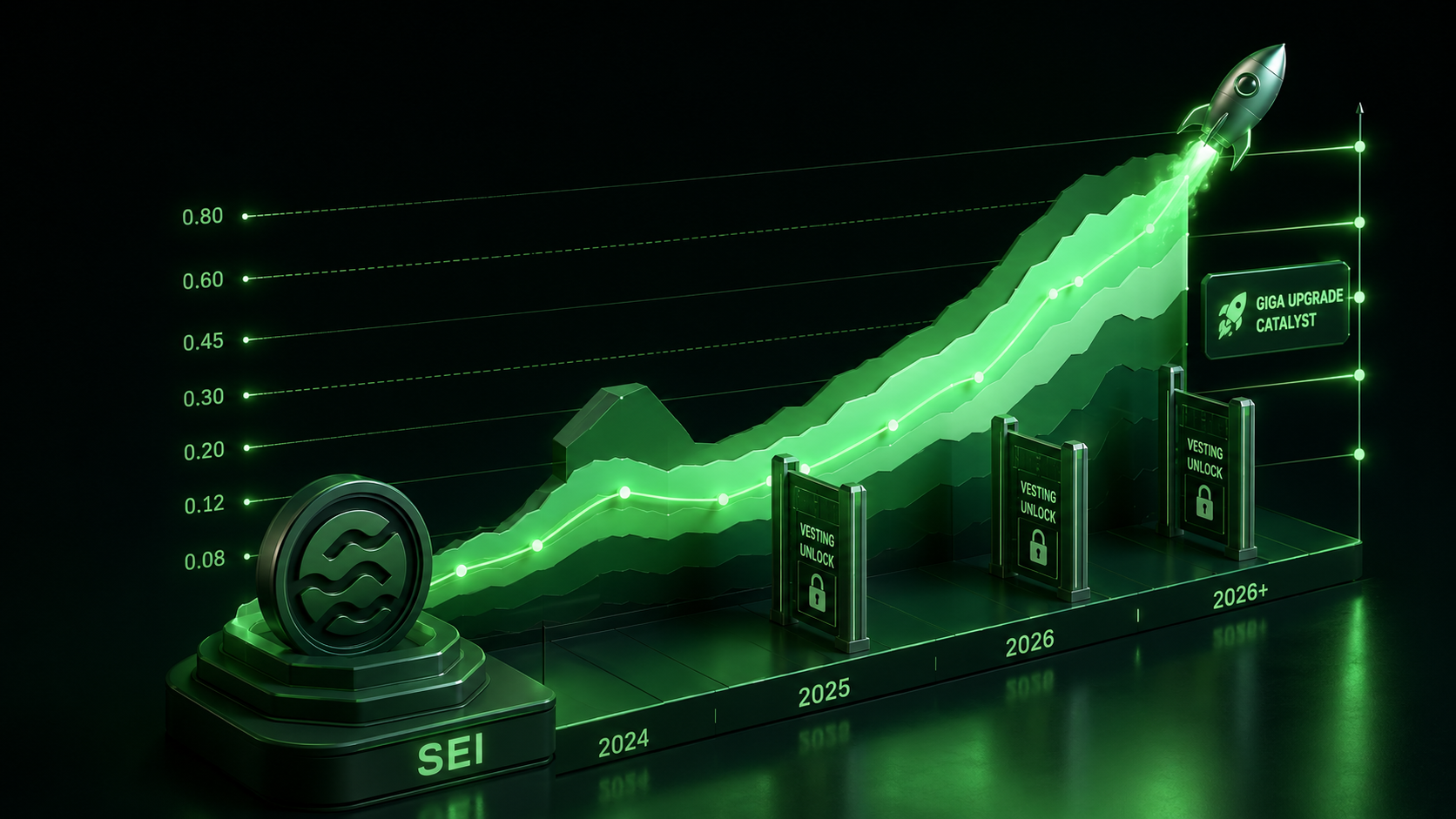
SEI traded near $0.07 in early March 2026, down roughly 94% from its all-time high of $1.14. That kind of drawdown either signals a project in terminal decline or a token that's been repriced by a brutal market while its fundamentals keep developing. For Sei, the evidence leans toward the latter, though the path back toward prior highs is far from guaranteed.
The token currently holds a market cap of approximately $470 million with 6.7 billion of its 10 billion total supply in circulation. Understanding what could move SEI's price from here requires examining the technical catalysts, macro conditions, and structural supply dynamics that will define the next 12 to 18 months.
What Analysts Are Forecasting
Price predictions for SEI in 2026 vary widely, reflecting genuine uncertainty about where the broader crypto market is heading.
| Source | Low Estimate | High Estimate | Key Assumption |
|---|---|---|---|
| Changelly | $0.05 | $0.27 | Technical analysis, moving averages |
| Cryptopolitan | $0.07 | $0.38 | Market cycle recovery by Q3-Q4 |
| CoinCodex | $0.057 | $0.15 | Bearish continuation scenario |
| 99Bitcoins | $0.08 | $0.45 | Support reclaim + EMA recovery |
The spread between the most bearish ($0.05) and most bullish ($0.45) projection amounts to a 9x range, which is typical for mid-cap altcoins at this stage of a market cycle. None of these predictions account for black swan events in either direction.
Technical Catalysts That Could Move the Price
The Giga upgrade
Sei's most significant near-term catalyst is the Giga upgrade, which targets 5 gigagas per second throughput and over 200,000 TPS. If delivered successfully, this would make Sei one of the fastest EVM chains in production. Major protocol upgrades historically generate trading volume spikes regardless of whether the upgrade delivers on every promise.
The timing matters. If Giga ships during a broader market recovery, the combination of technical milestone and rising risk appetite could create a meaningful price move. If it ships during continued bearish conditions, the impact will likely be muted.
EVM ecosystem growth
Sei's compatibility with Ethereum (where gas fees remain a persistent friction point) means any Solidity developer can deploy on Sei without learning a new stack. The network has already attracted over 90 million wallets, but the quality of DeFi applications, their TVL, and their user retention will matter more for price than raw wallet counts.
RWA partnerships with firms like Securitize represent a potential growth vector. The tokenized asset market has grown beyond $19 billion, and Sei's sub-second finality makes it technically suitable for asset settlement. Whether institutional capital actually flows onto Sei is a different question, and one that depends on regulatory clarity and bridge infrastructure as much as raw chain performance.
Supply Dynamics and Sell Pressure
SEI's vesting schedule is among the most important factors for near-term price action. With roughly 33% of total supply still locked, monthly unlocks of 112 to 132 million tokens create persistent sell pressure through mid-2027.
The remaining vesting falls primarily into two categories: team allocations and ecosystem reserve. Foundation and early investor vesting is approaching completion, which means the rate of new supply entering the market will stabilize and then decrease over the next 18 months.
For traders, this creates a clear framework. Accumulation during heavy unlock periods has historically worked well for tokens where fundamentals are intact, since the sell pressure is predictable and already priced in by sophisticated participants. The risk is that SEI's fundamentals don't develop fast enough to absorb the additional supply.
Macro Conditions and Market Cycle Position
SEI's price recovery depends heavily on what happens to the broader crypto market. Altcoins with sub-$1 billion market caps tend to amplify Bitcoin's movements, both up and down. A sustained Bitcoin rally above previous highs would likely pull capital into high-beta plays like SEI. The Bitcoin vs Ethereum dynamic also matters: when BTC dominance rises, altcoins typically lag, and when it falls, capital rotates into smaller tokens. Continued range-bound or bearish Bitcoin action would keep downward pressure on smaller tokens.
The Federal Reserve's monetary policy trajectory, global liquidity conditions, and crypto-specific regulatory developments (particularly around the US Bitcoin strategic reserve and potential stablecoin legislation) all form the backdrop against which any SEI price prediction plays out.
Where SEI Price Goes From Here
SEI sits at a crossroads that many mid-cap altcoins face after severe drawdowns: the technology keeps advancing, the ecosystem keeps building, but the market hasn't re-rated the token to reflect that progress yet. The Giga upgrade, declining unlock rates, and EVM ecosystem growth provide genuine upside catalysts. Sustained bearish macro conditions, execution risk on the upgrade, and competition from Solana and its own price recovery alongside other high-performance chains represent real downside risks.
Price predictions are tools for framing scenarios, not crystal balls. Any position in SEI should account for the full range of outcomes and size accordingly.
Trade SEI on LeveX through spot markets or perpetual futures with up to 500x leverage. Browse more token analysis in the Crypto in a Minute series.