
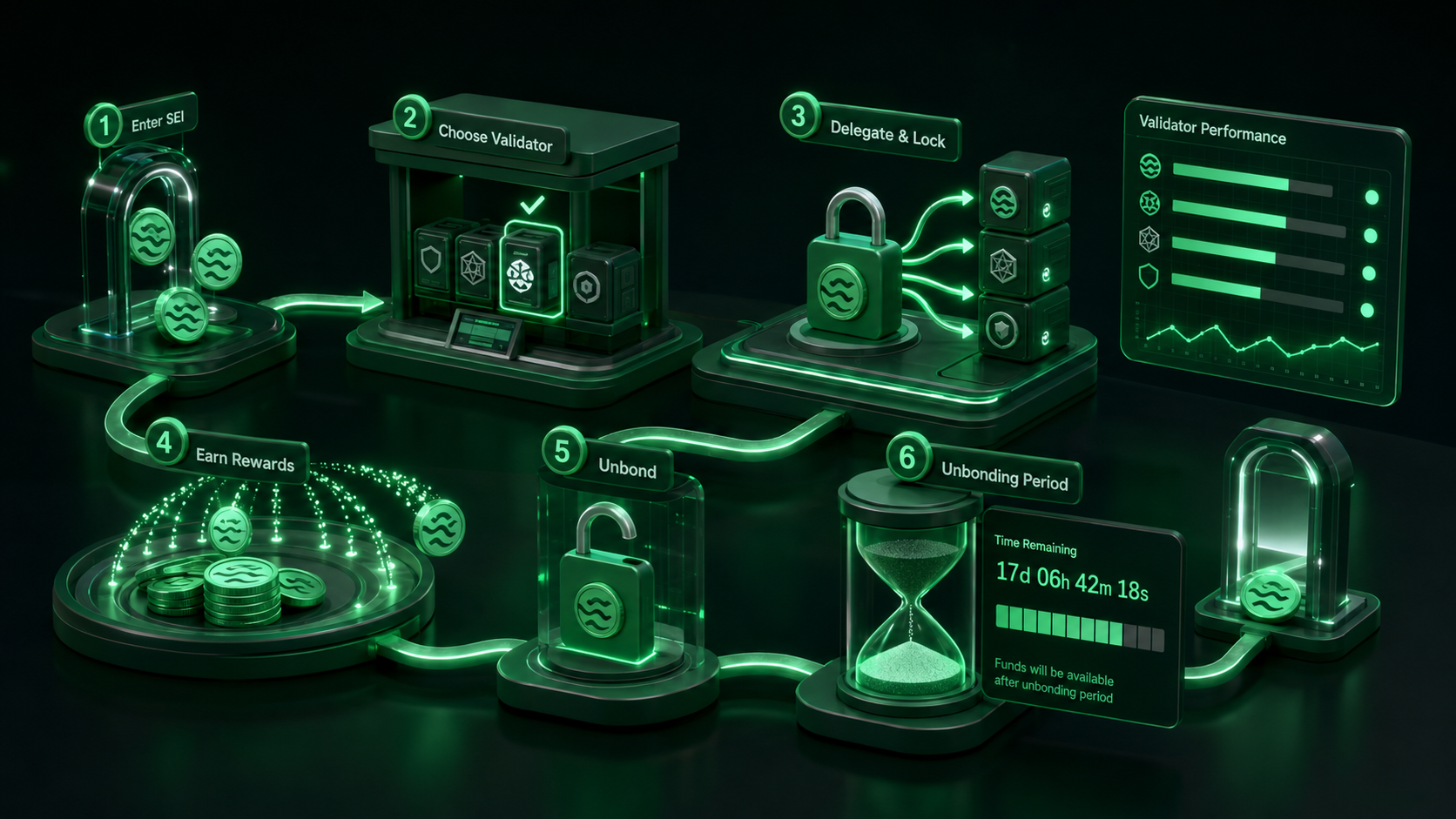
Staking SEI lets you earn passive rewards by delegating tokens to validators who secure the network. There's no minimum stake requirement, rewards begin accruing immediately after delegation, and the process takes under five minutes through any supported wallet. The tradeoff is a 21-day unbonding period when you want to withdraw, so staking works best for tokens you plan to hold for weeks or months rather than actively trade.
How Sei Staking Works
Sei uses Delegated Proof of Stake (DPoS), where token holders delegate their SEI to validators rather than running validator nodes themselves. Validators process transactions, propose blocks, and maintain the network. In return, they earn rewards from transaction fees and network inflation, then distribute a portion to their delegators based on each delegator's share of the total stake.
The validator keeps a commission (typically 5% to 10%) and passes the rest to delegators proportionally. If you delegate 10,000 SEI to a validator holding 1 million total delegated SEI, you receive 1% of that validator's distributed rewards.
Staking rewards on Sei fluctuate based on network activity, total staked supply, and validator commission rates. Current APR estimates range from approximately 3% to 6%, though this varies by validator and network conditions. Always check current rates on app.sei.io/stake before committing tokens.
Staking Through Compass Wallet
Compass is the most integrated option for Sei staking, built specifically for the network by the Leap Wallet team. For a broader look at wallet options, see the best SEI wallets guide.
- Install the Compass browser extension from the Chrome Web Store
- Create a new wallet or import an existing one using your seed phrase
- Transfer SEI tokens to your Compass wallet address
- Click the staking tab within the wallet interface
- Browse the validator list, comparing commission rates, uptime, and total stake
- Select a validator, enter the amount of SEI to delegate, and confirm the transaction
Leave a small amount of SEI unstaked (at least 0.5 SEI) to cover future transaction fees for claiming rewards, redelegating, or undelegating.
Staking Through Keplr
Keplr is the standard Cosmos ecosystem wallet and supports Sei staking alongside dozens of other chains. If you already hold ATOM or other Cosmos assets, Keplr lets you manage everything from one interface.
The staking process mirrors Compass: navigate to the Sei network within Keplr, select a validator from the dashboard at app.sei.io, enter your delegation amount, and approve the transaction. Keplr's mobile app (iOS and Android) also supports staking, making it accessible for users who prefer managing positions from their phone.
Choosing a Validator
Validator selection directly affects your rewards and risk profile. Three factors matter most:
Commission rate determines what percentage the validator keeps. Lower isn't always better. A validator charging 0% commission may be unsustainable and could raise rates or shut down. Validators in the 5% to 10% range typically offer a good balance between competitive returns and operational sustainability.
Uptime measures how reliably the validator participates in consensus. Validators with less than 95% uptime may get slashed (penalized), which reduces your delegated stake. Check uptime records before delegating.
Total delegated stake affects both rewards and decentralization. Very large validators offer stability but concentrating too much stake with a single validator weakens network decentralization. Delegating to mid-sized validators with strong uptime records supports network health while often providing slightly better reward rates due to lower competition per delegator slot.
Redelegation and Unbonding
Two mechanics affect how flexibly you can manage staked SEI:
Redelegation lets you move staked tokens from one validator to another instantly, with no unbonding period. This is useful if your current validator raises commission rates, drops in uptime, or if you find a better option. The catch: after redelegating, your tokens cannot be redelegated again for 21 days. Plan validator switches carefully.
Unbonding is the process of withdrawing staked tokens back to your wallet. Once you initiate unbonding, your SEI stops earning rewards immediately and enters a 21-day cooldown. After the cooldown completes, tokens return to your available balance. During those 21 days, your tokens are illiquid: you can't trade, transfer, or restake them.
This is the primary cost of staking. If SEI's price drops sharply during your unbonding period, you can't exit the position until the cooldown expires. Factor this lockup risk into your staking allocation.
Tax and Reward Tracking
Staking rewards on Sei are generated continuously and must be manually claimed through your wallet. Each claim is a taxable event in most jurisdictions, reported as income at the fair market value of SEI at the time of claiming.
Keep records of every claim transaction: the date, the amount of SEI received, and the price at the time. Crypto tax software that supports Cosmos chains can automate this, but manual tracking works for smaller portfolios.
The rewards themselves aren't automatically restaked (compounded). To compound your staking returns, you need to claim accumulated rewards and delegate them again manually. Some validators and third-party services offer auto-compounding, but always verify the security of any service that requires wallet permissions.
Staking as Part of a Broader SEI Strategy
Staking pairs naturally with a long-term hold thesis. If you're bullish on Sei's roadmap, including the Giga upgrade and ecosystem growth, staking generates yield while you wait for the thesis to play out. The APR adds incremental returns on top of any price appreciation.
For active traders, staking the portion of your SEI that you don't plan to trade in the near term is a practical way to put idle tokens to work. Keep a liquid allocation for trading opportunities and stake the rest.
Trade SEI on LeveX through spot markets or take leveraged positions with SEI perpetual futures. Find more token guides in the Crypto in a Minute series.