
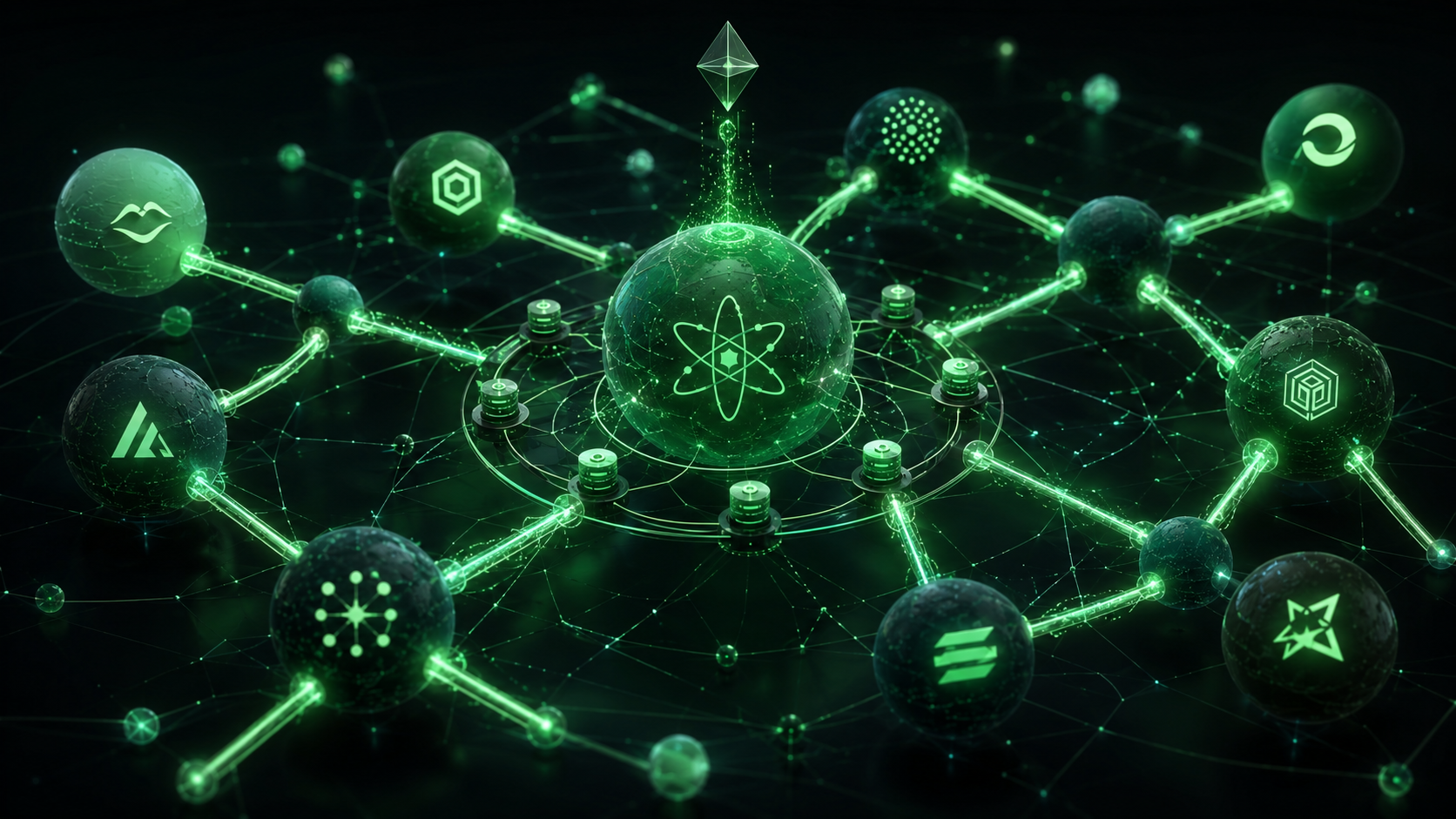
Over 250 sovereign blockchains exchange tokens and data through a single interoperability protocol, and ATOM sits at the center of that network. The Cosmos project launched in 2019 with an ambitious premise: instead of forcing every application onto one congested chain, let developers build purpose-specific blockchains that communicate freely with each other. That vision, often called the "Internet of Blockchains," has shaped how projects like dYdX, Osmosis, and Celestia architect their infrastructure today.
What Is Cosmos?
Cosmos is a decentralized network of independent, parallel blockchains (called "zones") connected through a central coordination layer known as the Cosmos Hub. Each zone runs its own consensus, sets its own rules, and processes its own transactions. The Hub acts as a router, relaying messages between zones using a standardized communication layer called IBC (Inter-Blockchain Communication).
The project was co-founded by Jae Kwon and Ethan Buchman, who recognized early that a single blockchain could never serve every use case efficiently. Their solution was modular by design: give developers the building blocks to launch a custom chain, then connect everything through a shared protocol.
This approach is sometimes called the "app-chain thesis." Rather than deploying smart contracts on a general-purpose chain like Ethereum, developers using Cosmos build entire blockchains optimized for a single application. The result is full sovereignty over governance, fee structures, and validator sets, with none of the congestion problems that come from competing for block space on a shared network.
How the Cosmos Network Works
Three core technologies power the Cosmos ecosystem:
CometBFT (formerly Tendermint) handles consensus and networking. It's a Byzantine Fault Tolerant engine that finalizes blocks in seconds rather than minutes. Validators stake ATOM to participate, and the protocol tolerates up to one-third malicious nodes before consensus breaks down. Block finality is instant once confirmed, meaning transactions don't require multiple confirmations the way proof-of-work chains do.
The Cosmos SDK is the open-source framework developers use to build application-specific blockchains. It provides pre-built modules for staking, governance, token transfers, and more, so teams can focus on their application logic rather than building infrastructure from scratch. dYdX migrated its entire perpetual futures exchange from Ethereum's Layer 2 infrastructure to a dedicated Cosmos SDK chain in order to gain full control over order book processing and transaction throughput.
IBC (Inter-Blockchain Communication) is the protocol that connects it all. IBC allows any two chains with compatible light clients to exchange tokens and data without relying on centralized bridges. The protocol authenticates packet transfers cryptographically, which avoids the security risks that have plagued third-party bridge solutions. As of early 2026, IBC handles cross-chain transfers across hundreds of connected zones.
ATOM Tokenomics and Staking
ATOM serves three functions within the Cosmos Hub: staking, governance, and transaction fees. With roughly 487 million tokens in circulation and a market cap near $1 billion, it ranks among the top 60 cryptocurrencies by capitalization.
| Metric | Value |
|---|---|
| Circulating Supply | ~487 million ATOM |
| Staking Ratio | 61.4% |
| Annual Staking Yield | ~10–15% |
| Inflation Rate | 7–20% (dynamic) |
| All-Time High | $44.80 (September 2021) |
The inflation model adjusts dynamically based on the percentage of ATOM staked. When staking participation drops below the target threshold, inflation increases to incentivize more staking. When participation exceeds the target, inflation decreases. This mechanism keeps the network secure by ensuring a substantial portion of the supply is always locked with validators.
A significant governance discussion is underway as of 2026 to overhaul this model entirely. The proposed shift would move ATOM away from inflation-based rewards toward a revenue-based system, where validator compensation comes primarily from fees generated by Interchain Security and IBC relaying rather than new token issuance.
The Cosmos Ecosystem
The app-chain thesis has attracted some of the largest projects in crypto. Here are several notable chains built on Cosmos SDK:
- Osmosis — The ecosystem's flagship decentralized exchange, offering customizable liquidity pools and cross-chain swaps via IBC. Osmosis processes millions in daily volume and serves as the primary trading venue for Cosmos-native tokens.
- Celestia — A modular data availability layer that launched as a sovereign blockchain using Cosmos SDK. Celestia provides data storage that rollups and other chains subscribe to, offloading one of the most resource-intensive aspects of blockchain operation.
- dYdX — The leading decentralized perpetual futures platform, which migrated its entire stack to a dedicated Cosmos chain. The move gave dYdX control over block times, order matching, and fee structures that weren't possible on Ethereum L2s.
- Injective — A DeFi-focused chain built for sophisticated trading instruments, including derivatives, prediction markets, and cross-chain swaps.
- Cronos — The EVM-compatible chain powering Crypto.com's DeFi ecosystem, built on Cosmos SDK to leverage IBC connectivity alongside Ethereum tooling.
Beyond these, the ecosystem includes infrastructure projects like Akash (decentralized cloud computing), Stride (liquid staking), and Kujira (DeFi primitives). The Cosmos SDK has become one of the most widely adopted blockchain development frameworks in the industry.
Interchain Security and the 2026 Roadmap
Interchain Security (ICS) represents the Cosmos Hub's most significant economic upgrade. The feature allows new chains, called "consumer chains," to lease security directly from the Hub's validator set rather than bootstrapping their own. Validators who already stake ATOM automatically validate consumer chains, and the Hub earns fees in return.
This matters because it creates direct revenue for the Hub and ATOM stakers. Before ICS, the Cosmos Hub's economic role was limited to processing transactions and relaying IBC packets. Consumer chains give it a monetization pathway that scales with ecosystem growth.
The Cosmos Labs 2026 roadmap outlines several additional priorities: a native EVM framework (allowing Cosmos chains to run Ethereum-compatible smart contracts), BLS signature aggregation for improved validator efficiency, and BlockSTM technology for parallel transaction execution. The overarching goal is making the Cosmos SDK easier to upgrade and IBC simpler to implement across non-Cosmos chains.
Frequently Asked Questions
How does Cosmos differ from other Layer 1 blockchains? Most Layer 1s like Solana or Ethereum compete to host applications on a single chain. Cosmos takes the opposite approach: every application can launch its own chain and connect through IBC. This means no shared block space, no congestion from unrelated applications, and full sovereignty over each chain's governance and economics.
What is the difference between Cosmos and Polkadot? Both projects focus on interoperability, but their architectures differ. Polkadot uses a relay chain model where parachains share security through a central chain. Cosmos zones are fully sovereign and opt into shared security only if they choose Interchain Security. Cosmos prioritizes independence, while Polkadot prioritizes unified security.
Is ATOM inflationary? Yes, currently. ATOM's inflation rate ranges from 7% to 20% depending on staking participation. However, a governance proposal to shift toward a fee-based revenue model is actively being discussed, which could fundamentally change ATOM's supply dynamics if approved.
What wallets support ATOM? Keplr is the most widely used wallet for Cosmos ecosystem tokens. It supports staking, governance voting, and IBC transfers natively. Ledger hardware wallets also support ATOM when paired with the Keplr interface, and Cosmostation offers a mobile alternative.
ATOM's Role in the Multichain Future
Cosmos has quietly assembled one of the most productive developer ecosystems in crypto. While other platforms compete on TVL rankings and transaction throughput, the Cosmos SDK has become the default framework for teams that want full sovereignty over their chain's design. The migration of dYdX alone validated the app-chain thesis at scale, and ICS gives the Hub a sustainable revenue model tied directly to ecosystem adoption.
The 2026 roadmap signals that the project's ambitions are expanding. EVM compatibility opens Cosmos infrastructure to Ethereum developers, BLS signatures improve validator economics, and the tokenomics overhaul addresses the longest-standing criticism of ATOM's value capture. Whether these upgrades translate into renewed market interest depends on execution, but the technical foundation is already powering some of the most actively used protocols in DeFi.
Trade ATOM on LeveX through spot or futures markets, with fees starting at 0.1% and access to tools like multi-trade mode for managing multiple positions simultaneously. For more token guides and project breakdowns, explore the Crypto in a Minute library.