
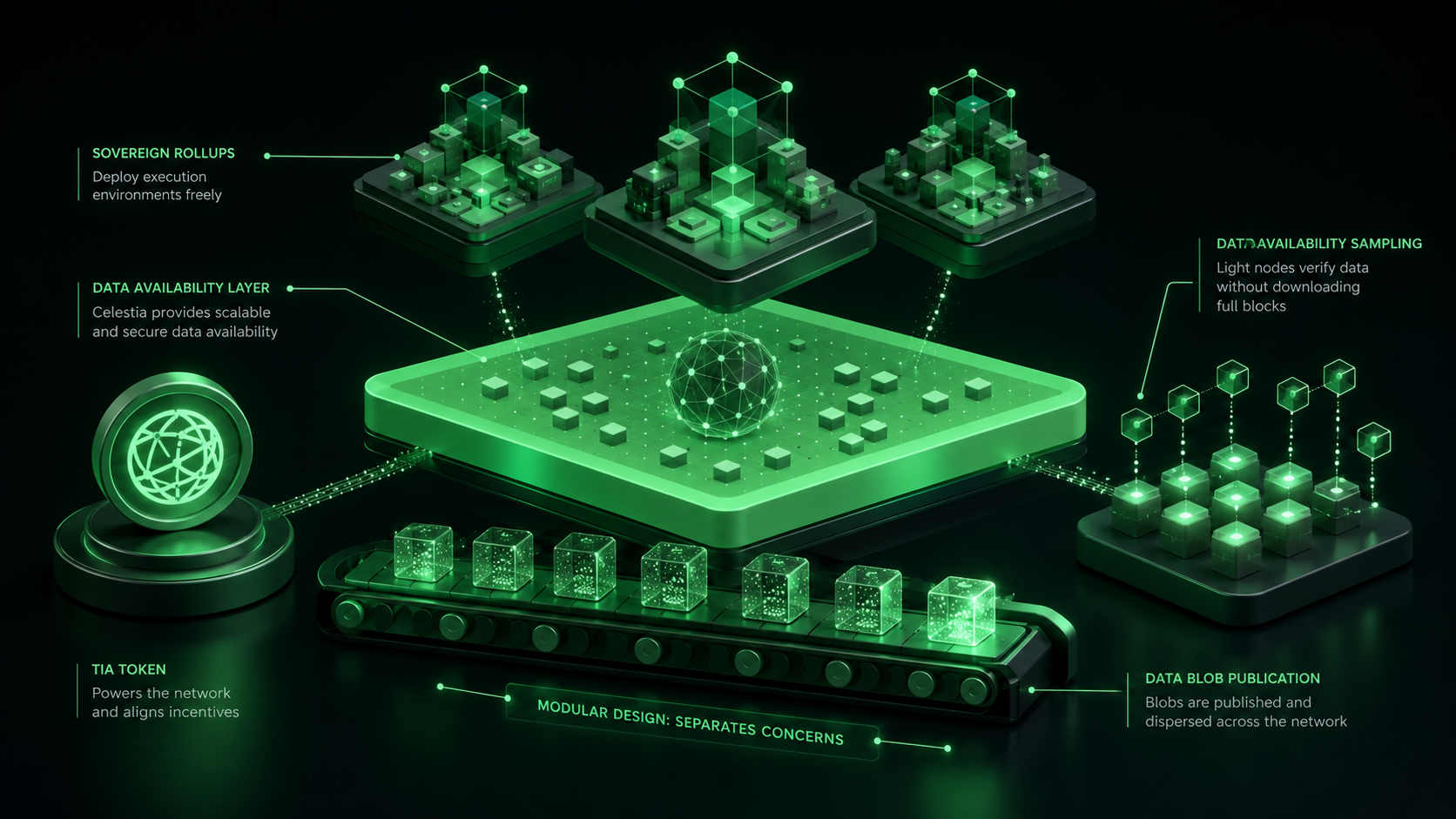
Every blockchain has the same fundamental problem: as more people use it, the system slows down. Celestia tackles this by doing something counterintuitive, building a blockchain that deliberately does less. Instead of handling every function from transaction execution to consensus to data storage, Celestia focuses exclusively on data availability and ordering, letting other chains handle the rest.
This modular approach has attracted $155 million in funding from Bain Capital Crypto, Polychain Capital, and Coinbase Ventures, and positioned TIA as a core infrastructure token powering the next generation of scalable blockchains.
What is Celestia?
Celestia is a modular blockchain that serves as a data availability (DA) layer for rollups, Layer 2 networks, and sovereign chains. Rather than competing with Ethereum or Solana as a general-purpose platform, Celestia provides a single specialized service: ensuring that transaction data is published and accessible for anyone to verify.
The project originated from Mustafa Al-Bassam's 2019 whitepaper called LazyLedger, which proposed a blockchain that "abstains from computation" and functions purely as a data availability layer. Al-Bassam, who holds a PhD in Computer Science from University College London and previously co-founded Chainspace (acquired by Meta in 2019), assembled a team including CTO Ismail Khoffi from the Cosmos ecosystem and John Adler, an expert in optimistic rollup technology.
Originally called LazyLedger, the project rebranded to Celestia in June 2021 and launched its mainnet on October 31, 2023. TIA tokens debuted around $2.30, surged to an all-time high of approximately $21 by February 2024, and have since corrected sharply to trade around $0.35-$0.55 as of early 2026.
The Monolithic vs. Modular Problem
Traditional blockchains like Bitcoin and Ethereum are "monolithic," meaning a single network handles four core functions simultaneously:
| Function | What It Does |
|---|---|
| Execution | Processing transactions and running smart contracts |
| Settlement | Finalizing transaction validity and resolving disputes |
| Consensus | Agreeing on the order of transactions |
| Data Availability | Ensuring all transaction data is published and accessible |
Handling everything on one layer creates bottlenecks. When Ethereum gets congested, gas fees spike because execution, consensus, and data availability all compete for the same limited resources. Celestia's solution is to separate these layers entirely: it handles consensus and data availability, while execution and settlement happen on independent chains built on top.
How Celestia's Technology Works
Two innovations make Celestia's architecture possible, as detailed in the project's official documentation.
Data Availability Sampling (DAS) allows light nodes to verify that all transaction data has been published without downloading entire blocks. Instead of processing every byte, nodes randomly sample small portions of a block. Using a technique called erasure coding, the full block can be reconstructed from just 50% of the data. This means a malicious block producer would need to withhold at least half the block to hide anything, making attacks impractical.
The more light nodes that participate in sampling, the larger blocks can safely become, creating a network that scales with participation rather than hardware requirements.
Namespaced Merkle Trees (NMTs) allow rollups and chains connected to Celestia to download only their own relevant data, rather than processing everything posted by other applications. Each application's data is tagged with a unique namespace, so a gaming rollup only fetches gaming data while a DeFi protocol like a liquid staking platform pulls its own transactions independently.
Sovereign Rollups and the Developer Experience
Celestia enables a new type of blockchain deployment called sovereign rollups. These are independent chains that use Celestia for data availability and consensus while maintaining full control over their own execution rules, governance, and upgrade processes.
For developers, this dramatically simplifies launching a blockchain. Instead of bootstrapping a validator set, securing funding for network security, and building consensus infrastructure from scratch, teams can deploy a rollup on Celestia and immediately inherit its security guarantees. The process is comparable to deploying a smart contract on Ethereum, but with the flexibility of an entirely custom chain.
Notable projects already leveraging Celestia's DA layer include Aevo (options trading), Orderly Network (DeFi infrastructure), Manta Network, and Eclipse. According to co-founder Al-Bassam, over 30 rollups have deployed on the network, and Celestia commands roughly 50% of the alternative data availability market.
Understanding TIA Tokenomics
TIA launched with a genesis supply of 1 billion tokens. The network uses an inflationary model starting at 8% annually, decreasing each year until stabilizing at 1.5%.
Token Allocation:
- Public (20%): Genesis Drop airdrop and community incentives
- R&D and Ecosystem (26.79%): Foundation and developer grants
- Early Backers, Seed (15.9%): Seed round investors with vesting
- Early Backers, Series A&B (19.7%): Later-stage investors with vesting
- Initial Core Contributors (17.6%): Team members with vesting schedules
Early team and investor tokens unlocked 33% after the first year, with the remainder vesting over two to four years. A major unlock event in October 2024, releasing approximately 175.7 million TIA (roughly 85% of then-circulating supply), coincided with significant price declines, a dynamic that drew community scrutiny.
TIA serves three primary functions: paying for data blob space when rollups publish to Celestia, staking to secure the network through proof-of-stake consensus, and governance participation over protocol upgrades and parameter changes.
Celestia's Roadmap and Technical Upgrades
The network is pursuing aggressive scaling targets through several major upgrades:
Matcha Upgrade increases block size from 8MB to 128MB while cutting inflation from 5% to 2.5%. This represents a 16x increase in data throughput capacity.
1GB Block Target aims to eventually support data throughput sufficient for a million rollups and a billion light nodes, a goal that would position Celestia as critical infrastructure for the broader blockchain ecosystem.
Lazy Bridging (Mid-2026) will enable seamless cross-rollup asset transfers, reducing friction for users moving between different chains built on Celestia.
Fibre Blockspace introduces zero-knowledge data processing capabilities targeting high-throughput applications that need millisecond-level performance.
Advantages and Challenges
Strengths:
Celestia's specialization creates genuine technical advantages. By handling only consensus and DA, the network avoids the tradeoffs forced on monolithic chains. Developers get customizable execution environments while inheriting enterprise-grade security. The DAS mechanism scales elegantly with participation, and costs for rollups using Celestia are dramatically lower than posting data directly to Ethereum.
The project's $100 million+ treasury provides over six years of operational runway, ensuring sustained development regardless of short-term token price fluctuations.
Challenges:
TIA has declined over 95% from its all-time high, fueling community criticism around tokenomics and insider selling allegations. While co-founder Al-Bassam has disputed these claims, the vesting schedule and unlock dynamics remain a concern for investors. The modular blockchain thesis is still proving itself, as investor Larry Sukernik has noted, Celestia may have launched before rollup demand matured enough to drive meaningful DA revenue. Competition from Ethereum's own data availability improvements (danksharding) and other DA solutions like EigenDA adds pressure to capture market share quickly.
Trading TIA on LeveX
LeveX provides access to TIA through both spot trading and perpetual futures contracts. Spot trading suits investors building long-term positions around modular blockchain infrastructure, while futures contracts with up to 100x leverage enable traders to capitalize on TIA's volatility in either direction.
With LeveX's competitive fee structure starting at 0.02% for futures makers and Multi-Trade Mode allowing up to 99 simultaneous positions on the same pair, traders can implement sophisticated strategies like scaling into positions across different price levels while managing risk independently.
Celestia's Role in the Modular Future
Whether the modular blockchain thesis becomes the dominant architecture or remains one approach among many, Celestia has established itself as the category leader in data availability infrastructure. The network processes over 2.7 TB of transaction data since launch, and its technology has influenced how even monolithic chains think about scaling through data availability separation.
The coming months will be critical as upgrades like Matcha and Lazy Bridging aim to translate technical innovation into real economic demand for TIA tokens. For builders deploying rollups and for traders watching infrastructure plays, Celestia remains one of the most closely watched projects in the modular blockchain space.
Trade TIA on LeveX through spot or futures markets, or explore our Crypto in a Minute guides to learn about other blockchain infrastructure projects shaping the next generation of decentralized technology.