
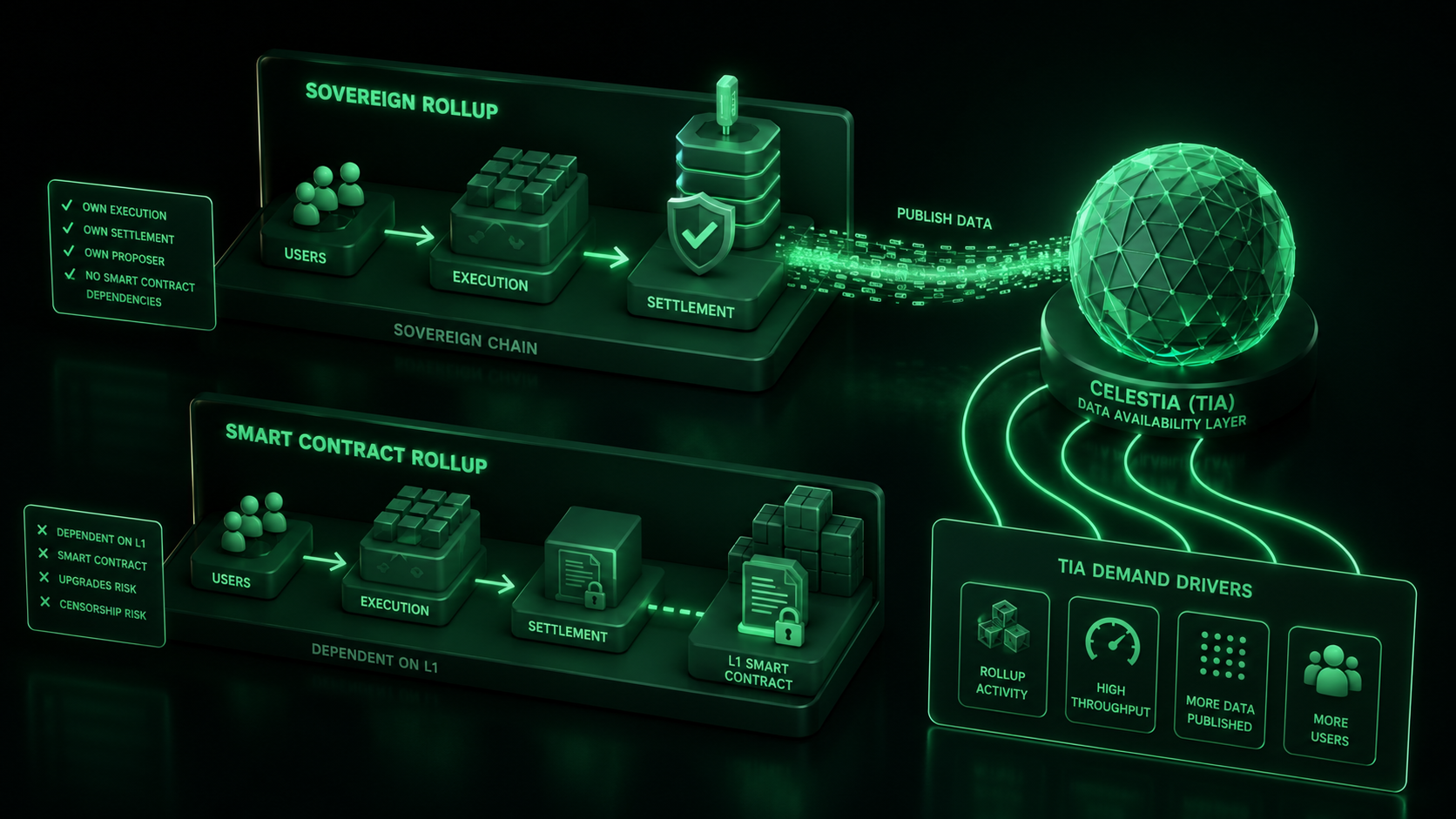
Sovereign rollups are the reason Celestia exists. While Ethereum rollups like Arbitrum and Optimism post their blocks to smart contracts that determine what's valid, sovereign rollups handle their own settlement entirely. Celestia provides ordering and data availability, and the rollup's own node network decides the rest. Over 56 rollups now use Celestia's DA layer, with 37 live on mainnet as of mid-2025, and the sovereign model is central to that growth.
What Sovereign Rollups Actually Do Differently
Traditional rollups on Ethereum work through a dependency chain. A rollup posts its transaction batches to a set of smart contracts on the settlement layer. Those contracts verify the rollup's blocks using fraud proofs or validity proofs, maintain a canonical chain state, and control a trust-minimized bridge for deposits and withdrawals. The settlement layer is the final authority on which transactions are valid and which chain fork is correct.
Sovereign rollups break that dependency. According to Celestia's technical overview, a sovereign rollup publishes its blocks as raw data directly onto the DA layer. Celestia's consensus mechanism orders those blocks and ensures the data is available for anyone to download, but it performs zero computation on the rollup's transactions. No smart contracts on Celestia interpret, validate, or settle anything.
Instead, the rollup operates its own peer-to-peer network of full nodes and light clients. These nodes download rollup blocks, verify transactions locally, and determine the canonical chain through their own fork-choice rules. The only thing they check against Celestia is a Merkle proof confirming that the block data was actually included and properly ordered on the DA layer.
The practical consequence: sovereign rollups behave like independent Layer 1 blockchains that happen to outsource their data availability to a shared, specialized network. They retain full control over execution logic, state transitions, and governance decisions.
The Upgrade Problem That Sovereignty Solves
Upgradability is where the distinction between sovereign and smart contract rollups becomes most concrete.
Smart contract rollups face a fundamental tension. Their canonical chain is defined by contracts on the settlement layer, so upgrading the rollup means upgrading those contracts. In practice, most Ethereum rollups use a multisig to control contract upgrades, which introduces a trust assumption: whoever controls the multisig can alter the rules. Even when governance mechanisms exist, the rollup community can't push changes that conflict with the settlement layer's social consensus. As Celestia's original sovereign rollup proposal explains, this makes rollups subordinate chains rather than independent networks.
Sovereign rollups upgrade through forks, exactly like a Layer 1. The development team publishes new software, and node operators choose whether to adopt it. If the community disagrees with a proposed change, dissenting nodes stay on the old version. No multisig, no settlement layer permission, no external governance constraints.
This forkability has direct implications for security response. When a smart contract rollup discovers a critical vulnerability, patching requires coordinating a contract upgrade through whatever governance mechanism controls the multisig. A sovereign rollup can push an emergency fork through its node network immediately, the same way Bitcoin or any independent blockchain responds to threats.
How Sovereign Rollups Inherit Security
A common misconception is that sovereign rollups sacrifice security by removing settlement layer verification. The security model works differently, not necessarily worse.
Data availability guarantees come directly from Celestia. The rollup's transaction data gets ordered and finalized by Celestia's validator set, and data availability sampling lets light nodes verify that the data is genuinely accessible. This provides two critical properties: liveness (the chain keeps making progress) and re-org resistance (finalized transactions stay finalized as long as Celestia itself doesn't reorganize).
Transaction validity is enforced by the rollup's own proof system. ZK sovereign rollups generate validity proofs distributed through the peer-to-peer network for nodes to verify locally. Optimistic sovereign rollups distribute fraud proofs through the same P2P layer. In both cases, invalid transactions get rejected by honest nodes regardless of what anyone else claims.
| Security Property | Smart Contract Rollup | Sovereign Rollup |
|---|---|---|
| Data availability | Settlement layer | DA layer (Celestia) |
| Transaction validity | Settlement layer contracts | Rollup node network |
| Re-org resistance | Settlement layer finality | DA layer finality |
| Censorship resistance | Settlement layer + forced inclusion | DA layer + direct submission |
| Upgrade authority | Multisig / settlement governance | Rollup social consensus (forks) |
The tradeoff centers on bridging. Smart contract rollups get trust-minimized bridges to their settlement layer because the settlement layer verifies the rollup's state. Sovereign rollups don't have this by default. Bridges between sovereign rollups and other chains require additional trust assumptions or governance mechanisms. For applications where cross-chain asset movement is critical, this matters. For application-specific chains that primarily operate within their own ecosystem, the tradeoff is minimal.
Building Sovereign Rollups: The Developer Toolkit
Several frameworks make launching sovereign rollups on Celestia practical rather than theoretical.
Rollkit provides an ABCI-compatible client that replaces Tendermint consensus for Cosmos SDK chains. Instead of running its own validator set, a Rollkit-based chain publishes blocks to Celestia and operates as a sovereign rollup. Developers familiar with the Cosmos SDK can repurpose existing tooling and modules while eliminating the cost of bootstrapping a consensus network. Celestia's recent pitch highlighted the economics: standalone L1s like Solana reportedly spent $4.4 billion on validator issuance in 2025, a cost sovereign rollups avoid entirely.
Sovereign SDK targets ZK sovereign rollups specifically, providing a framework for building chains with validity proofs that verify through the P2P layer rather than on-chain contracts. The Arbitrum Orbit framework also supports Celestia as a DA option alongside its native Arbitrum infrastructure.
Live examples of the model in production include Forma, the first sovereign rollup built on the Astria sequencing stack with Celestia DA, and Eclipse, which combines Solana's virtual machine with Ethereum settlement and Celestia data availability. The Chopin Framework takes a different approach entirely, converting standard web applications into sovereign rollups so developers can build blockchain applications using familiar web development tools.
Each implementation demonstrates a key advantage of the sovereign model: execution environment flexibility. Because Celestia doesn't interpret rollup transactions, developers can run EVM, SolanaVM, MoveVM, CosmWasm, or any custom runtime they want. The comparison between Celestia and competing DA solutions like EigenDA often comes down to how much design freedom the DA layer grants to rollup builders, and sovereignty is Celestia's strongest differentiator.
Why Sovereignty Matters for TIA
Every sovereign rollup publishing data to Celestia pays fees in TIA. As more rollups launch and transaction volumes grow, demand for blobspace creates direct buying pressure on the token. Developers can also designate TIA as the native gas token for their sovereign rollup, further expanding its utility beyond the base DA layer.
The validator economics reinforce this dynamic. TIA stakers secure the Celestia network that all sovereign rollups depend on, and staking rewards currently yield approximately 10-11% APR. For a deeper look at how these demand drivers factor into TIA's price trajectory, the relationship between rollup adoption metrics and token valuation provides the fundamental framework.
Celestia's Lotus upgrade (v4 mainnet) integrates Hyperlane for seamless TIA interoperability between Celestia rollups and external ecosystems like Ethereum. Combined with Ethereum's own danksharding roadmap expanding blob capacity, the competitive dynamics between modular DA and native Ethereum scaling will shape how quickly the sovereign model scales.
Sovereignty as Celestia's Core Thesis
Sovereign rollups represent a philosophical bet: that blockchains should be independent networks with full control over their own rules, governance, and upgrade paths, while sharing a common data availability layer for security and cost efficiency. The model eliminates the need to bootstrap expensive validator sets while preserving the self-determination that makes decentralized networks valuable in the first place.
For TIA holders, the sovereign rollup thesis ties directly to token demand. Every rollup publishing to Celestia's blobspace consumes TIA for fees, and the number of live rollups continues growing. Storing TIA in a wallet that supports staking and governance, like those covered in our Celestia wallet comparison, lets holders participate in securing the network these rollups depend on.
Traders looking to position around Celestia's modular infrastructure can access TIA spot markets for direct token ownership or TIA perpetual futures for leveraged exposure in either direction. Explore our Crypto in a Minute series for additional guides on data availability solutions and Layer 2 architecture.