
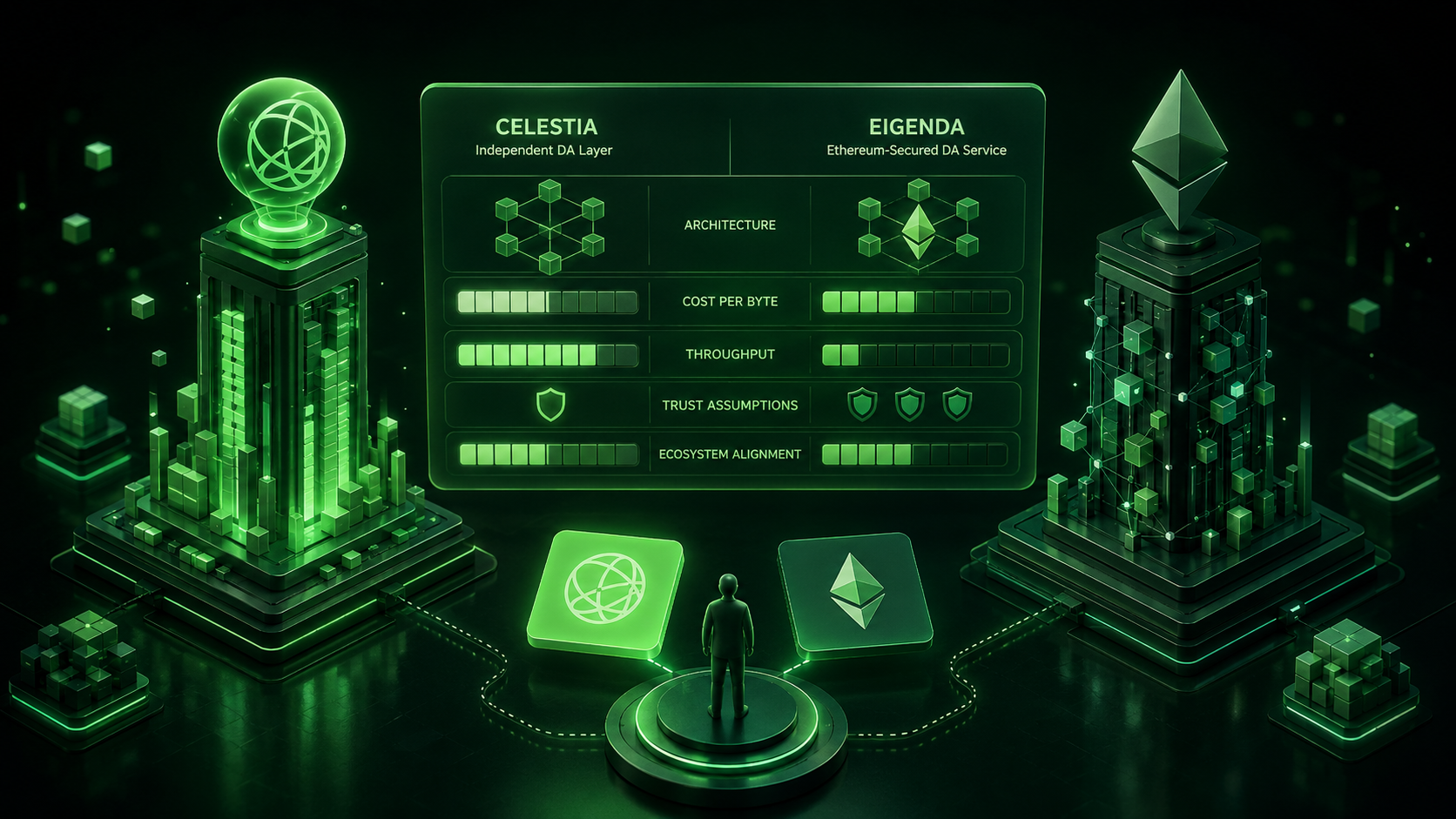
Two protocols dominate the conversation around blockchain data availability, and they approach the problem from fundamentally different directions. Celestia built an entirely independent blockchain dedicated to storing and verifying rollup data. EigenDA piggybacked on Ethereum's existing validator set through restaking, creating a data availability committee secured by billions in staked ETH. For traders evaluating these ecosystems and for developers choosing where to publish rollup data, the technical and economic tradeoffs between these two architectures carry real consequences.
How Each System Works
Celestia: The Standalone DA Blockchain
Celestia operates as a purpose-built Layer 1 that does exactly one thing: make data available. It deliberately excludes smart contracts, DeFi applications, and token transfers from its core function. Rollups post compressed transaction data (called "blobs") to Celestia, and the network ensures that data remains accessible for verification. Understanding how Layer 2 solutions handle this data is central to evaluating both protocols.
The key innovation is Data Availability Sampling (DAS). Instead of requiring every node to download entire blocks, light nodes randomly sample small portions and use erasure coding to verify completeness. This means even low-powered devices can participate in securing the network, which keeps Celestia decentralized as block sizes increase.
Celestia uses Namespaced Merkle Trees to organize blob data by rollup, so each project only needs to download its own data. The consensus mechanism is a fork of CometBFT (formerly Tendermint), and blocks finalize in roughly 6 seconds, though full DA finality takes approximately 10 minutes due to the fraud proof challenge period.
EigenDA: Ethereum's Restaking-Powered DA
EigenDA takes a different architectural approach entirely. Rather than launching a new blockchain, it operates as an Actively Validated Service (AVS) within the EigenLayer restaking protocol. Ethereum validators "restake" their ETH to simultaneously secure EigenDA, which means the service inherits Ethereum's economic security without needing its own validator set.
The verification model also differs. Where Celestia relies on fraud proofs (assume valid unless challenged), EigenDA uses KZG polynomial commitments, a form of zero-knowledge proof that provides immediate cryptographic verification. This eliminates the challenge period Celestia requires, offering faster finality at the cost of higher upfront computational requirements.
Crucially, EigenDA functions as a Data Availability Committee (DAC) rather than a publicly verifiable blockchain. Operators form a trusted set who commit to making data available, but end users cannot independently verify data availability through sampling the way they can on Celestia. This distinction matters for projects that prioritize trustless verification over raw performance.
Performance and Cost Head-to-Head
| Metric | Celestia | EigenDA |
|---|---|---|
| Architecture | Independent PoS blockchain | DAC on Ethereum via restaking |
| Current Throughput | ~1.33 MB/s (8MB blocks) | ~100 MB/s (V2) |
| Block Time | 6 seconds | Tied to Ethereum (~12s) |
| DA Finality | ~10 minutes (fraud proof window) | Near-instant (KZG proofs) |
| Verification | Public DAS by light nodes | Committee-based attestation |
| Cost per MB | ~$0.07 | Varies by reservation tier |
| Security Source | TIA staking (~$300M market cap) | Restaked ETH (~$8B+) |
The throughput gap looks dramatic on paper, with EigenDA claiming roughly 75x Celestia's current capacity. However, Celestia's recently announced Fibre Blockspace protocol targeting 1 Tb/s would dramatically reshape this comparison if it reaches mainnet production. For now, EigenDA holds a clear raw speed advantage.
On cost, Celestia has demonstrated significant savings. Eclipse, a major rollup using Celestia for DA, reported posting costs of approximately $0.07 per megabyte versus $3.83 per megabyte on Ethereum blobs during March 2025, making Celestia over 55 times cheaper. EigenDA's pricing operates through reserved bandwidth tiers rather than per-blob fees, making direct cost comparisons dependent on usage patterns.
The Trust Tradeoff
This is where the comparison gets genuinely interesting for anyone thinking about blockchain security at a deeper level.
Celestia's DAS model allows anyone running a light node to independently verify that data has been made available. If a block producer withholds data, sampling will fail, and honest nodes can detect the problem. This probabilistic approach scales well because verification costs don't increase proportionally with block size, but it requires sufficient light node participation to maintain security guarantees.
EigenDA's security derives from Ethereum's massive economic stake. With over $8 billion in restaked assets as of early 2025, the cost of attacking EigenDA is prohibitively expensive. However, the committee-based structure means users must trust that operators are genuinely storing data rather than just signing attestations. EigenLayer introduced slashing in April 2025 to penalize misbehavior, but the restaking model itself is relatively untested compared to traditional staking.
The practical implication: Celestia offers stronger trustless guarantees at the verification layer, while EigenDA provides stronger economic security through Ethereum alignment. Neither approach is objectively superior; the right choice depends on what a project values most.
Ecosystem Adoption
Both protocols have secured meaningful adoption, though their user bases reflect their different design philosophies.
Celestia currently supports 30+ active rollups consuming roughly half its blobspace capacity. Notable projects include Eclipse, Bullet, and several Cosmos SDK-based chains that leverage Celestia's sovereignty features. The Matcha upgrade in November 2025 expanded block capacity to 128MB and opened Celestia as a cross-chain routing layer through Hyperlane integration, broadening its appeal beyond pure DA.
EigenDA has attracted Ethereum-aligned rollups, including projects built on OP Stack and zkSync frameworks. Its integration with Ethereum's existing tooling, particularly MetaMask, Remix, and standard Ethereum development environments, creates lower friction for teams already embedded in the Ethereum ecosystem. Celo and Mantle are among the notable projects that have adopted EigenDA.
The competitive dynamic extends beyond these two. Avail (formerly from Polygon) targets multi-chain applications, and Ethereum's own blob system continues expanding through upgrades like Pectra. The DA market is fragmenting rather than consolidating, which could benefit rollups through competitive pricing but creates uncertainty for token holders of any single protocol.
What This Means for TIA Traders
For traders evaluating TIA's price trajectory, the competitive landscape with EigenDA reveals both risks and opportunities.
The bear case centers on EigenDA's throughput advantage and Ethereum alignment potentially capturing rollup market share, especially as Ethereum's danksharding roadmap progresses. If rollups increasingly choose to stay within Ethereum's security umbrella, demand for Celestia's blobspace, and by extension TIA, could plateau.
The bull case highlights Celestia's first-mover advantage, its stronger decentralization properties through DAS, and the transformative potential of Fibre Blockspace. If Celestia successfully delivers 1 Tb/s throughput on mainnet while maintaining its cost advantages, it could define an entirely new category of high-bandwidth applications that EigenDA's committee model can't serve as effectively. TIA's recent inflation reduction to 2.5% through the Matcha upgrade also improves its long-term tokenomics relative to earlier projections.
Which DA Layer Wins the Modular Future?
The honest answer is that both Celestia and EigenDA are likely to coexist rather than produce a single winner. Their architectures target subtly different markets: Celestia appeals to sovereign rollups and projects prioritizing verifiable data availability through sampling, while EigenDA serves Ethereum-native teams that value restaking economics and fast finality through KZG proofs. The real competition may come from Ethereum itself, as future danksharding upgrades could eventually reduce the cost advantage that external DA layers currently enjoy.
What matters most for traders is adoption velocity. Raw technical specs are table stakes at this point; what drives token value is actual blobspace demand and fee revenue. Celestia's 30+ active rollups and its aggressive throughput roadmap provide a strong foundation, but converting infrastructure capacity into sustained economic activity remains the defining challenge for TIA going forward.
Trade TIA on LeveX through spot markets or futures contracts with competitive fees starting at 0.02% maker. Explore our Crypto in a Minute series for deeper dives into blockchain infrastructure and modular architecture.