
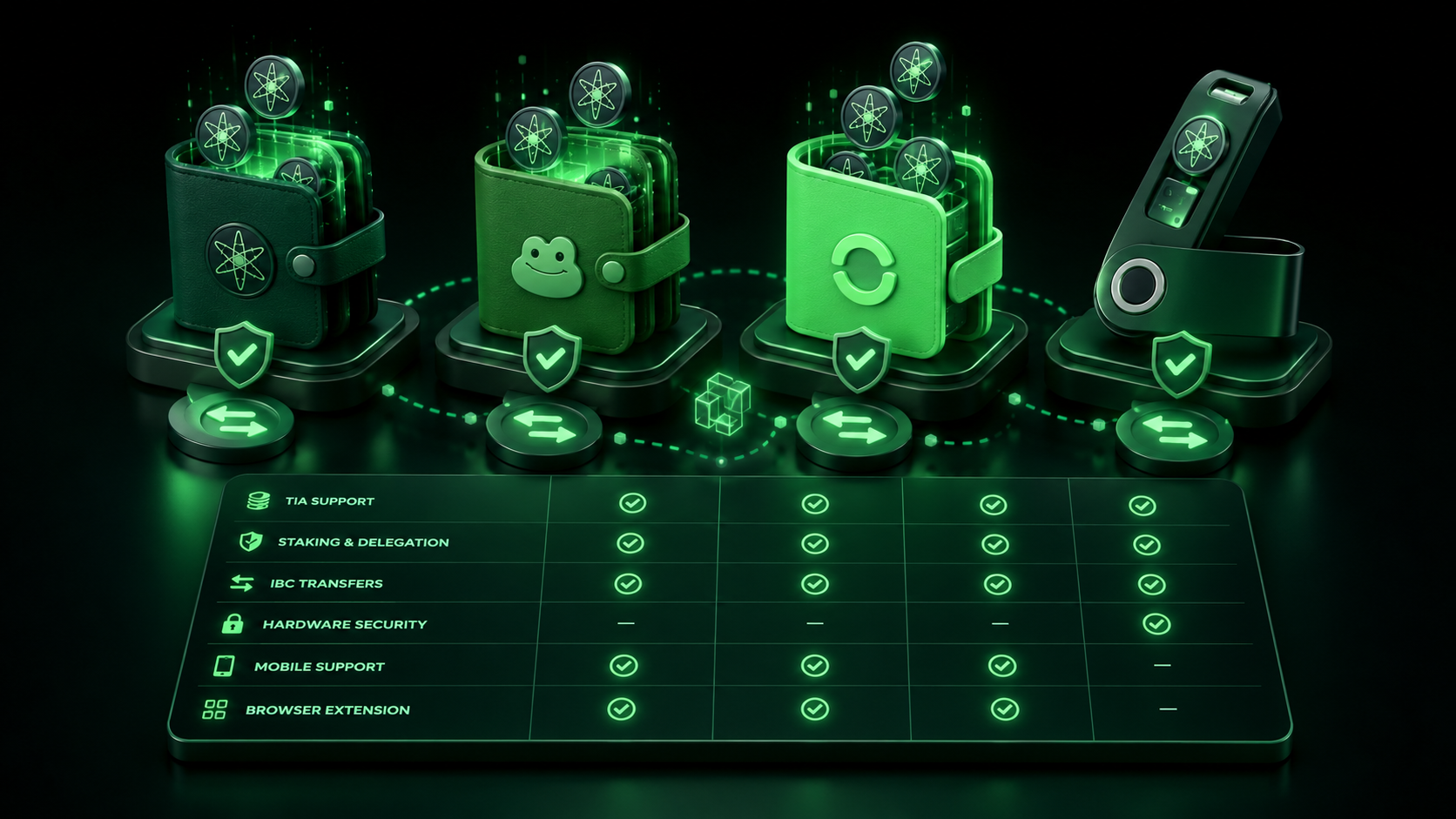
Celestia runs on the Cosmos SDK, which means standard Ethereum wallets like MetaMask can't hold TIA tokens. You need a wallet that speaks Cosmos, supports staking to validators, and handles IBC transfers across the interchain ecosystem. The good news: several strong options exist, each with different strengths depending on whether you prioritize convenience, security, or ecosystem access.
What Makes a Wallet Celestia-Compatible
TIA operates on a Cosmos-based chain with its own address format (the celestia1... prefix). Any wallet supporting Celestia needs to implement Cosmos SDK standards, including BIP-44 key derivation and the network's specific chain parameters. Beyond basic send and receive functionality, the most useful wallets offer direct access to features that make TIA valuable in the first place.
Staking ranks as the most important wallet capability for TIA holders. Celestia uses Proof-of-Stake consensus with a validator set capped at 100, and delegators earn approximately 10-11% APR by staking through their wallet of choice. According to Celestia's official documentation, staking requires selecting a validator, confirming the delegation transaction, and then managing a 21-day unbonding period when you want to withdraw.
Governance voting gives staked TIA holders influence over network parameters and community fund allocation. Wallets that integrate governance interfaces let you vote directly without visiting external tools. IBC transfers enable moving TIA across Cosmos-connected chains, which matters for accessing DeFi protocols on Osmosis or other interchain platforms.
Top TIA Wallets Compared
| Wallet | Type | Chains | TIA Staking | Governance | Ledger Support |
|---|---|---|---|---|---|
| Keplr | Browser extension + mobile | 186+ | Yes | Yes | Yes |
| Leap | Browser extension + mobile | 200+ | Yes | Yes | Yes |
| Cosmostation | Mobile + browser extension | 60+ | Yes | Yes | Yes |
| Ledger (via Keplr) | Hardware | Via Cosmos app | Yes | Yes | Native |
Keplr: The Cosmos Standard
Keplr dominates Celestia wallet usage, accounting for the vast majority of staked TIA according to on-chain delegation data. The wallet offers a dedicated staking dashboard where you can compare validators by commission rate, voting power, and uptime before delegating. Validator commissions on Celestia typically range between 5% and 20%, so this comparison tool saves meaningful money over time.
The browser extension integrates with Celestia dApps and governance portals, while the mobile app handles day-to-day transfers. Keplr also runs its own validator node on Celestia with a 5% commission rate, though you're free to delegate to any active validator through the interface.
Leap: The Multi-Chain Contender
Leap grew to 300,000+ users in its first year by supporting over 200 chains natively, including Celestia, the broader Cosmos ecosystem, and EVM-compatible networks. The wallet's "All Chains" portfolio view consolidates balances across every connected network into a single dashboard.
For advanced users, Leap offers something unique: the ability to run Celestia light nodes directly from the wallet, contributing to the network's data availability sampling process while using the same interface for staking and transfers. The built-in dApp browser provides direct access to Cosmos DeFi without switching between applications.
Cosmostation: Mobile-First Approach
Cosmostation focuses on the Cosmos ecosystem with a polished mobile experience available on iOS and Android. The wallet supports staking across 60+ Cosmos chains with a streamlined delegation flow that works well for users who primarily manage their portfolio from a phone.
A standout feature is batch reward claiming, letting you collect staking rewards from multiple Cosmos chains in a single step rather than visiting each network individually. Cosmostation also maintains its own validator infrastructure across several Cosmos chains, giving the team direct operational knowledge of the networks they support.
Ledger: Hardware Security Through Keplr
Ledger devices (Nano S Plus, Nano X, and Flex) support TIA through the Cosmos application installed via Ledger Live. The hardware wallet doesn't connect to Celestia directly. Instead, you pair your Ledger with Keplr's browser extension, which handles the interface while the Ledger signs transactions offline.
This combination delivers the strongest security model available for TIA. Private keys never touch an internet-connected device, and every staking delegation, governance vote, or transfer requires physical confirmation on the hardware wallet. The tradeoff is convenience: you need the physical device present for every transaction, making it better suited for long-term holders than active traders.
Choosing a Validator When Staking
Picking the right wallet solves only half the equation. Your validator choice directly impacts staking returns and network health. Celestia caps its active validator set at 100, and only those top 100 by delegated stake receive rewards.
Key factors to evaluate:
- Commission rate: Ranges from 5% to 20% on Celestia. Lower commission means more rewards flow to you, though extremely low rates sometimes indicate unsustainable validator operations.
- Voting power concentration: Delegating to validators with already-massive stake increases centralization risk. Spreading delegation across mid-sized validators strengthens the network.
- Uptime history: Validators with poor uptime risk slashing penalties that affect both their stake and yours.
Large validators like Polychain (20% commission, 47.7M TIA delegated) offer reliability but high fees. Smaller operators like P-OPS Team (5% commission) or Chorus One (8% commission) provide competitive rates with strong track records. Your wallet's validator comparison interface makes this analysis practical rather than theoretical.
For context on how TIA staking rewards factor into broader price dynamics, the staking ratio directly influences circulating supply and selling pressure, two key variables for traders monitoring TIA markets.
Security Practices for TIA Storage
Wallet security extends beyond choosing the right application. A few practices apply regardless of which wallet you use.
Seed phrase protection matters more than any other factor. Every Cosmos wallet generates a 12 or 24-word recovery phrase during setup that grants full access to your funds across all connected chains. Store it offline on paper or metal, never in a screenshot, cloud storage, or text file. Anyone who obtains this phrase controls your TIA.
Verify transaction details before signing. Keplr, Leap, and Cosmostation all display transaction parameters (recipient address, amount, fees) before confirmation. For staking transactions, confirm the validator address matches your intended delegation target. Phishing attacks in the Cosmos ecosystem frequently impersonate popular validators.
Consider the IBC bridge risk. Moving TIA across chains via IBC introduces smart contract and bridge risk. While IBC maintains an excellent security record compared to third-party bridges, keeping the majority of long-term holdings on Celestia's native chain reduces exposure to cross-chain vulnerabilities.
The broader question of how Celestia's data availability architecture compares to alternatives, and how Celestia compares to Ethereum's danksharding approach, provides context for why holding TIA involves exposure to a specific technical thesis about modular blockchain infrastructure.
Matching Your Wallet to Your Strategy
The right wallet depends on what you plan to do with your TIA. Long-term holders staking for yield and governance participation benefit from Ledger's hardware security paired with Keplr's interface. Active Cosmos ecosystem participants who move assets across chains and interact with dApps regularly will find Leap's multi-chain dashboard and light node integration more practical. Mobile-first users who want clean staking management across multiple Cosmos positions should look at Cosmostation.
Celestia's modular design has attracted significant developer attention, and TIA's utility as the gas token for rollups, staking asset for consensus, and governance token for protocol decisions gives it multiple demand drivers. Choosing a wallet that supports all three functions ensures you can participate fully in the ecosystem rather than treating TIA as a passive holding.
For traders looking to gain exposure to Celestia's data availability thesis, LeveX offers TIA spot trading for direct ownership and TIA perpetual futures for leveraged positions in either direction. Explore our Crypto in a Minute series for deeper coverage of modular blockchain infrastructure and Cosmos ecosystem projects.