
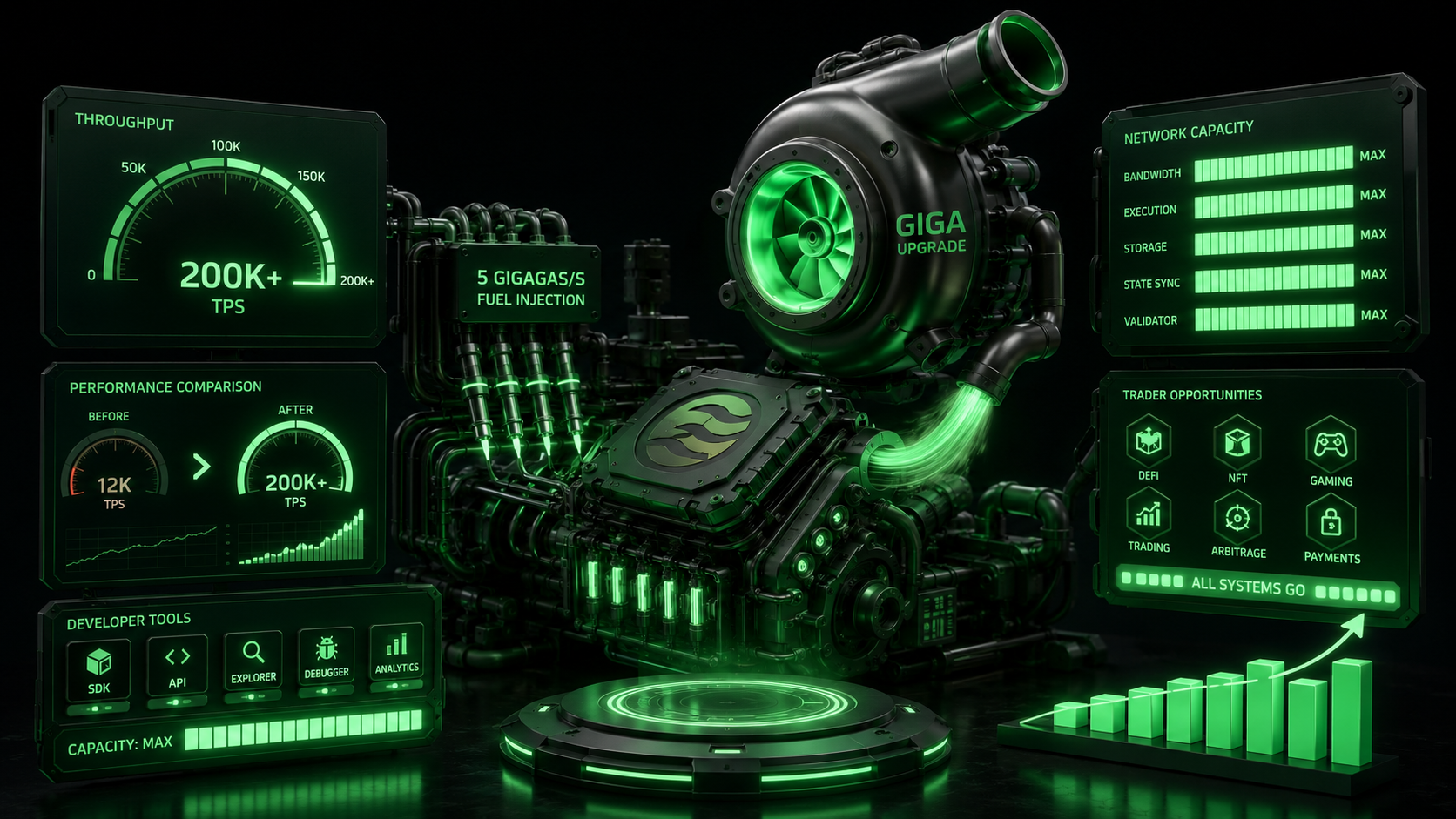
Sei already achieves 400ms finality and 12,500+ TPS on mainnet. The Giga upgrade aims to push those numbers into territory that would make Sei the highest-throughput EVM chain in production: 5 gigagas per second, over 200,000 TPS, and sub-400ms finality preserved. If delivered, Giga represents the most ambitious performance upgrade any EVM-compatible chain has attempted.
The upgrade introduces three architectural changes that work together to remove the remaining bottlenecks in Sei's execution pipeline.
Parallel Block Proposals
Current blockchain architecture relies on a single validator to propose each block. Even on fast chains, this creates a sequential chokepoint: one validator assembles the block, broadcasts it, and the rest validate it. Giga changes this by allowing multiple validators to construct block proposals simultaneously.
The practical effect is that block production no longer waits on a single node's processing speed. If one validator is slower than others, the network continues building blocks from other proposers without delay. This eliminates a class of latency spikes that occur on single-proposer chains during periods of high network load.
For DeFi applications, particularly decentralized exchanges and lending protocols where order matching speed matters, this reduces the variance in transaction inclusion times. Traders get more predictable execution, even during volatile market conditions when transaction volume spikes.
Multi-Proposer Consensus
Related to parallel proposals but architecturally distinct, multi-proposer consensus distributes the block proposal role across several nodes for each round. Traditional Tendermint-based chains rotate through a single proposer per round. Giga allows multiple nodes to submit proposals, with the consensus mechanism selecting and merging the optimal set.
This improves both throughput and resilience. If a proposer goes offline or lags, the network doesn't stall or slow down waiting for it. The other proposers fill the gap automatically. For network reliability, this is significant. Sei's comparison with Solana often centers on performance claims, and Giga's multi-proposer design addresses one of the failure modes that has historically caused outages on high-throughput chains.
Asynchronous Execution
This is the change that enables the largest throughput gains. On current Sei (and most blockchains), execution and consensus are coupled: the network reaches agreement on a block, then executes the transactions in that block, then moves to the next block. Asynchronous execution decouples these steps entirely.
With Giga, the network can reach consensus on block N+1 while still executing the transactions from block N. Execution runs in parallel with consensus rather than sequentially after it. This effectively doubles the utilization of network resources, since validators are never idle waiting for one phase to complete before starting the next.
The target throughput of 5 gigagas per second refers to gas processing capacity, which translates to over 200,000 transactions per second depending on transaction complexity. Simple token transfers consume less gas than complex smart contract interactions, so the actual TPS varies by workload. The gas metric is more accurate than TPS for measuring raw chain capacity.
What Giga Means for Developers
For developers already building on Sei, Giga is designed to be backward-compatible. Existing smart contracts deployed on Sei's EVM layer should continue functioning without modifications after the upgrade. The performance improvements happen at the infrastructure level, below the smart contract execution layer.
The practical benefits for developers include higher throughput headroom (applications won't hit chain capacity limits as quickly), more consistent block times under load, and the ability to build applications that would be impractical on slower chains. High-frequency trading protocols, real-time gaming with on-chain state, and streaming payment systems all become more viable when the underlying chain can sustain hundreds of thousands of operations per second.
Developers who want to choose the right wallet for testing on Sei's testnet can use any EVM-compatible wallet, since Giga doesn't change the interface layer.
What Giga Means for Traders
The upgrade has implications for SEI's price trajectory. Major protocol upgrades tend to generate attention, trading volume, and speculative positioning in the weeks surrounding launch. Ethereum's Merge, Solana's Firedancer announcement and its price impact, and similar milestones all created tradeable events regardless of their long-term impact.
Beyond the event itself, Giga's success (or failure) will influence Sei's competitive positioning. Delivering on 200,000+ TPS would validate the chain's technical thesis and likely attract new developers and liquidity. Delays, bugs, or underwhelming real-world performance would weaken confidence in a chain that's staked its reputation on speed.
Traders staking SEI through the upgrade period should note that staked tokens remain locked for 21 days after undelegation. If you want liquidity to trade around the Giga launch, plan your unstaking timeline accordingly.
Risks and Open Questions
The Giga upgrade hasn't shipped yet, and the gap between testnet performance and mainnet reality is where ambitious blockchain upgrades often underwhelm. Achieving 5 gigagas per second in controlled conditions is different from sustaining it under adversarial real-world loads with diverse transaction types and edge cases.
Validator hardware requirements may increase with Giga's computational demands. If the upgrade raises the cost of running a validator node, smaller validators could drop out, potentially reducing network decentralization. The Sei team hasn't published detailed hardware requirement changes for Giga yet, so this remains an open question.
Timeline risk is also real. The upgrade was anticipated for early 2026 but no firm launch date has been confirmed. Delays in blockchain upgrades are common and typically don't damage projects permanently, but they do create uncertainty for traders positioning around the event.
Giga in the Context of Sei's Roadmap
The Giga upgrade builds on the foundation laid by Sei V2, which introduced EVM compatibility and parallel execution. If V2 made Sei competitive, Giga aims to make it dominant in the high-performance EVM niche. The progression from a Cosmos-only chain to a parallelized EVM to a 200,000+ TPS machine represents a coherent technical roadmap, with each phase addressing the bottleneck exposed by the previous one.
Whether Giga delivers on its promises will likely define Sei's trajectory for 2026 and beyond. The SEI tokenomics and vesting schedule mean the project needs to demonstrate sustained technical progress to absorb ongoing token supply expansion.
Trade SEI on LeveX via spot or perpetual futures. Explore more project deep dives in the Crypto in a Minute series.