
SushiSwap (SUSHI) is a decentralized exchange that runs automated market maker pools and a swap aggregator across more than 40 blockchains, and SUSHI is the token that governs it and shares in its trading fees. It launched in August 2020 as a fork of Uniswap and became famous within weeks for luring hundreds of millions of dollars of liquidity away from the protocol it copied.
As of November 2026, SUSHI trades near $0.19 with a market cap of about $54 million and roughly 286.75 million tokens in circulation, according to CoinGecko's Sushi page. That is more than 99% below the $23.38 all-time high from March 2021. This guide explains how Sushi works today, what the token does, how its supply has changed, and what a trader should watch.
A Fork That Started a Fight
SushiSwap copied the code of Uniswap version 2 almost line for line. What it added was a reward: anyone who staked their Uniswap liquidity-provider tokens with SushiSwap earned SUSHI, and on a set date that liquidity would be pulled out of Uniswap and moved into SushiSwap's own pools. When the migration ran on September 9, 2020, more than $800 million changed venues in a single transaction batch. The episode gave DeFi a new term, the "vampire attack," which our account of the SushiSwap vampire attack walks through step by step.
The launch nearly collapsed days earlier. The anonymous founder, Chef Nomi, sold the developer fund's SUSHI for about $14 million in ETH and handed control of the contracts to outside parties. After a community backlash he returned the funds, and a contributor known as 0xMaki took over day-to-day leadership. Sushi grew into one of the largest DEXs of the 2021 cycle under that team.
Leadership has changed several times since. Jared Grey ran the project as "Head Chef" from late 2022, oversaw a 2024 restructuring that moved development into a company called Sushi Labs, and stepped back to an advisory role on December 1, 2025. Alex McCurry, whose investment firm Synthesis bought into SUSHI at the time, now leads Sushi Labs as managing director.
What You Can Do on Sushi Today
Sushi is a set of trading products sharing one interface and one token. The main pieces, as of November 2026:
| Product | What it does | Who uses it |
|---|---|---|
| SushiSwap v2 pools | Classic 50/50 AMM pools with a 0.30% swap fee | Long-tail token pairs, passive LPs |
| SushiSwap v3 pools | Concentrated liquidity, where LPs choose a price range | Active LPs on major pairs |
| Aggregator routing | Splits a swap across many pools for a better price | Traders who want the best fill |
| Cross-chain swaps | Swaps one asset on one chain for another on a different chain | Users moving between networks |
| Solana swaps | Added in February 2026 using Jupiter's routing API | Solana users on the Sushi interface |
Sushi's footprint is unusually wide. It runs on Ethereum, Arbitrum, Base, Polygon, Avalanche, Katana and dozens of smaller networks. That breadth is a strength for reach and a weakness for depth, since liquidity spread over 40 chains is thin on many of them. Our breakdown of where SushiSwap runs covers the chain-by-chain picture, including the Katana launch and the Solana integration.
Sushi Labs has also announced products still in development, including Susa, an on-chain perpetuals exchange, and Blade, an AMM design meant to reduce the losses liquidity providers suffer when prices move. Neither had reached full public launch as of this writing, so treat them as roadmap items.
What the SUSHI Token Does
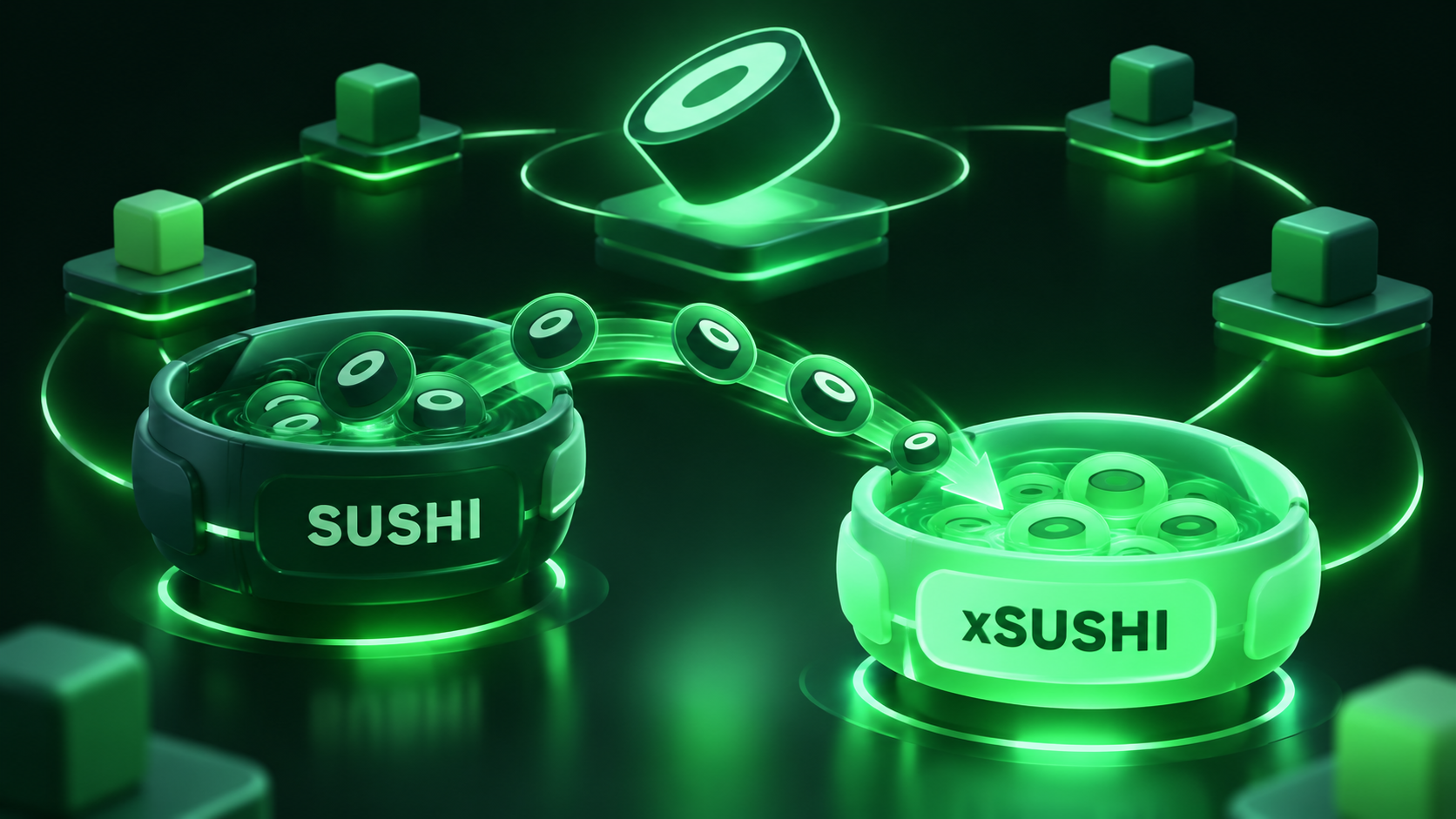
SUSHI has three jobs. It is the governance token for the Sushi DAO, where holders vote on Snapshot proposals that set emissions, fees and treasury policy. It is the incentive paid to liquidity providers on pools the DAO wants to grow. And when staked in the Sushi Bar, it becomes xSUSHI, which has historically earned a share of trading fees.
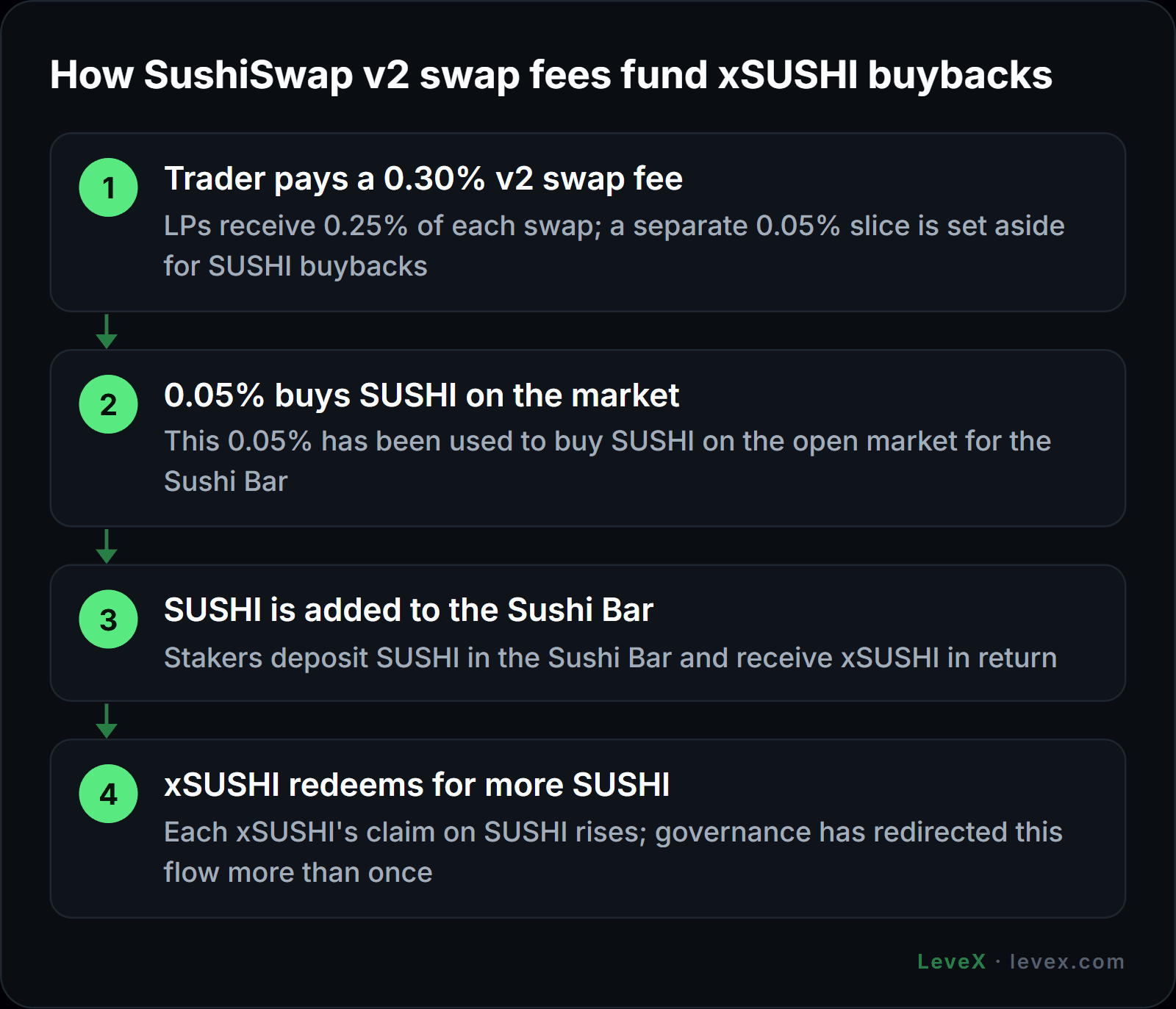
The fee link works through buybacks. On v2 pools, 0.25% of each swap goes to liquidity providers and 0.05% has been used to buy SUSHI on the open market for the Sushi Bar, raising the amount of SUSHI each xSUSHI redeems for, as the Sushi Bar FAQ describes. Governance has redirected that flow more than once, most recently in a 2026 tokenomics refactor that split protocol revenue between weekly buys for a Strategic Reserve, monthly xSUSHI buybacks and Sushi's operating budget. Our step-by-step on how to stake SUSHI covers the current mechanics and what yield to expect.
How SUSHI Supply Has Changed
SUSHI was designed with a 250 million soft cap. It no longer has one. CoinGecko lists total supply at about 291.5 million and the maximum supply as unlimited, because governance has twice approved new emissions:
- June 2024: A restructuring minted 25 million SUSHI for Sushi Labs and set an annual emission rate of 1.5%.
- December 14, 2025: A Snapshot vote raised the allowed annual rate to as much as 5%, roughly 14 million SUSHI a year, to fund liquidity on core chains. The Defiant reported that a single wallet cast almost all of the deciding votes.
- September 2026: Weekly Strategic Reserve buybacks began, pulling some SUSHI back off the market.
The net direction is still inflationary. A 5% emission ceiling dwarfs buybacks measured in tens of thousands of tokens a week. The full arithmetic is in our SUSHI tokenomics breakdown.
Where Sushi Sits Among DEXs
Sushi is now a mid-sized DEX competing against much larger rivals. Uniswap dominates Ethereum and its layer 2 networks, Curve owns stablecoin swaps, and PancakeSwap leads on BNB Chain. CoinGecko put Sushi's total value locked at about $92 million in November 2026, a small fraction of its 2021 peak in the billions.
Sushi's argument for itself rests on reach and routing: one interface that finds a price across dozens of networks. Its weakness is that a long tail of thin pools can produce bad fills, a risk made vivid in March 2026 when a $50 million trade routed by another protocol ended in a SushiSwap pool holding about $73,000 of liquidity. Our SushiSwap vs Uniswap comparison lays out where each one wins.
Risks to Weigh Before Trading SUSHI
Dilution is the biggest structural risk. With no hard cap and an emission ceiling of 5% a year, SUSHI needs growing demand just to hold its price, and the token is down about 58% over the past twelve months.
Governance concentration comes next. Large holders can pass proposals on their own, as the December 2025 emissions vote showed, so the rules around supply and fees can change quickly.
The third is competition and execution. Sushi has announced products that took years to arrive, and its market share depends on keeping liquidity deep enough to matter on the chains it serves. Analysts' bull, base and bear cases for these factors are compared in our SUSHI price prediction.
Frequently Asked Questions
Is SushiSwap still active in 2026?
Yes. SushiSwap runs live pools and swap routing on more than 40 chains, added Solana support in February 2026 and began weekly SUSHI buybacks in September 2026. Development is led by Sushi Labs under managing director Alex McCurry.
What is the difference between SUSHI and xSUSHI?
SUSHI is the base governance token. xSUSHI is the receipt you get for staking SUSHI in the Sushi Bar on Ethereum, and it redeems for a growing amount of SUSHI as fee-funded buybacks are added to the bar.
Does SUSHI have a max supply?
No. SUSHI was designed with a 250 million soft cap, but governance votes in 2024 and 2025 approved new emissions, and total supply stood near 291.5 million in November 2026.
Who created SushiSwap?
SushiSwap was launched in August 2020 by an anonymous developer called Chef Nomi, alongside a co-founder known as 0xMaki. Chef Nomi left after a controversy over the developer fund, and 0xMaki led the project through its 2021 growth.
Where can I store SUSHI?
SUSHI is an ERC-20 token, so any Ethereum-compatible wallet can hold it, with hardware wallets the safer choice for larger balances. Our list of the best SUSHI wallets compares the main options.
SushiSwap's Next Chapter Depends on Fees
Sushi has outlived a founder scandal, several leadership changes and a long decline from its 2021 peak, and it still routes trades across more chains than most rivals. What decides the token's future is simple to state: whether trading fees grow fast enough to fund buybacks that offset a supply now growing by up to 5% a year.
You can hold SUSHI outright on the LeveX SUSHI/USDT spot market, or take a long or short view on the SUSHIUSDT perpetual contract. For more short explainers on DeFi tokens, browse Crypto in a Minute.