
SUSHI is an inflationary governance token with no maximum supply: about 291.5 million tokens exist as of November 2026, roughly 286.75 million of them circulating, and governance allows up to 5% new issuance a year. The token was designed around a 250 million soft cap, and that limit stopped binding in 2024.
What offsets the inflation is a fee-funded buyback system, rebuilt in 2026, that buys SUSHI for a Strategic Reserve every week and for SushiSwap's xSUSHI stakers every month. This breakdown follows the supply from launch to today and shows how big each side of the ledger really is.
SUSHI Supply Over Six Years
SushiSwap launched in August 2020 paying 100 SUSHI per Ethereum block to liquidity providers, with a 10x bonus during the first two weeks and 10% of every emission routed to a developer fund. That front-loaded design is why so much of the supply was distributed early. The original rules are still described in Sushi's tokenomics documentation.
| Period | Change | Effect on supply |
|---|---|---|
| Aug 2020 | 100 SUSHI per block, 10x launch bonus, 10% dev fund | Fast early distribution |
| 2021 to 2023 | Emissions tapered toward the 250M design limit | Supply approaches the cap |
| Jan 2023 | "Kanpai" vote sends xSUSHI's fee share to the treasury for a year | Staker yield paused |
| Jun 2024 | 25M SUSHI minted for Sushi Labs, 1.5% annual emission rate set | Cap no longer binding |
| Dec 2025 | Annual emission ceiling raised to 5% | Up to ~14M new SUSHI a year |
| Sep 2026 | Weekly Strategic Reserve buybacks begin | Partial offset to emissions |
| Oct 2026 | Monthly xSUSHI buybacks begin | Fees return to stakers |
CoinGecko now lists the maximum supply as unlimited. The gap between total and circulating supply is small, about 5 million tokens, so there is no large locked overhang waiting to unlock. The pressure comes from fresh issuance instead.
How the 2025 Emissions Increase Works
The December 14, 2025 Snapshot vote moved the Annual Emission Rate (AER) from 1.5% to a ceiling of 5%. At today's supply, 1.5% is about 4.3 million SUSHI a year and 5% is about 14.3 million. The proposal framed the new tokens as a budget for deep liquidity on core chains, market-making deals and incentives tied to volume and fees.
The vote passed with 99.98% in favor, but The Defiant reported that one wallet supplied almost all of the deciding votes. Two things follow for holders. Emissions policy can change quickly in either direction, and the token's supply now depends on how the DAO and Sushi Labs choose to spend the ceiling, since 5% is a ceiling the DAO can choose to spend below.
Where Fees Go After a Swap
On a SushiSwap v2 pool, every trade pays a 0.30% fee. Following that fee through the system shows how value reaches SUSHI:
- Liquidity providers take 0.25%. This is paid directly into the pool and accrues to LP tokens.
- The protocol keeps 0.05%. Historically this slice bought SUSHI for the Sushi Bar; it now feeds protocol revenue.
- The 2026 refactor splits that revenue. Part funds weekly purchases for the Strategic Reserve, part funds monthly xSUSHI buybacks, and the remainder goes to Sushi's operating budget.
- xSUSHI rises in value. SUSHI bought for the bar increases the amount each xSUSHI redeems for, which is how stakers are paid.
Exact revenue shares have been revised by governance several times, so check the current proposal on Sushi's Snapshot before relying on any one figure. Our explainer on crypto token buybacks compares this model with the buy-and-burn and buy-and-distribute designs other protocols use.
Emissions Against Buybacks in Numbers
The buyback program is real, but its scale is modest. By the fourth weekly purchase in late September 2026, the Strategic Reserve had bought about 37,840 SUSHI, with that week's 9,054 tokens filled at an average of $0.26. Extending that pace over a year gives roughly 450,000 to 500,000 SUSHI.
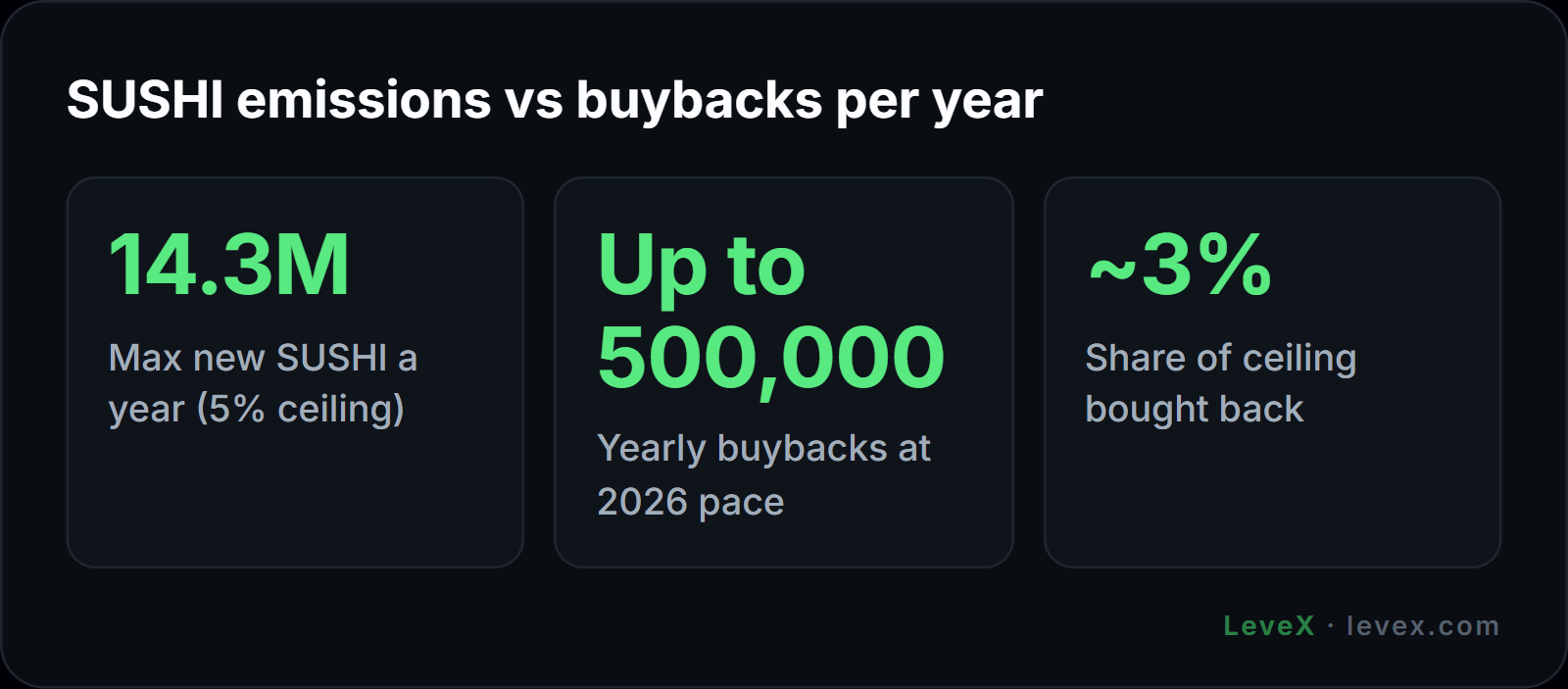
Set against an emission ceiling of 14.3 million tokens, buybacks currently absorb around 3% of the maximum new supply. Even against the old 1.5% rate, they would cover about a tenth. For buybacks to neutralize inflation, Sushi's fee revenue would need to grow many times over, or governance would need to issue far less than the ceiling allows. That arithmetic sits behind the cautious scenarios in our SUSHI price prediction.
Frequently Asked Questions
What is the total supply of SUSHI?
SUSHI's total supply was about 291.5 million tokens in November 2026, with roughly 286.75 million in circulation. There is no maximum supply, because governance approved new emissions in 2024 and 2025.
Is SUSHI deflationary?
No. SUSHI is inflationary, with governance allowing up to 5% new issuance a year. Weekly buybacks remove some tokens from circulation, but at 2026 volumes they are far smaller than the emission ceiling.
Who decides SUSHI emissions?
SUSHI holders decide emissions through Snapshot votes, with proposals usually drafted by Sushi Labs or DAO contributors. Voting power is concentrated, so a small number of large wallets can determine the outcome.
Why SUSHI Supply Decides Its Value
SUSHI's tokenomics now look like a company paying staff in new shares while running a small buyback: the share count grows unless revenue rises fast enough to buy back more than is issued. The 2026 refactor gave the token a direct fee link again, and the next test is whether volume grows enough to make that link matter.
When you are ready to trade the token, the SUSHI spot market on LeveX lets you hold it directly, while SUSHIUSDT perpetual futures let you position for or against the supply math. More bite-sized DeFi explainers are collected in Crypto in a Minute.