

Uniswap is the bigger, deeper exchange and the better choice for large trades on Ethereum and its main layer 2 networks, while SushiSwap covers more chains from one interface and pays its token holders a direct share of fees through buybacks. For most swaps on major pairs, Uniswap gives the better fill. For reaching smaller networks or Solana from the same app, Sushi has the edge.
The two share a family tree. SushiSwap began in 2020 as a near copy of Uniswap v2 and spent its first weeks pulling liquidity away from it. Six years later they look very different, in size, in chain strategy and in what their tokens actually do.
The Two DEXs Side by Side
| SushiSwap | Uniswap | |
|---|---|---|
| Launched | August 2020 (fork of Uniswap v2) | November 2018 |
| Current AMM versions | v2 and v3 pools | v2, v3 and v4 (with hooks) |
| Chains | 40+, including Solana since Feb 2026 | Ethereum, major L2s, its own Unichain |
| Token | SUSHI, no max supply, up to 5% annual emissions | UNI, fixed 1 billion supply at genesis plus 2% annual inflation allowed |
| Holder value link | Weekly reserve and monthly xSUSHI buybacks | Protocol fee switch approved by governance |
| Total value locked | About $92M (CoinGecko, Nov 2026) | Several billion dollars |
| Developer | Sushi Labs | Uniswap Labs |
The size gap is the headline. DefiLlama's Sushi page shows Sushi's value locked spread across dozens of chains, with no single chain holding a dominant share, while Uniswap concentrates far more liquidity on a handful of networks.
Liquidity and Trade Execution
Deeper pools mean lower price impact. On major pairs like ETH/USDC, Uniswap's pools are many times larger than Sushi's on the same chain, so a large order moves the price less there. Sushi's routing tries to close that gap by splitting swaps across its own pools and other liquidity sources, which helps on mid-sized trades.
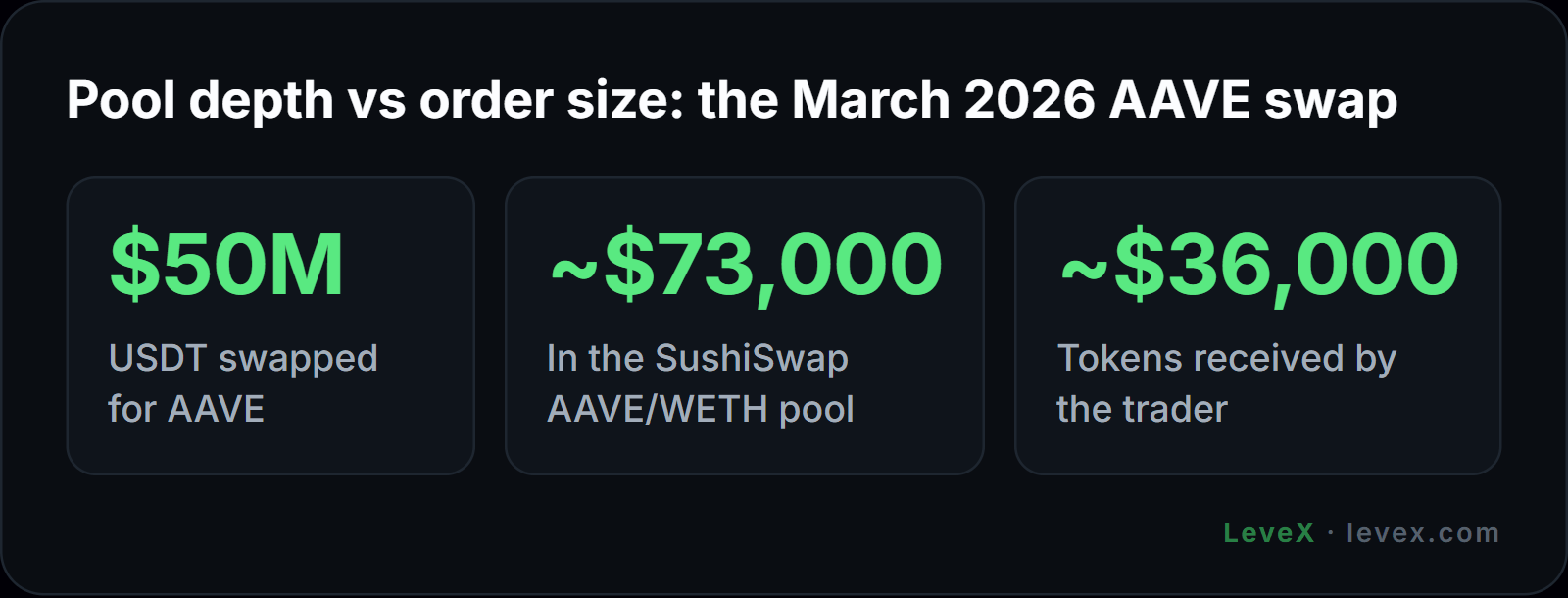
Thin pools are where things go wrong. In March 2026, a trader swapping about $50 million of USDT for AAVE through another protocol's interface was routed into a SushiSwap AAVE/WETH pool holding about $73,000 and received roughly $36,000 of tokens, as FinTech Weekly reported. The fault lay mostly with routing and ignored warnings, but it shows why pool depth matters more than the logo on the interface.
Fees and What Token Holders Get
Both use a 0.30% fee tier on classic pools, and both offer lower and higher tiers on concentrated-liquidity pools. The difference sits in what happens to the protocol's cut.
Sushi has shared fees with stakers since 2020, through xSUSHI. Governance paused that flow in 2023 and rebuilt it in 2026 as scheduled buybacks, but the link to holders is long established. The trade-off is supply: SUSHI can grow by up to 5% a year, and our SUSHI tokenomics breakdown shows buybacks currently cover only a small fraction of that.
Uniswap kept all trading fees with liquidity providers for years. Its governance has since moved to turn on protocol fees for UNI, a change explained in our Uniswap fee switch explainer. UNI holders gain from fees on a much larger volume base, which is the main reason UNI's market cap dwarfs SUSHI's.
Chains and Features
Uniswap focuses its effort on Ethereum, the leading layer 2s and its own Unichain network. Its v4 release added hooks, custom code that lets developers build dynamic fees, limit orders and other logic into pools, covered in our guide to Uniswap v4 hooks.
Sushi goes wide instead. It deploys to new chains early, often as a launch partner, as with Katana in 2025, and in February 2026 it added Solana swaps through Jupiter's routing. For a user who moves between many networks, one interface covering all of them is a real convenience. Sushi also offers xSUSHI staking for passive holders, walked through in our guide on how to stake SUSHI.
Which One Should You Use?
Pick Uniswap when:
- You are trading a large order on Ethereum, Base, Arbitrum or another major network
- You want the deepest liquidity and the most audited, widely used contracts
- You are a developer who wants v4 hooks
Pick SushiSwap when:
- You need a swap on a smaller chain that Uniswap does not support
- You want cross-chain swaps or Solana trades from one interface
- You want a token whose holders already receive scheduled fee buybacks
For other matchups, our Curve vs Uniswap comparison covers stablecoin trading and PancakeSwap vs Uniswap covers BNB Chain.
Frequently Asked Questions
Is SushiSwap safer than Uniswap?
Neither is risk-free, but Uniswap's contracts handle far more volume and have been tested longer at scale. Sushi suffered a 2023 exploit in a routing contract that affected users with open approvals, so revoking old approvals matters on either platform.
Is SushiSwap cheaper than Uniswap?
Swap fees are similar, with 0.30% on classic pools for both. The real cost difference comes from price impact and gas, and Uniswap's deeper pools usually give a better net price on large trades.
Is SUSHI or UNI the better investment?
UNI represents a much larger protocol and carries lower dilution, while SUSHI is a smaller, higher-risk bet on a recovery in Sushi's market share. Our SUSHI price prediction sets out the scenarios for SUSHI specifically.
The Original and the Fork in 2026
Uniswap won the scale contest, and on the chains where both compete it usually offers the better trade. SushiSwap survived by covering ground Uniswap does not, and its token keeps a direct fee link that comes at the cost of ongoing dilution.
If you want exposure to the smaller DEX without managing wallets, LeveX lists the SUSHI/USDT spot pair and a SUSHIUSDT perpetual contract for long or short trades. You can compare more DeFi projects through Crypto in a Minute.