
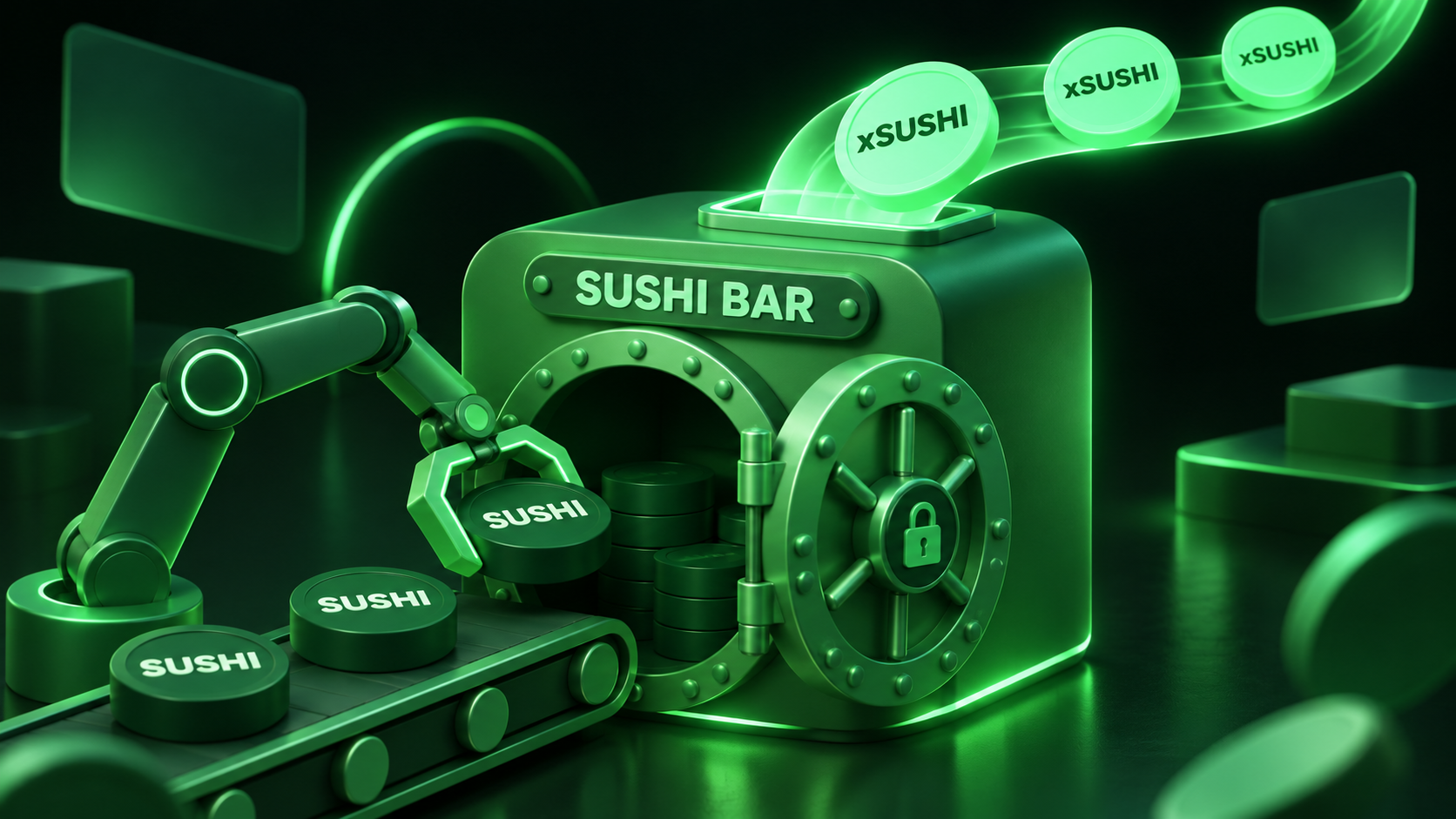
To stake SUSHI, you deposit it into the Sushi Bar on the SushiSwap website using an Ethereum wallet, and you receive xSUSHI in return. xSUSHI has no lockup, and it redeems for a growing amount of SUSHI as protocol fees are used to buy SUSHI for the bar.
The process takes a few minutes and two Ethereum transactions. The harder questions are how much it actually earns in 2026, after several governance changes to the fee flow, and whether staking beats the other ways to put SUSHI to work.
Staking SUSHI Step by Step
You need SUSHI on Ethereum mainnet and a little ETH for gas. Staking only works with the Ethereum version of the token, so bridge or withdraw to Ethereum first if your SUSHI sits on another chain.
- Connect your wallet. Open sushi.com, choose Stake or the Sushi Bar section, and connect an Ethereum wallet such as MetaMask, Rabby or a hardware wallet through one of them.
- Check the exchange rate. The page shows how many SUSHI one xSUSHI is worth. This rate only moves upward when buybacks are added.
- Approve SUSHI. Enter the amount and sign an approval transaction that lets the Sushi Bar contract move your SUSHI. This costs a small amount of ETH in gas.
- Stake. Confirm the staking transaction. Your wallet receives xSUSHI at the current rate.
- Track it. Add the xSUSHI token (contract 0x8798249c2E607446EfB7Ad49eC89dD1865Ff4272) to your wallet so the balance appears. Always confirm the address on Sushi's own site first.
- Unstake when you want. Return to the same page, choose Unstake and burn your xSUSHI. You receive SUSHI at the current rate, including any growth since you staked.
Gas is the hidden cost. On a small stake, two Ethereum transactions to enter and one to exit can cost more than months of rewards, so staking makes most sense for balances large enough to absorb those fees.
What xSUSHI Earns in 2026
xSUSHI pays no fixed interest. Its reward comes from SUSHI bought with protocol revenue and sent to the bar, which raises the SUSHI each xSUSHI is worth. The Sushi Bar FAQ describes the original model: 0.05% of every swap on v2 pools bought SUSHI for stakers, with no set distribution schedule.
That flow has been switched off and on. The 2023 Kanpai vote sent stakers' share to the treasury for a year, after which Sushi revived xSUSHI rewards. The 2026 tokenomics refactor then split protocol revenue between weekly Strategic Reserve buys, monthly xSUSHI buybacks starting October 1, 2026, and Sushi's operating budget. Stakers now receive a smaller, scheduled slice of fees.
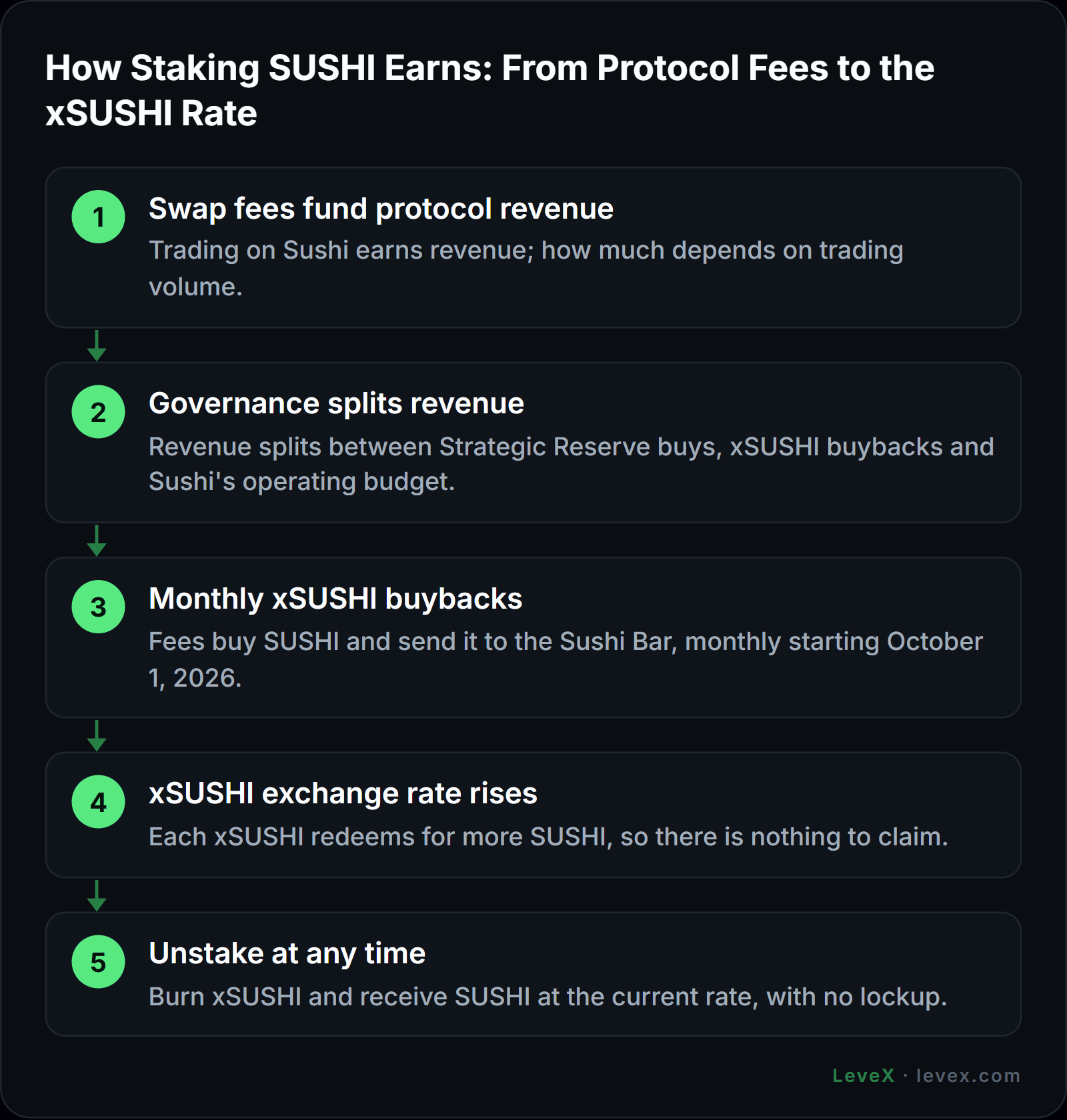
In practice, the xSUSHI yield depends on how much Sushi earns and how big a slice governance assigns to the bar. Neither is fixed. Our SUSHI tokenomics breakdown shows how that slice compares with new emissions, which run at up to 5% a year and dilute anyone who holds SUSHI without staking it.
Staking Compared With Other Ways to Earn
xSUSHI is the simplest option, but it is one of three ways to earn with SUSHI.
| Option | How you earn | Main risk |
|---|---|---|
| xSUSHI staking | Fee-funded SUSHI buybacks raise the xSUSHI rate | Low yield; depends on governance |
| Providing SUSHI liquidity | Swap fees from a SUSHI pair, plus any incentives | Impermanent loss if prices diverge |
| Holding plain SUSHI | Price movement only | Dilution from emissions |
Providing liquidity to a SUSHI/ETH pool can pay more in active markets, but if SUSHI falls sharply against ETH, the pool ends up holding more of the falling asset. Our general guide to what staking is in crypto explains how fee-based models like xSUSHI differ from proof-of-stake validator rewards.
Risks Before You Stake
Smart contract risk is the first. The Sushi Bar contract has been live since 2020, but any contract can carry undiscovered bugs, and approvals you sign stay active until revoked. Sushi's April 2023 RouteProcessor2 exploit, which drained wallets that had approved a faulty routing contract, showed why revoking old approvals is worth the gas.
Governance risk is the second. The fee share for stakers has been changed several times by vote, and it can change again. A staker's return depends on decisions they may not be able to influence.
Price risk is the third, and the largest. xSUSHI gains SUSHI, but if SUSHI's dollar price falls faster than the bar grows, the position still loses value. The bear, base and bull cases for that price are set out in our SUSHI price prediction.
Frequently Asked Questions
Is there a lockup period for staking SUSHI?
No. You can unstake xSUSHI at any time and receive SUSHI at the current exchange rate. The only costs are Ethereum gas fees for each transaction.
Can I stake SUSHI on a chain other than Ethereum?
The Sushi Bar runs on Ethereum mainnet, so you need the Ethereum version of SUSHI to stake. Bridged SUSHI on other chains must be moved to Ethereum first.
Do I need to claim xSUSHI rewards?
No. Rewards are built into the xSUSHI exchange rate, so there is nothing to claim. When you unstake, you receive more SUSHI than you deposited if buybacks have been added in the meantime.
Is SUSHI Staking Worth It?
Staking SUSHI is simple, has no lockup and gives holders a direct share of protocol fees again after the 2026 refactor. The return is modest and depends on governance and trading volume, so it works best for larger, long-term balances where gas costs are small relative to the stake.
LeveX offers SUSHI/USDT spot trading for buying the tokens you plan to stake, along with SUSHIUSDT perpetual futures for hedging a staked position. For more short guides to DeFi tokens, explore Crypto in a Minute.