

Stacks and Rootstock both bring smart contracts to Bitcoin, but they make opposite bets. Stacks has its own token, STX, its own Clarity language, and pays bitcoin to holders who lock STX. Rootstock is merge-mined by Bitcoin miners, runs Ethereum-compatible contracts, and uses a bitcoin-pegged coin, RBTC, as its gas, with no separate token you need to hold. The short verdict: Rootstock is easier for Ethereum developers and has no extra token risk, while Stacks offers faster blocks, a broader bitcoin bridge design and native BTC yield.
The two have traded the lead in decentralized finance for years. A July 2026 snapshot of DefiLlama data showed Rootstock with about $92 million in DeFi value locked against roughly $83 million for Stacks, so neither has pulled clearly ahead.
Stacks and Rootstock Side by Side
| Stacks | Rootstock | |
|---|---|---|
| Launched | January 2021 (Stacks 2.0) | January 2018 |
| How blocks are secured | Proof of Transfer, settled on Bitcoin | Merge mining by Bitcoin miners |
| Smart contract language | Clarity | Solidity, Ethereum-compatible |
| Gas token | STX | RBTC, pegged 1:1 to BTC |
| Bitcoin bridge | sBTC, 15 signers with a 70% threshold | PowPeg, a federation using hardware security modules |
| Block time | A few seconds since Nakamoto | About 30 seconds |
| Native BTC yield | Yes, through Stacking and Bitcoin Staking | No protocol-level yield |
How Each Network Borrows Bitcoin's Security
Rootstock's model is merge mining. Bitcoin mining pools include Rootstock work in the same hashing they do for Bitcoin, so Rootstock blocks are protected by a large share of Bitcoin's hash rate (around 80% or more in 2026 reports) at no extra energy cost. The weakness is that miners have little direct stake in Rootstock, so its security depends on pools continuing to participate.
Stacks takes a different path. Miners spend real bitcoin to win the right to produce blocks, and since the Nakamoto upgrade every confirmed Stacks block can only be reversed if Bitcoin itself reorganizes. A signer set drawn from STX stakers approves each block. That makes Stacks' security partly a function of the value of STX, which is the main trade-off critics point to.
Neither network changes Bitcoin's own code, and both remain separate chains with their own validators or miners. They are closer to sidechains with Bitcoin anchoring than to rollups in the Ethereum sense.
Developer Experience and Apps
Rootstock is the easier pick for teams already building on Ethereum. Solidity contracts, familiar tooling and EVM wallets work with minor changes, which lowers the cost of porting existing lending or exchange code.
Stacks asks developers to learn Clarity, a language designed so that a contract's behavior and cost are known before it runs. That limits some patterns common in Solidity but removes several classes of bugs, and Clarity can read Bitcoin's state directly. Stacks ranked among the five fastest-growing developer ecosystems in Electric Capital's data in early 2026 and leads Bitcoin-focused projects on developer activity. Its main apps include Zest Protocol for lending, Bitflow for trading, Granite for borrowing and Hermetica for the USDh synthetic dollar.
The Bitcoin Each Network Uses
On Rootstock, bitcoin enters through the PowPeg, a federated bridge run by known functionaries whose keys sit in hardware security modules. Peg-outs are approved by the federation, so users rely on those operators acting in good faith. RBTC then serves as both the network's money and its gas.
On Stacks, bitcoin enters through sBTC, where 15 institutional signers must reach 70% agreement to approve deposits and withdrawals. Deposits mint in about one Bitcoin block and withdrawals complete after six. Both bridges depend on a set of trusted parties, but sBTC's minting is permissionless and its signer set is designed to open up over time. The mechanics are covered in detail in our sBTC explainer.
Yield and Token Exposure
Stacks is the only one of the two that pays bitcoin at the protocol level. Holders who lock STX receive the BTC that miners spend, a process explained step by step in our guide on how to stake STX. Since July 2026, BTC holders can also lock bitcoin on the Bitcoin chain and pair it with STX to earn a target of about 3% a year, covered in our article on Stacks Bitcoin Staking. About 735 BTC was bonded in the first two periods.
Rootstock offers yield only through applications, such as lending RBTC on its DeFi protocols. That keeps users free of exposure to another token, but it also means the return depends on borrowing demand inside a fairly small ecosystem.
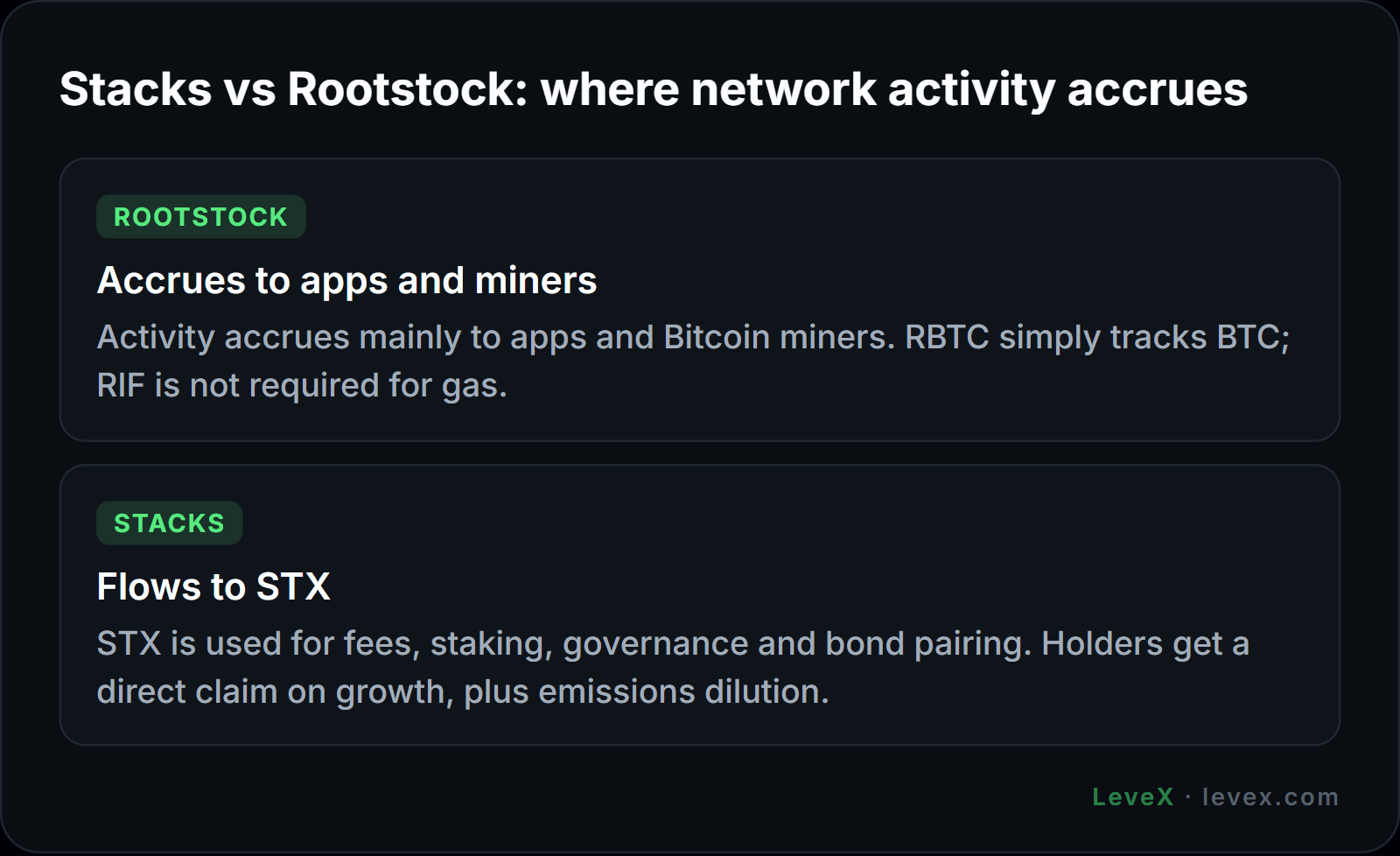
The biggest practical difference for traders is the token. Rootstock activity accrues mainly to applications and to Bitcoin miners, and RBTC simply tracks BTC. Rootstock does have a separate utility token, RIF, for its infrastructure services, but RIF is not required for gas.
Stacks activity flows to STX, which is used for fees, staking, governance and bond pairing. That gives STX holders a direct claim on the network's growth along with the dilution of continuous emissions, a balance laid out in our STX tokenomics breakdown. It also means STX swings far more than BTC, as the scenario ranges in our STX price prediction show.
Payments are a separate category. Neither Stacks nor Rootstock competes directly with the Lightning Network, which focuses on fast, cheap transfers rather than smart contracts.
Stacks vs Rootstock FAQ
Is Rootstock better than Stacks?
Rootstock is better for developers who want Ethereum compatibility and users who want to avoid holding a separate token. Stacks is stronger for native BTC yield, fast block times and a permissionless bitcoin bridge. The right choice depends on which of those matters more.
Can you stake on Rootstock like on Stacks?
No. Rootstock has no protocol-level staking reward. Its yield comes from lending and liquidity apps, while Stacks pays BTC to holders who lock STX or bond bitcoin.
Which is more secure, Stacks or Rootstock?
They rely on different assumptions. Rootstock borrows hash rate from Bitcoin miners through merge mining, while Stacks settles every block on Bitcoin and relies on STX-staking signers. Both use trusted parties to hold the bitcoin backing their bridged BTC.
Choosing Between Two Bitcoin Layers
Rootstock and Stacks are both credible routes to programmable bitcoin, and the gap in DeFi value between them is small. Rootstock leans on compatibility and simplicity, while Stacks has built a more ambitious stack around its own token, its own language and a native BTC yield that Rootstock cannot match at the protocol level.
For traders, only one of them offers a token with direct exposure to that growth. You can buy STX on the LeveX spot market, or trade STX perpetual futures to take either side. For more side-by-side looks at crypto networks, explore Crypto in a Minute.