

STX Price Prediction: 2026, 2027 and 2030 Outlook
Our base case puts Stacks (STX) between $0.28 and $0.38 at the end of 2026, $0.40 to $0.70 in 2027 and $0.60 to $1.20 by 2030, with wide bear and bull ranges on either side. STX trades near $0.30 as of late October 2026, more than 90% below its April 2024 high of about $3.86, so even the base case assumes a recovery that depends on Bitcoin holders actually using the network's new staking products.
These are scenario ranges built from supply, adoption and market data. They are not guarantees, and STX has a history of moving far outside any forecast in both directions.
STX Forecast Ranges at a Glance
| Period | Bear case | Base case | Bull case |
|---|---|---|---|
| End of 2026 | $0.18 to $0.22 | $0.28 to $0.38 | $0.50 to $0.60 |
| End of 2027 | $0.15 to $0.20 | $0.40 to $0.70 | $1.00 to $1.50 |
| 2030 | $0.10 to $0.25 | $0.60 to $1.20 | $2.00 to $3.50 |
For comparison, published model forecasts for STX span an unusually wide band. Statistical models that extend the recent downtrend put STX near $0.11 at the end of 2026, while momentum-based forecasts reach above $0.50 for the same date and above $10 for 2030. The spread itself is useful information: the market has not settled on whether Stacks is a declining 2021-era token or an early-stage claim on Bitcoin yield.
Where STX Stands Today
STX began the 2024 cycle as one of the strongest performers among tokens tied to Bitcoin, peaking near $3.86 in April 2024 as excitement built around the Nakamoto upgrade and sBTC. The decline since then has been steep and fairly steady. As of October 2026, CoinGecko lists STX at about $0.30, a market capitalization near $570 million and daily volume around $14 million.
The fall happened while the network kept shipping. Nakamoto went live in October 2024, sBTC opened in December 2024, and Bitcoin Staking launched on mainnet in September 2026. That gap between delivery and price is the core of the bull argument, and it is also a warning: good engineering has not been enough to lift STX so far.
What Will Move the STX Price
Bitcoin Staking Adoption
Bitcoin Staking is the catalyst most likely to decide whether STX trades in the base or bull column. Holders lock BTC on the Bitcoin chain, pair it with STX, and earn a target return of about 3% a year in bitcoin. The first two bonding periods attracted about 735 BTC, against a launch capacity of 3,000 BTC, according to the Bitcoin Staking rollout page and Stacks' third-quarter figures.
The direct buying pressure from staking is smaller than many traders assume. The minimum STX pairing is 5% of the BTC position, so filling all 3,000 BTC of capacity at a BTC price near $80,000 needs only about $12 million worth of STX locked. The larger effect is indirect: more bonded BTC makes Stacks more attractive to miners and institutions, and more miner spending raises the yield paid to every STX staker.
Miner Economics and the Reflexive Loop
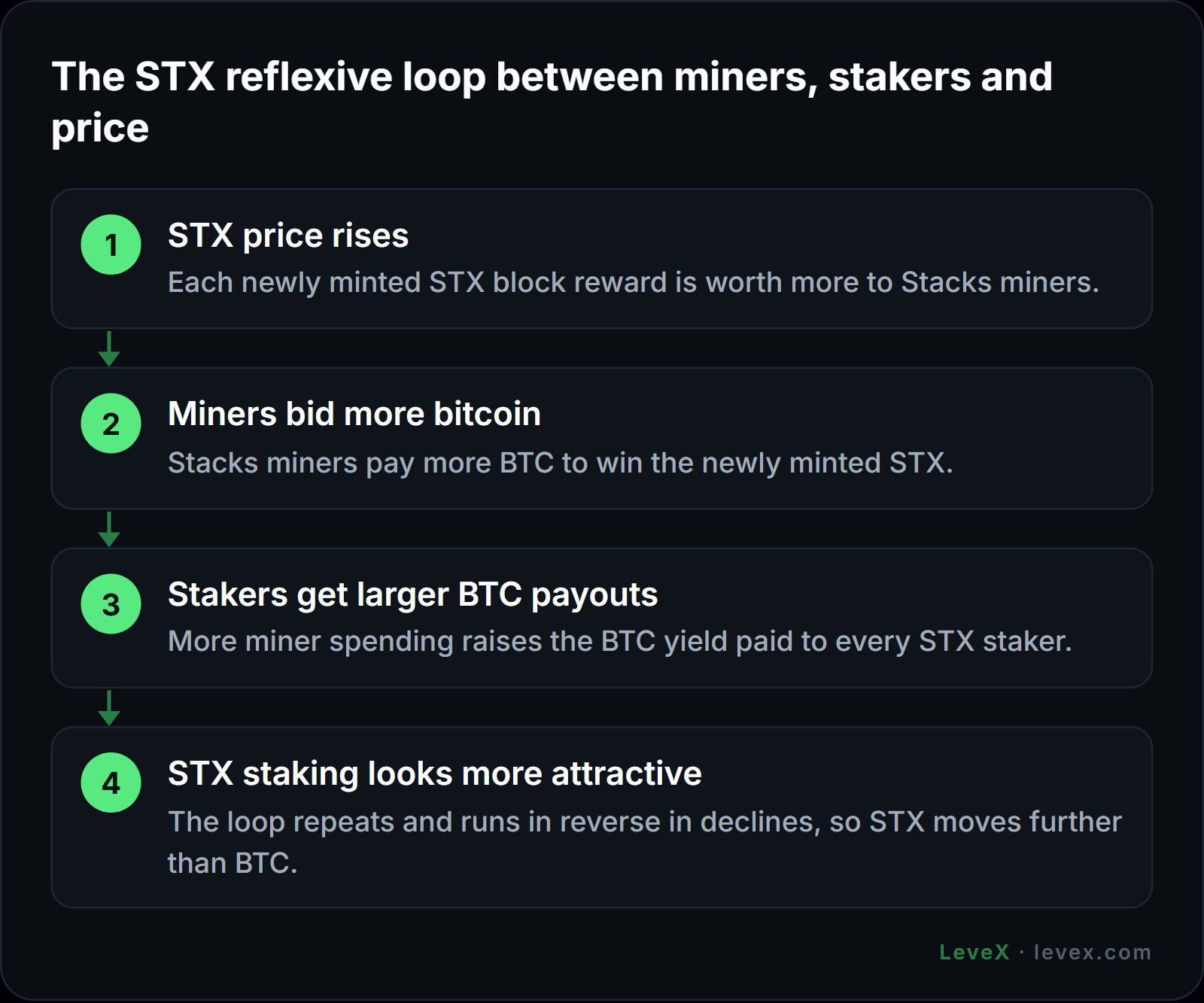
Stacks miners pay BTC to win newly minted STX. When STX rises, each block reward is worth more, miners bid more bitcoin, and stakers receive larger BTC payouts, which in turn makes holding and staking STX more attractive. The same loop runs in reverse during declines, and it explains why STX tends to move further than BTC in both directions.
Supply Growth
SIP-045 restored the block reward to 1,000 STX per Bitcoin block in July 2026, with no scheduled reductions during the PoX-5 phase. That adds roughly 52 million STX a year, close to 2.8% of the circulating supply, before separate endowment emissions. Supply growth at that pace is a steady headwind, and any future vote to cut emissions would likely be read as bullish.
Bitcoin's own market cycle sits above all of this. STX has historically traded as a high-beta Bitcoin proxy, and the timing of the next leg in the Bitcoin four-year cycle will shape every scenario in the table.
How the Scenarios Were Built
The bear case assumes Bitcoin Staking stalls well below capacity, sBTC supply stagnates near its mid-2026 level of about 2,950 BTC, and emissions continue unchanged. STX keeps losing ground to BTC, and the 2030 range reflects several more years of dilution without a demand response.
The base case assumes steady growth: bonding periods fill over 2027, Stacks DeFi value locked (about $121 million at the start of 2026 on DefiLlama) roughly doubles, and STX recovers part of its 2024 to 2026 decline alongside a firm Bitcoin market. A move to $1.00 would still leave STX about 74% under its all-time high.
The bull case requires institutional BTC to arrive in size through custodians that integrate Bitcoin Staking, combined with a strong crypto market. Under those conditions, STX could reclaim part of its previous cycle range, though a return to $3.86 sits outside even this scenario.
STX Price Prediction FAQ
Can STX reach $1?
STX could reach $1 within our base case by 2030, and in the bull case as early as 2027. That would require a gain of more than 200% from the October 2026 price of about $0.30, driven by Bitcoin Staking adoption and a supportive Bitcoin market.
Will STX return to its all-time high?
A return to the April 2024 high near $3.86 is unlikely before 2030 under current assumptions. The circulating supply has grown since 2024, so the same price today would imply a higher market capitalization than it did at the peak.
Does Bitcoin Staking make STX more valuable?
Bitcoin Staking can support STX by raising miner spending and demand for staking, but the direct effect is limited because participants only need STX worth about 5% of their BTC. Its main value to STX holders is the potential for higher BTC yields if adoption grows.
Reading the STX Outlook
STX is a leveraged bet on one question: whether Bitcoin holders will put their BTC to work on Stacks. The network now has the products to test that thesis, and 2027 should show whether bonding demand keeps growing beyond the first institutional participants. Until then, emissions and Bitcoin's own direction will do most of the work on price.
If you want exposure either way, the STX/USDT spot market on LeveX lets you buy and hold, while STX perpetual futures let you go long or short with leverage. More token explainers are waiting in Crypto in a Minute.