
Stacks (STX) is a Bitcoin layer that adds smart contracts, DeFi and apps to Bitcoin while settling its own blocks on the Bitcoin chain. STX is the network's native token: miners spend BTC to win the right to produce Stacks blocks, and that BTC is paid out to holders who lock their STX, so stakers earn yield in bitcoin instead of in new tokens. Since the PoX-5 upgrade in July 2026, BTC holders can also lock their bitcoin on the main chain alongside STX and earn a BTC return without bridging it anywhere.
That design makes Stacks the oldest and largest attempt to turn Bitcoin into a programmable financial system without changing Bitcoin itself. This guide explains how the network works, what the token does, where the ecosystem stands as of October 2026, and the risks that come with it.
What Stacks Adds to Bitcoin
Bitcoin's scripting language is deliberately limited. It can move coins and enforce simple spending conditions, but it cannot run lending markets, exchanges or stablecoins. Stacks runs those applications on its own chain and writes a record of every Stacks block into Bitcoin transactions, so the history of Stacks is anchored to the most secure blockchain in operation.
Smart contracts on Stacks are written in Clarity, a language built for predictability. Clarity code is interpreted exactly as written (there is no compiler step that could introduce surprises), and a contract's cost and behavior can be known before it runs. It can also read Bitcoin's state, which lets a Stacks contract react to a confirmed BTC transaction. Developers coming from Ethereum will find the model more restrictive than Solidity, and that restriction is the point: the most common classes of smart contract bugs are harder to write in the first place.
The October 2024 Nakamoto upgrade changed the user experience. Before it, Stacks produced a block roughly every Bitcoin block, about ten minutes. Afterward, blocks arrive every few seconds, and a confirmed Stacks transaction can only be reversed if Bitcoin itself reorganizes. That second property, called Bitcoin finality, is what lets Stacks describe itself as secured by Bitcoin rather than as a separate chain that happens to sit beside it.
How Proof of Transfer Works
Stacks reaches consensus through Proof of Transfer (PoX), a mechanism that recycles Bitcoin instead of burning energy or minting rewards out of nothing. Each reward cycle runs for 2,100 Bitcoin blocks, roughly two weeks, and follows the same loop:
- Miners bid in BTC. Stacks miners send bitcoin in a Bitcoin transaction to compete for the right to produce the next Stacks tenure.
- A winner is chosen. The protocol selects a miner, weighted by how much BTC each one committed.
- The winner earns new STX. The selected miner receives the STX block reward, known as the coinbase, plus transaction fees.
- The BTC goes to stakers. The bitcoin the miners spent is sent to addresses belonging to STX holders who locked their tokens for that cycle.
- Signers confirm blocks. Since Nakamoto, a set of signers chosen from those stakers approves each block the miner produces.
Locking STX this way is called Stacking, a process the PoX-5 documentation now simply calls staking. According to Stacks' Q2 2026 ecosystem report, PoX has distributed more than 4,200 BTC to participants since mainnet launched in 2021. The return is paid in bitcoin, but it depends on how much BTC miners are willing to spend, which in turn depends on the market value of the STX they win.
Stacks now sits among a crowded group of Bitcoin layer-2 networks chasing BTC yield, and PoX is the main thing that sets it apart: the yield comes from miner spending in BTC, so it does not rely on printing a separate reward token to attract deposits.
From Blockstack to PoX-5: Key Milestones
| Date | Milestone |
|---|---|
| 2013 | Muneeb Ali and Ryan Shea start Blockstack, a project for a decentralized internet built on Bitcoin |
| July 2019 | Blockstack completes the first token offering qualified by the SEC under Regulation A+ |
| January 2021 | Stacks 2.0 mainnet launches with Proof of Transfer and Clarity |
| April 2024 | STX reaches its all-time high near $3.86 |
| October 2024 | Nakamoto upgrade brings fast blocks and Bitcoin finality |
| December 2024 | sBTC opens for Bitcoin deposits on mainnet |
| July 2026 | PoX-5 hard fork activates Bitcoin Staking and restores the 1,000 STX coinbase |
| September 2026 | The first Bitcoin Staking bond opens with institutional participants |
The 2019 offering still matters. It gave STX an unusual regulatory history, and the project has since been structured around open-source development, the Stacks Foundation and the Stacks Endowment rather than a single company running the network.
What the STX Token Does
STX has four jobs inside the network, and each one creates demand from a different group.
Fees. Every transaction and contract call on Stacks is paid in STX. The 2026 roadmap describes letting sBTC pay fees in the future, which is under evaluation and not yet live.
Mining rewards. New STX is issued to the miner of each block. SIP-045, approved by more than 99.99% of voting STX in July 2026, set the coinbase back to 1,000 STX per Bitcoin block with no scheduled reductions during the PoX-5 phase, reversing a 2024 decision that had cut it to 500 in April 2026. The full proposal is published in the Stacks SIP repository.
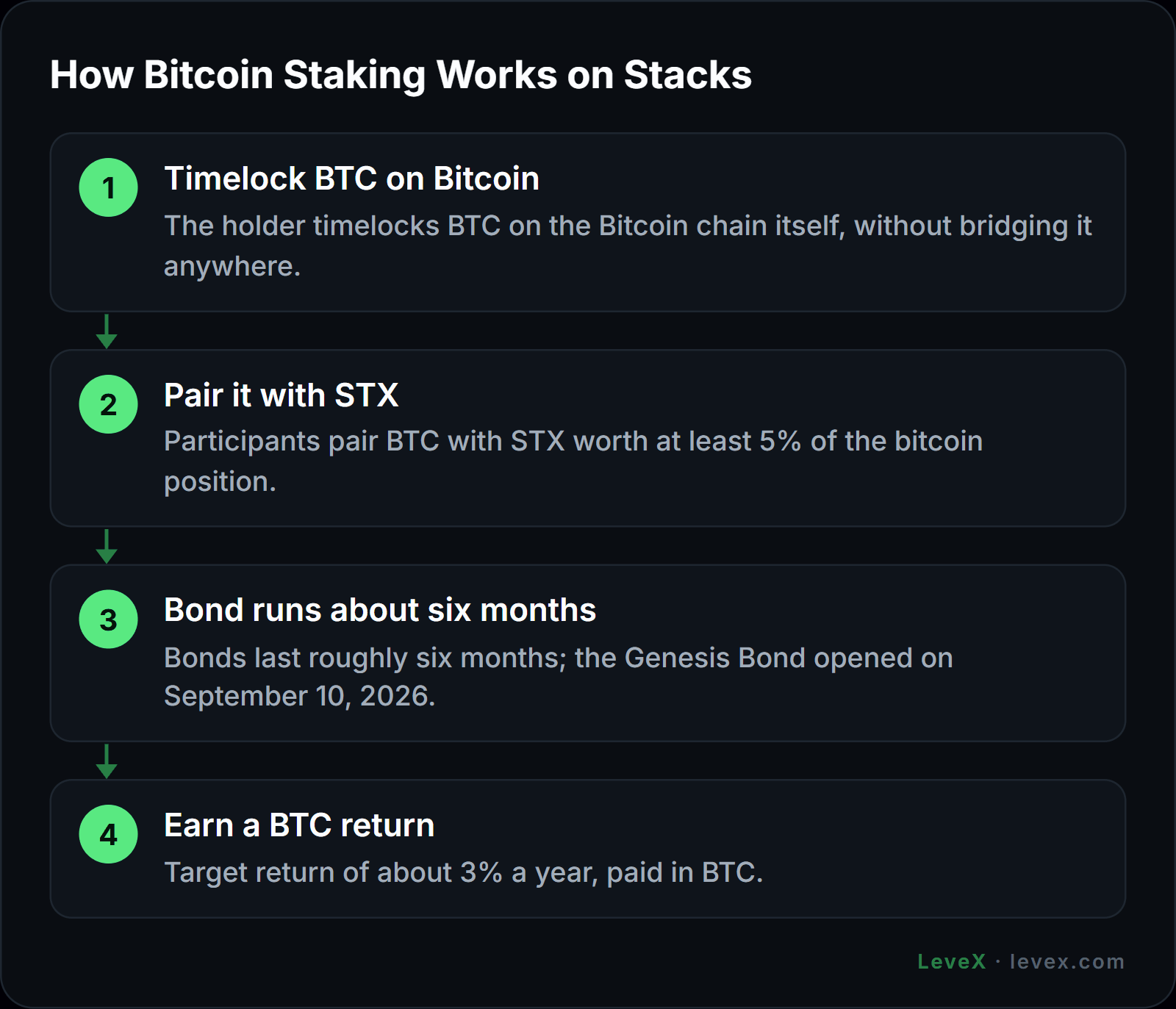
Stacking and Bitcoin Staking are where most of the demand now comes from. Holders lock STX to secure the network and receive BTC, and Bitcoin Staking requires participants to pair their BTC with STX worth at least 5% of the bitcoin position. Liquid staking tokens such as Stacking DAO's stSTX let holders earn the same rewards while keeping a tradable token, following the liquid staking model used on other chains.
The last role is governance. Upgrades to Stacks are proposed as SIPs (Stacks Improvement Proposals), and hard forks need approval from both stacked and liquid STX holders.
As of October 2026, about 1.88 billion STX circulate, according to CoinGecko, and the protocol sets no hard maximum supply. STX trades near $0.30, giving it a market capitalization of roughly $570 million, more than 90% below its 2024 peak.
The Stacks Ecosystem in 2026
sBTC, the Bitcoin Asset of Stacks
sBTC is a token backed 1:1 by bitcoin that moves BTC onto Stacks so it can be used in applications. Deposits and withdrawals are approved by a decentralized group of signers, with 70% agreement required, instead of a single custodian. The deposit cap was fully removed in early 2026, and sBTC supply stood at 2,949 BTC at the end of June 2026.
Lending, Trading and Stablecoins
Zest Protocol is the largest lender on Stacks, with more than $80 million in value locked by the third quarter of 2026 and over 1,500 liquidations processed without bad debt. Bitflow runs the main decentralized exchange, Granite offers BTC-backed borrowing, Hermetica issues the USDh synthetic dollar, and USDCx brings Circle's dollar to the network. Stacks DeFi is still small by the standards of the largest smart contract chains, so liquidity on individual pools can be thin.
Bitcoin Staking
Bitcoin Staking is the newest piece and the one Stacks treats as its main growth engine. A holder timelocks BTC on the Bitcoin chain itself, pairs it with STX, and receives a target return of about 3% a year in BTC. Bonds last roughly six months. The Genesis Bond opened on September 10, 2026, and the first two bonding periods attracted about 735 BTC. Over the same period the amount of staked STX rose from 392 million to 493 million.
Activity on the network has grown alongside these launches. Cumulative active wallets passed 1.6 million by mid-2026, and daily active users rose about 55% in the second quarter.
Risks Worth Weighing
STX carries the risks of a mid-cap token whose value depends on a single thesis. If Bitcoin holders do not adopt Bitcoin Staking and sBTC at scale, miner revenue stays modest, the BTC yield shrinks, and the case for holding STX weakens. Competing Bitcoin layers, from merge-mined sidechains to the Lightning Network for payments, all pursue some of the same users.
Supply is the second issue. Restoring the 1,000 STX coinbase and running separate endowment emissions under SIP-031 means new STX enters the market every block, and governance can change those parameters again. Stakers who receive BTC still hold an asset that is being diluted. Finally, sBTC and Bitcoin Staking rely on signer sets and timelocks that are young compared with Bitcoin itself, and a technical failure in either would hit confidence across the ecosystem.
Frequently Asked Questions
Is Stacks a layer 2 for Bitcoin?
Stacks calls itself a Bitcoin layer and is usually grouped with Bitcoin layer-2 networks. It has its own token and validators, but it records every block on Bitcoin and, since the Nakamoto upgrade, its transactions can only be reversed if Bitcoin reorganizes. It does not change Bitcoin's own code.
How do you earn BTC with STX?
You earn BTC by Stacking: locking STX for one or more two-week reward cycles, either on your own or through a pool. The bitcoin that miners spend to produce blocks is distributed to stakers. Pools let holders join without meeting the solo minimum.
What is the difference between STX and sBTC?
STX is the native token of Stacks, used for fees, mining rewards, staking and governance. sBTC is a separate token backed 1:1 by bitcoin that lets BTC be used in Stacks applications. Their prices are unrelated, since sBTC tracks BTC.
Does STX have a maximum supply?
No. STX has no hard cap, and new tokens are issued to miners with every block plus separate endowment emissions. About 1.88 billion STX circulate as of October 2026.
Who created Stacks?
Stacks began as Blockstack, founded in 2013 by Muneeb Ali and Ryan Shea. The network launched its Stacks 2.0 mainnet in January 2021 and is now developed by independent teams supported by the Stacks Foundation and the Stacks Endowment.
Where Stacks Goes From Here
Stacks has spent over a decade on one bet: that Bitcoin holders want to use their BTC without handing it to a custodian or moving it to another chain. Proof of Transfer, Bitcoin finality, sBTC and now Bitcoin Staking are all steps toward that goal, and 2026 is the first year the network can offer native BTC yield at scale. Whether STX benefits depends on how much bitcoin follows.
You can trade STX on the LeveX spot market, or use the STXUSDT perpetual contract to go long or short from the same account. To learn about more of the tokens built around Bitcoin and beyond, browse Crypto in a Minute.