

How to Stake STX and Earn BTC Rewards
To stake STX, move your tokens to a self-custody wallet such as Leather or Xverse, choose a pool (called a signer-manager), and lock your STX for between 1 and 96 reward cycles of about two weeks each. Your tokens never leave your own account, and rewards arrive as sBTC or, if your pool supports it, as native bitcoin. This process was long known as Stacking, and the July 2026 PoX-5 upgrade renamed it staking and merged the old solo and delegated routes into a single interface.
The reward comes from the bitcoin that miners spend to produce blocks on Stacks. The steps below cover the most common route, then the alternatives, the timing rules that catch people out, and what the yield looks like after PoX-5.
Ways to Stake STX Compared
| Method | Who it suits | Custody | Rewards paid in | Lock |
|---|---|---|---|---|
| Pool (STX-only staking) | Most holders | Your wallet | sBTC or BTC | 1 to 96 cycles |
| Your own signer-manager | Large holders running infrastructure | Your wallet | sBTC or BTC | 1 to 96 cycles |
| Liquid staking (stSTX) | Holders who want a tradable token | Protocol contract | Accrues to stSTX | None, exit via market or protocol |
| Protocol bond | Allowlisted BTC holders | Your wallet and a BTC timelock | BTC | About 6 months |
Under PoX-5, staking with a pool and staking solo use the same contract. Solo simply means running your own signer-manager, which most individuals will not do. Each pool needs 50,000 STX staked in aggregate before it receives distributions, but that threshold applies to the pool as a whole, so a small holder can join an existing pool with any amount.
Step-by-Step: Staking STX With a Pool
- Withdraw STX to a Stacks wallet. Leather and Xverse both support staking. Update to the latest version, and if you use a Ledger, install Stacks App 0.26.15 or newer.
- Open the staking page. Leather's staking app lists available signer-managers, and several pool operators run their own interfaces.
- Check the pool before committing. Look at the current fee, the fee ceiling (fixed when the contract was deployed), who administers the contract, and whether it has an active signer key. A pool without an active key will make your transaction fail.
- Enter the amount and the number of cycles. Choose anywhere from 1 to 96 cycles. A longer lock saves you from restaking, but your STX cannot be decreased mid-lock without losing a cycle.
- Add a Bitcoin payout address if you want native BTC. If the pool supports it, supplying a BTC address converts your sBTC rewards to bitcoin when you claim. Leave it out and rewards stay as sBTC.
- Submit and confirm. A transaction ID only proves the transaction was sent. Check your wallet or a block explorer to confirm the position is active before assuming you are earning.
The official Stacks staking documentation lists the error codes and contract details for each step if something goes wrong.
Timing Rules That Catch People Out
Each cycle lasts 2,100 Bitcoin blocks, and the final 100 blocks form a prepare phase. You cannot stake, change or unstake during that window, and a transaction sent then simply fails. You start earning from the cycle after you enroll, so staking a day before a new cycle and a day after can mean a two-week difference in your first payout.
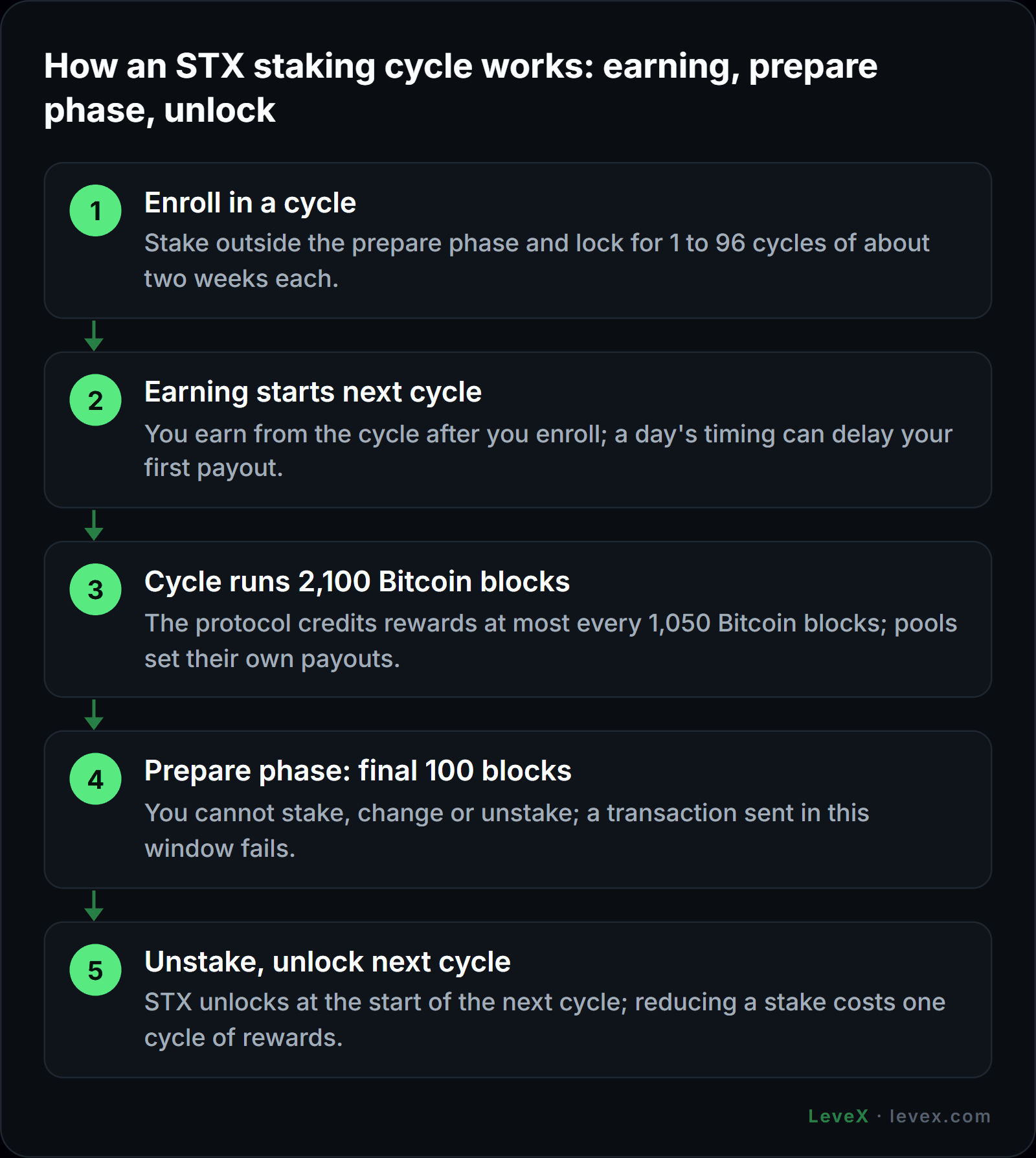
Pool payouts follow their own schedules. The protocol credits rewards at most every 1,050 Bitcoin blocks, about weekly, but some pools pay weekly, some roughly monthly, and some require you to claim manually. Choosing a pool with automatic payouts saves gas and attention.
Changing your position is easier than it was before PoX-5, as the Stacks guide to what changed in PoX-5 explains. You can increase the amount, extend the lock, switch pools or update your BTC address in one transaction without missing a cycle. Reducing your stake is the exception: you must unstake, wait for the cycle to end, and stake again, which costs one cycle of rewards. When you unstake, your STX unlocks at the start of the next cycle.
What You Earn After PoX-5
STX-only staking rewards now depend on what is left after Bitcoin Staking participants are paid. Under PoX-5, bonded BTC positions receive their target return first, and the surplus miner revenue is split 85% to STX-only stakers and 15% to a reserve. The mechanics of that waterfall, and the emissions that feed it, are covered in our STX tokenomics breakdown.
Before PoX-5, the stacking dashboard showed annualized returns around 7% in the cycles leading up to the upgrade, measured as BTC received against the value of STX locked. Tracking sites put recent figures between roughly 7% and 9%, but they vary widely from cycle to cycle. Two factors move the number: how much BTC miners spend, and how much STX is staked. Staked STX rose from 392 million to 493 million after PoX-5, according to Stacks' third-quarter 2026 report, so each staker's share of miner spending fell even as total participation grew.
Remember that the yield is paid in BTC while your principal stays in STX. A 7% BTC return does not offset a 30% drop in the STX price, and our STX price prediction lays out how wide those swings can be.
Liquid Staking and Protocol Bonds
Liquid staking through Stacking DAO gives you stSTX, a token that represents staked STX and collects rewards while remaining usable. You can lend it on Zest Protocol or sell it on a decentralized exchange instead of waiting for an unlock. The trade-off is that your tokens sit in a protocol's smart contract, adding contract risk, and stSTX can trade at a discount to STX when markets are stressed. The liquid staking model works the same way on Ethereum and other chains.
Protocol bonds are the Bitcoin Staking product, pairing BTC timelocked on the Bitcoin chain with STX worth at least 5% of that bitcoin for about six months. As of October 2026, bond capacity is allocated mainly to allowlisted institutions and pools, and a holder cannot run a bond and an STX-only position from the same address. For most STX holders, a pool is the practical choice today.
STX Staking FAQ
What is the minimum STX needed to stake?
There is no individual minimum when you stake through a pool. Each pool needs 50,000 STX in aggregate across all its members before it receives rewards, so any amount can join an established pool.
Can I stake STX on Ledger?
Yes. Connect your Ledger to Leather or Xverse and use Stacks App version 0.26.15 or newer. Your STX remains on the Ledger-controlled address while it is locked.
How long does it take to unstake STX?
Your STX unlocks at the start of the next reward cycle after you call unstake, which can be up to about two weeks. You cannot unstake during the final 100 Bitcoin blocks of a cycle.
Is Stacking the same as staking?
Yes. Stacking is the original name for locking STX to earn BTC under Proof of Transfer. PoX-5 documentation calls it staking, and both terms describe the same process.
Is Staking STX Worth It?
Staking STX makes sense for holders who already plan to keep the token, since it adds a BTC income stream with no transfer of custody. It suits less well anyone who wants to react quickly to price moves, because unlocking takes until the next cycle and the BTC return can be erased by a falling STX price. Start with a reputable pool, a short lock, and a payout address you control.
STX for staking can be bought on the STX spot market at LeveX and withdrawn to your wallet. If you prefer to trade price moves instead of locking tokens, STX perpetual futures are on the same account. Find more beginner explainers in Crypto in a Minute.