
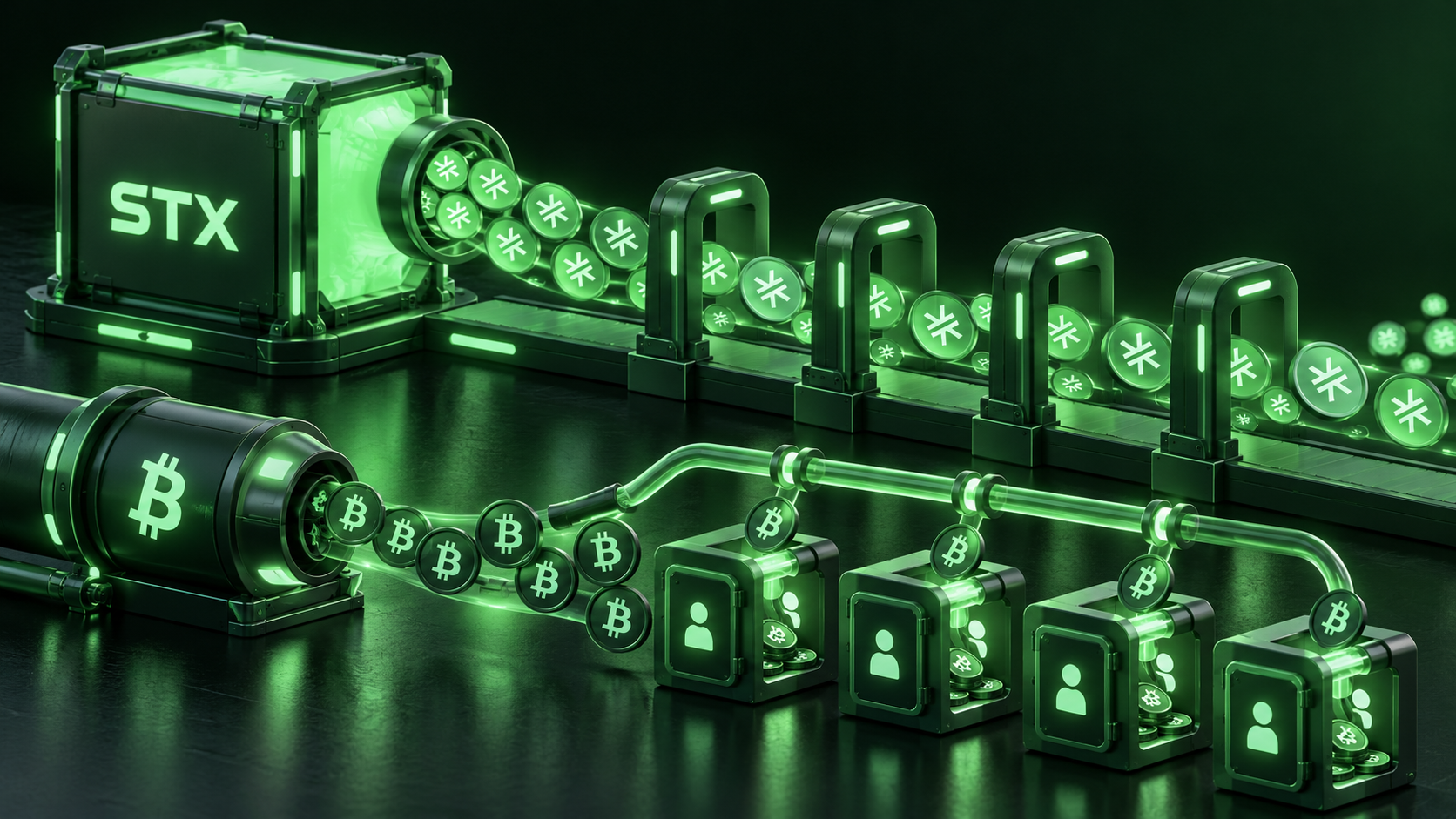
STX has no maximum supply: about 1.88 billion tokens circulate as of October 2026, and new STX is minted with every Bitcoin block at a rate of 1,000 STX per block plus a separate stream that funds the Stacks Endowment. What makes the tokenomics of Stacks unusual is where the value flows next. Miners pay bitcoin for those new tokens, and that bitcoin is distributed to people who lock STX, so the network's staking rewards are paid in BTC rather than in fresh STX.
This article breaks down where new STX comes from, how the BTC reward system splits its payouts after the July 2026 PoX-5 upgrade, and what holders should watch in future governance votes.
Where New STX Comes From
Two emission streams add to the supply, and one older source shaped where the existing tokens sit.
The coinbase. Every Bitcoin block, the miner who wins the Stacks tenure receives newly created STX. SIP-045 set this at 1,000 STX per block when the PoX-5 hard fork activated in July 2026, with no scheduled reductions during the PoX-5 phase. At roughly 52,500 Bitcoin blocks a year, that is about 52 million STX annually.
Endowment emissions. SIP-031 created a second minting stream that funds the Stacks Endowment, the body that pays for core engineering, security audits and ecosystem grants. SIP-045 left this stream unchanged and describes total supply growth as staying in single digits, then declining toward a low single-digit rate as SIP-031 emissions wind down. The endowment held about 112 million STX in long-term treasury at the end of June 2026.
The genesis allocation from the Blockstack years accounts for most of the remaining supply. Early investors, the founding team and buyers in the 2019 SEC-qualified offering received tokens that have long since vested, which is why circulating and total supply are almost identical today.
How the Emission Rate Has Changed
| Period | Coinbase per Bitcoin block | What drove it |
|---|---|---|
| January 2021 to April 2026 | 1,000 STX | Original schedule, extended by SIP-029 in late 2024 |
| April 2026 to July 2026 | 500 STX | First SIP-029 reduction, aligned with the Bitcoin halving cycle |
| July 2026 onward | 1,000 STX | SIP-045 restores the reward and removes scheduled cuts for PoX-5 |
The reversal in July 2026 surprised some holders who expected supply growth to keep slowing. The reasoning in the SIP-045 proposal is that higher miner rewards attract more BTC spending, which funds the BTC yield promised to Bitcoin Staking participants. The document calls the 1,000 STX rate provisional and says it will be reassessed under PoX-6.
For valuation, the trade-off is clear in numbers. Annual coinbase issuance of around 52 million STX equals about 2.8% of current supply, and endowment emissions sit on top. Our STX price prediction treats this dilution as the main headwind in its bear case.
Where the BTC Rewards Go After PoX-5
Before PoX-5, the bitcoin miners spent was shared among everyone who stacked STX, in proportion to their stake. PoX-5 replaced that with a three-tranche waterfall, and the order matters because it decides who gets paid first when miner revenue is low.
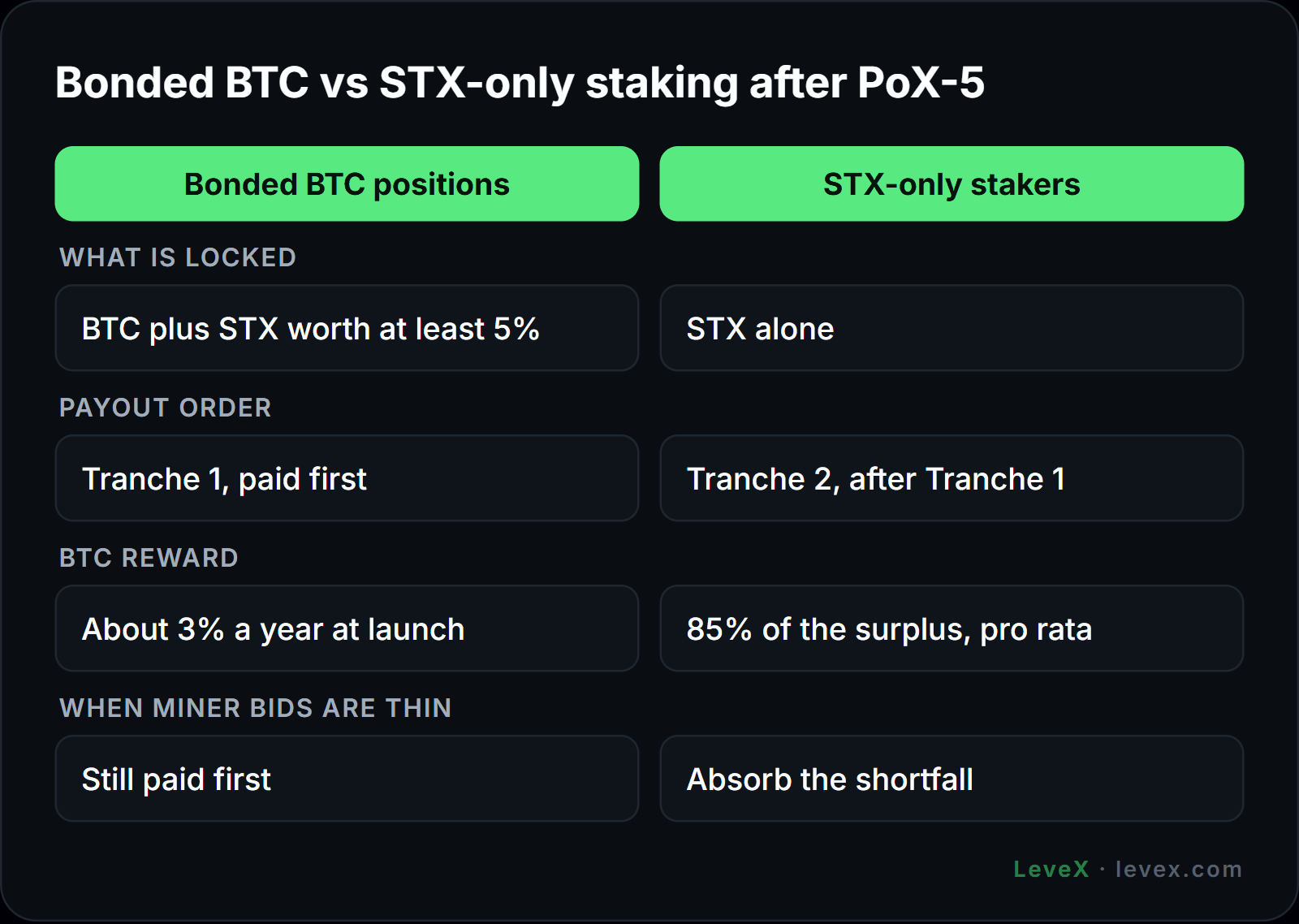
- Tranche 1, bonded positions. Participants who lock BTC on the Bitcoin chain and pair it with STX worth at least 5% of that BTC receive the target return first, about 3% a year in bitcoin at launch. Each bond lasts 25,200 Bitcoin blocks, roughly six months.
- Tranche 2, STX-only stakers. Miner revenue left over after Tranche 1 is split, with 85% going to holders who stake STX alone, pro rata.
- Tranche 3, the reserve. The remaining 15% of the surplus builds a reserve that can cover Tranche 1 payouts in weak periods. During PoX-5 it can only accumulate, and spending it would require a hard fork.
This structure turns STX-only staking into the residual claim on miner revenue. When miners bid heavily, STX stakers capture most of the upside. When bidding is thin, bonded BTC holders are paid first and STX-only stakers absorb the shortfall.
What Creates Demand for STX
Staking Locks
Staking is the largest sink for STX. According to Stacks' third-quarter 2026 figures, staked STX rose from 392 million to 493 million after PoX-5, a little over a quarter of the circulating supply. Reward cycles still run for 2,100 Bitcoin blocks, about two weeks, and PoX-5 removed the old cooldown so stakers can switch signers without missing a cycle.
Fees and DeFi Collateral
Every transaction on Stacks pays a fee in STX, and STX is used as collateral and liquidity across lending and trading apps. Stacking DAO alone reached a record 110 million STX in value locked during the second quarter, according to the Stacks Q2 2026 report. The 2026 roadmap mentions letting sBTC pay fees in the future, which would weaken this demand source if adopted.
The Bitcoin Staking Pairing
Bitcoin Staking requires STX alongside every bonded BTC position. The minimum ratio is small, so the direct demand is modest, but it ties STX to the growth of the product Stacks is betting on most heavily.
Governance and the Rules That Can Change
Every parameter above can be changed by a SIP. Hard forks need at least 80% approval from stacked STX with a quorum of 80 million stacked tokens, plus 80% approval from liquid STX holders voting separately. SIP-045 passed with more than 99.99% support in July 2026. Holders should treat the emission schedule as a policy that the community has already rewritten twice in two years, and that PoX-6 is expected to revisit.
STX Tokenomics FAQ
What is the total supply of STX?
The total supply of STX is about 1.88 billion as of October 2026, nearly all of it circulating. There is no hard cap, so the total increases with every Bitcoin block.
Is STX inflationary?
Yes. New STX is minted to miners every block and to the Stacks Endowment, adding several percent to the supply each year. SIP-045 states that annual supply growth stays in single digits and should decline as endowment emissions wind down.
Why are STX staking rewards paid in BTC?
Rewards are paid in BTC because Stacks miners spend bitcoin to win new STX, and Proof of Transfer sends that bitcoin to stakers. Stakers never receive newly minted STX as their reward.
Why STX Tokenomics Hinge on Miner Demand
STX tokenomics trade steady dilution for a BTC income stream, and the balance between the two decides whether holding the token makes sense. Supply grows every block regardless, while the BTC paid to stakers rises or falls with how much miners are willing to spend. PoX-5 adds a priority order that pays bonded bitcoin first, so STX-only stakers now hold the most leveraged claim on that miner demand.
Once you understand the supply picture, you can buy STX on the LeveX spot market or hedge supply-driven moves with STX perpetual futures. For short explainers on other tokens, head to Crypto in a Minute.