

sBTC Explained: Bitcoin You Can Use on Stacks
sBTC is a token backed 1:1 by bitcoin that lets BTC holders use their coins in lending, trading and yield apps on Stacks and convert back to BTC whenever they want. It opened for mainnet deposits on December 17, 2024, and instead of relying on one custodian, it uses a group of signers who must reach 70% agreement before any bitcoin moves. By mid-2026 the deposit cap had been removed and sBTC supply stood at about 2,950 BTC.
For anyone holding Bitcoin, sBTC is the doorway to the Stacks economy. This guide covers how deposits and withdrawals work, who holds the keys, how sBTC compares with custodial wrapped bitcoin, and what you can actually do with it.
How Bitcoin Becomes sBTC
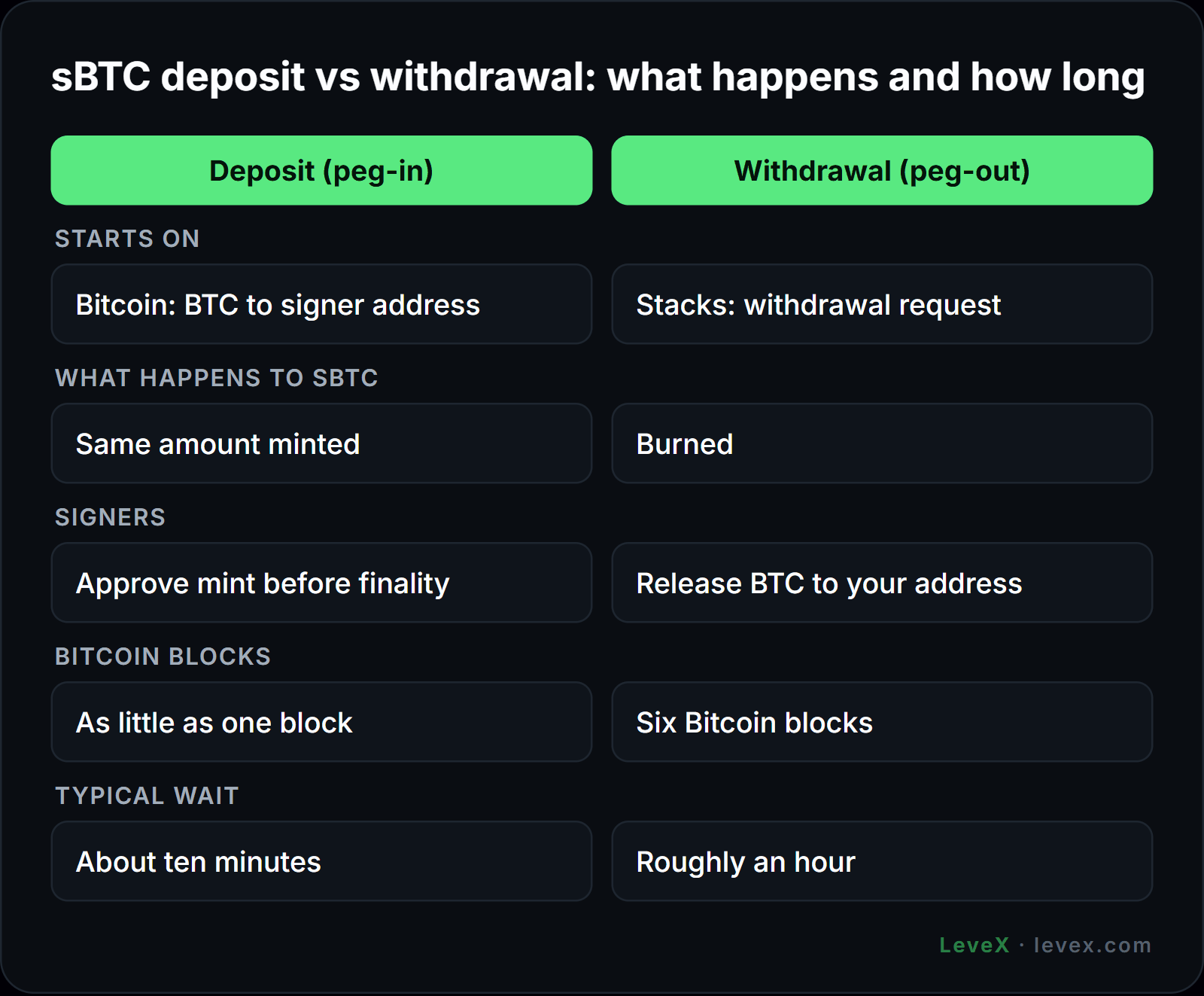
A deposit, or peg-in, takes as little as one Bitcoin block:
- Start a deposit in a supported app. The sBTC bridge app or a compatible wallet such as Leather, Xverse or Asigna creates the deposit transaction.
- Send BTC to the signer address. Your bitcoin goes to an address controlled jointly by the sBTC signers, and the transaction records your Stacks address.
- Signers approve the mint. Once the deposit is seen on Bitcoin, the signers approve it and the same amount of sBTC is minted to your Stacks address.
Signers do not wait for Bitcoin finality before minting, according to the sBTC timing documentation, so sBTC usually arrives within about ten minutes. Users who want more certainty can wait for additional confirmations.
Withdrawals, or peg-outs, run in reverse. You request a withdrawal on Stacks, the sBTC is burned, and the signers release BTC to your Bitcoin address after six Bitcoin blocks, roughly an hour. Network fees apply on both legs.
Who Holds the Bitcoin Behind sBTC
The BTC backing sBTC is held by a set of signers who jointly control the deposit address. The first phase launched with 15 institutional signers chosen for technical expertise and reliability, and the set is expected to grow toward a fully open model over time. Any deposit or withdrawal needs approval from 70% of them, so no single operator can move funds alone.
The sBTC security model adds external audits, a public bug bounty and ongoing research from security firms. Because Stacks blocks settle on Bitcoin, the record of sBTC transfers inherits Bitcoin's finality once confirmed.
This is a meaningful step up from a single custodian, but it is still a trust assumption. If enough signers colluded or were compromised, the bitcoin backing sBTC could be at risk. Users are trusting a threshold of known institutions, plus the code that coordinates them.
sBTC vs Custodial Wrapped Bitcoin
The most widely used form of bitcoin on other chains is custodial wrapped BTC, where one company holds the coins and issues tokens on chains such as Ethereum.
| Feature | sBTC on Stacks | Custodial wrapped BTC |
|---|---|---|
| Who holds the BTC | 15 signers, 70% threshold | A single custodian or small group |
| Minting | Permissionless through the bridge | Usually through approved merchants |
| Settlement | Stacks blocks anchored to Bitcoin | Host chain's own consensus |
| Redemption time | About 6 Bitcoin blocks | Depends on custodian processing |
| Main risk | Signer collusion or software failure | Custodian failure or freeze |
The difference that matters most to users is who can mint and redeem. With sBTC, anyone can move bitcoin in and out through the bridge without applying to a custodian. With custodial models, ordinary users usually buy the wrapped token on the market, and only approved partners deal with the custodian directly.
What You Can Do With sBTC
Earn Yield
The simplest use is earning a return on BTC. Lending markets such as Zest Protocol pay interest on sBTC deposits, and decentralized exchanges such as Bitflow pay trading fees to liquidity providers. Bitflow reported average yields on sBTC pairs of about 17.9% over 30 days in the second quarter of 2026, a figure driven by trading incentives that is unlikely to hold steady.
Borrow Without Selling
Borrowers can post sBTC as collateral on Zest or Granite and borrow stablecoins against it, keeping their bitcoin exposure without a taxable sale. Zest held more than $80 million in value by the third quarter of 2026 and had processed over 1,500 liquidations without bad debt.
Receive Staking Rewards
sBTC is also the default currency for Stacks staking rewards. When you lock STX, the BTC that miners spend is credited to you as sBTC unless your pool converts it to native bitcoin, as covered in our guide on how to stake STX. Many stakers keep those rewards as sBTC and put them to work in the same apps.
Risks of Holding sBTC
sBTC carries the risks of any bridged asset. A software flaw in the signer software, the Stacks contracts or the bridge app could freeze or lose funds, and the signer set is still small enough that its independence matters. Market risk is lower than for most tokens, since sBTC tracks the price of bitcoin rather than STX, but liquidity in sBTC pools can thin out during sharp moves. The value of STX itself is a separate question, explored in our STX price prediction.
There is also a policy dimension. The 2026 Stacks roadmap describes letting sBTC pay transaction fees in place of STX, which would make sBTC more useful but could reduce one source of demand for STX. That proposal is under evaluation, and how it fits the wider supply picture is covered in our STX tokenomics breakdown.
sBTC FAQ
Is sBTC the same as bitcoin?
sBTC is a separate token on Stacks, backed 1:1 by bitcoin held by the signer set. It tracks the price of BTC and can be redeemed for real bitcoin at any time, but it lives on Stacks rather than on the Bitcoin chain.
How long does it take to convert sBTC back to BTC?
A withdrawal completes after six Bitcoin blocks, about an hour. Network fees on both chains are deducted from the amount you receive.
Is sBTC safe?
sBTC is designed to be safer than single-custodian wrapped bitcoin, since 70% of 15 signers must approve every movement of funds. It still depends on those signers and on the software that coordinates them, so it carries more risk than holding BTC directly.
Why sBTC Matters for Stacks
Almost every product on Stacks, from lending to the yield paid to stakers, runs through sBTC. It is the asset that turns bitcoin into something Stacks applications can use, and its growth from launch in late 2024 to about 2,950 BTC by mid-2026 is the clearest measure of whether Bitcoin holders trust the network.
Traders who want exposure to that growth can buy STX on the LeveX spot market or take a directional position with STX perpetual futures. Explore more plain-language token guides in Crypto in a Minute.