
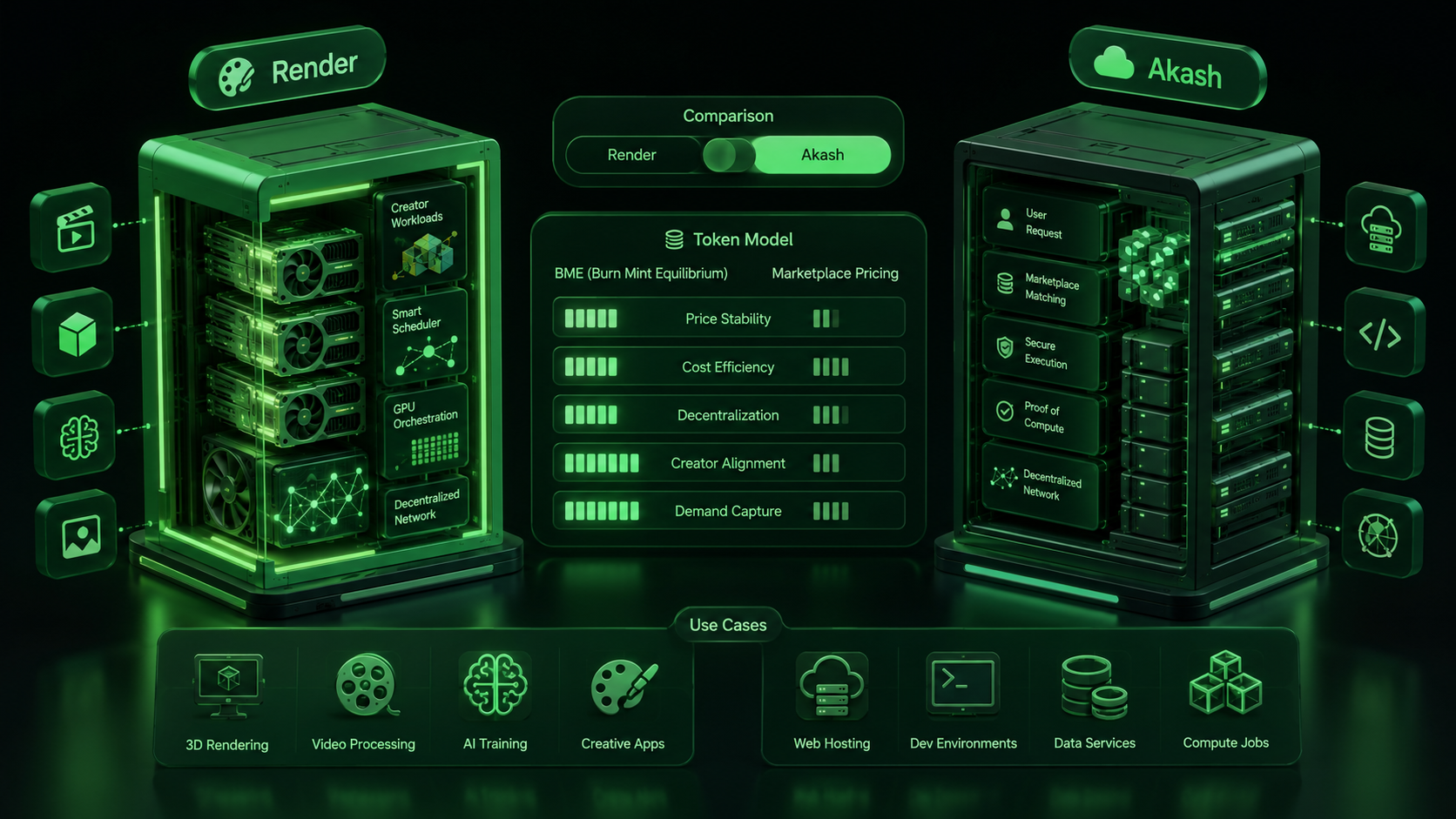
The race for decentralized GPU compute has created two distinct competitors with fundamentally different architectural philosophies. Render Network, a specialized rendering platform that recently migrated to Solana, and Akash, a general-purpose compute marketplace rooted in Cosmos, represent opposing approaches to solving the global compute shortage. While both networks tap idle GPU capacity to undercut centralized cloud providers, their design choices, use cases, and tokenomics reveal how different layers of the DePIN (Decentralized Physical Infrastructure Network) ecosystem can coexist.
Blockchain Foundation and Network Architecture
Render Network operates as a specialized application built on Solana's blockchain infrastructure. The move to Solana in 2025 addressed the scaling and cost limitations Render faced on Ethereum, where high transaction fees made it impractical for frequent job submissions and micropayments. According to Messari's analysis, Solana's throughput of 65,000+ transactions per second provides the speed necessary for a high-frequency marketplace. By building on Solana, Render leverages existing liquidity and infrastructure while maintaining control over its application layer. The blockchain primarily handles job coordination, payments, and cryptographic verification of completed work through Proof-of-Compute-Work (PoCW).
Akash built its own blockchain on the Cosmos SDK, creating a sovereign chain secured by its own validator set running Cosmos consensus. This design offered full control over protocol parameters and gas models, optimizing for low-cost deployments. However, Akash recently announced it will deprecate its self-built Cosmos chain by late 2026 and migrate to another network, evaluating Solana as a "strong candidate." This shift signals that even specialized chains may find advantages in settling on established Layer 1 networks rather than maintaining separate validator ecosystems.
Use Cases, Token Models, and Incentive Design
Render: Specialization in Rendering and Generative Media
Render's architecture optimizes for GPU-accelerated rendering pipelines, including 3D animation, visual effects, architectural visualization, and real-time graphics. The platform's compute client partitions complex rendering tasks across thousands of nodes simultaneously, with end-to-end encryption ensuring that node operators never see unobfuscated proprietary assets. This specialization extends to AI, where Render focuses on generative media (image synthesis, video generation, and content creation workflows).
The RENDER token operates on a burn-mint equilibrium model: tokens are burned when users pay for rendering jobs, and new tokens are minted as rewards to providers who complete work. Notably, RENDER cannot be staked by holders, functioning primarily as a payment medium and provider collateral signal. Token holders can vote on protocol upgrades and fee structures, but staking yields are not available. This design prioritizes payment fluidity over long-term token lockup incentives.
Akash: General-Purpose Compute Marketplace
Akash positions itself as a supercloud, accepting any containerized application submitted via its deployment specification. A developer specifies resource requirements (CPU, RAM, storage, GPU type), and providers bid competitively for the deployment. This general-purpose design accommodates ML model training, data analysis, web hosting, API services, and rendering jobs indifferently. The marketplace incentivizes cost competition while remaining agnostic to workload type.
The AKT token uses a burn-mint equilibrium mechanism (AKT 2.0) where tokens burned for compute create deflationary pressure tied directly to network usage. Critically, AKT can be staked by delegators and validators to secure the network through delegated proof-of-stake (DPoS) consensus. Stakers earn proportional rewards from transaction fees, creating an additional incentive layer for long-term holding beyond token appreciation. AKT holders also participate in governance through on-chain voting.
| Aspect | Render (RENDER) | Akash (AKT) |
|---|---|---|
| Primary Use Case | Rendering, visual effects, generative media | General-purpose compute (training, hosting, rendering) |
| Supply Mechanism | Burn-mint: tokens burned for jobs, minted for provider rewards | Burn-mint: tokens burned for compute, minted for staking rewards |
| Staking Availability | No staking; collateral signaling only | Full staking with validator/delegator rewards |
| Governance | Holders vote on upgrades and fees | AKT holders propose and vote on changes |
| Blockchain Home | Solana (post-2025 migration) | Cosmos SDK (migrating by late 2026) |
Provider Economics and Partnership Strategy
As documented by FinanceFeeds' analysis of the DePIN computing market, decentralized GPU providers undercut centralized cloud giants (AWS, Google Cloud, Azure) by 60–80% on compute rates, leveraging idle capacity that would otherwise remain unutilized. For Render, providers supply graphics processing power in exchange for RENDER token rewards distributed by the network. Job completion verification occurs on-chain, preventing fraud through cryptographic proofs. For Akash, providers submit bids in AKT, competing on price and hardware quality. Customers only pay for resources they use, avoiding cloud lock-in and overprovisioning costs.
Render's go-to-market strategy emphasizes enterprise and creative partnerships. The network secured integrations with NVIDIA Omniverse (for digital twin simulation and synthetic data generation), partnerships with AI labs like Stability AI and Luma Labs, and relationships with visual effects studios and game developers. These partnerships drive adoption by embedding Render into existing creative workflows, making GPU compute purchasing transparent to end users through partner applications.
Akash's strategy centers on openness and accessibility. By accepting any containerized workload, Akash appeals to developers, researchers, and small-to-medium enterprises seeking to avoid cloud vendor lock-in. The network's technical accessibility contrasts with Render's deep integration into creative industry workflows. Both approaches drive real economic activity: Render through rendering job volume (tracked on-chain), Akash through competitive provider bidding and deployment volume.
Technical Trade-Offs and Scaling Challenges
Render's Specialization Trade-Off
Render's narrow focus on rendering and generative media creates deep optimization for graphics workflows but limits addressable market scope. A developer needing GPU compute for data processing or model training might find Render's architecture overoptimized for rendering specifics. The platform's migration to Solana also creates execution risk: dependence on Solana's continued security and adoption. Additionally, RENDER's non-stakeable design means token holders cannot earn yield through protocol participation, limiting incentive structures for long-term holding beyond speculation.
Akash's Generalization Challenge
Akash's openness creates usability friction. Developers must understand containerization, specify resource requirements, and manage deployments manually. This flexibility appeals to technical users but excludes non-specialists. The platform's chain migration plans introduce regulatory and technical uncertainty, as moving from Cosmos to another Layer 1 will require careful token bridge design and validator coordination. Akash's lower barriers to entry also mean less competitive moat around partnerships compared to Render's deep studio relationships.
The GPU Computing Market's Architecture Divergence
Both networks are consolidating onto established blockchains: Render already on Solana, Akash in transition. This trend suggests that specialized DePIN applications benefit from existing blockchain security and liquidity rather than maintaining sovereign chains. The differentiation increasingly lies in which workloads each platform attracts and the depth of partnership integration.
Understanding these architectural differences helps contextualize long-term tokenomics and use-case resilience. Render's economic narrative centers on creative AI adoption and studio demand for on-demand rendering. Akash's upside depends on Web3 infrastructure maturity and cost-conscious compute purchasing. For deeper analysis, explore how Render Network GPU computing works, the Render price outlook, and Render tokenomics. Additional context comes from the Render Solana migration and Render ecosystem partnerships.
For traders evaluating both projects, the question is not which will dominate but how each will capture its segment of the decentralized compute economy. Both have demonstrated real economic activity and working networks. If you're accumulating RENDER tokens, understanding the best wallets for secure Render storage is essential for long-term security. The long-term winner will be determined by partnerships, provider supply stability, and whether decentralized compute can sustainably serve AI and creative industries at scale.
Trade RENDER on spot markets or explore RENDER futures on LeveX. For broader context on decentralized computing infrastructure, browse Crypto in a Minute for foundational token guides and ecosystem overviews.