
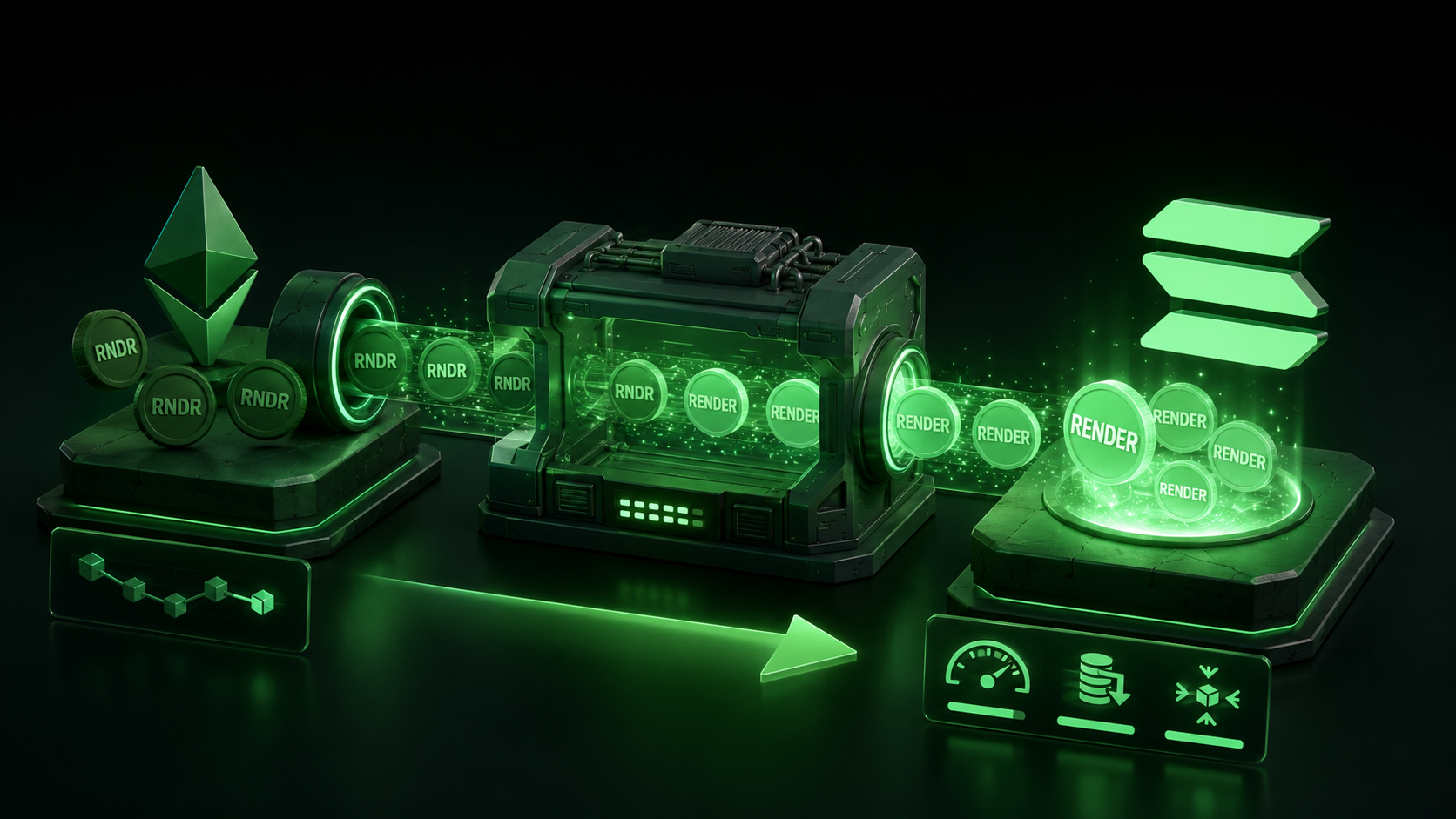
On November 2, 2023, Render Network completed one of the most significant infrastructure transitions in GPU computing. The network moved its token and blockchain foundation from Ethereum to Solana, retiring the RNDR ticker in favor of RENDER. This was a fundamental shift driven by the physics of how rendering and AI compute work. Thousands of micro-transactions, real-time streaming, and predictable costs became possible in ways they weren't on Ethereum.
For token holders, the migration raised practical questions: How does the swap work? What changed about RENDER itself? Why does Solana matter for GPU compute? This guide walks through what happened, why it mattered, and what holders need to know today.
The Shift from Ethereum to Solana
Render started on Ethereum because Ethereum was the natural choice for crypto infrastructure in 2020. By 2023, Ethereum's architecture no longer matched Render's workload. The network processes thousands of small payments per second, including GPU rentals that cost fractions of a cent. On Ethereum, a transaction that cost a cent to execute might cost dollars in gas fees to settle.
The Render community voted to move in governance proposal RNP-002, choosing Solana for its speed and throughput capacity. As documented in the Render Network Upgrade Portal FAQ, the transition was designed for minimal friction. Wormhole's cross-chain messaging protocol handled the asset transfer safely and trustlessly. RNDR tokens were burned on Ethereum and reissued as RENDER on Solana at a 1:1 ratio. The Render Foundation offered incentives to token holders who completed the upgrade within three months, and the upgrade portal remains open indefinitely for anyone who hasn't migrated yet.
Understanding the RNDR to RENDER Token Swap
The token swap followed a simple process, though the mechanics mattered for security:
- Connect your Ethereum wallet to upgrade.rendernetwork.com
- Select your RNDR balance and amount to migrate
- Approve the burn transaction on Ethereum (gas fees covered during the incentive period)
- Receive RENDER tokens at your Solana wallet within 15-20 minutes
Key mechanics: 1 RNDR = 1 RENDER with no premium or discount. RNDR tokens were burned, not held in escrow, eliminating the risk of duplicate supply across chains. After the incentive period, holders paid their own Ethereum gas fees to migrate.
Most major exchanges (including several leading platforms) auto-migrated customer holdings on a 1:1 basis. If you held RNDR on a smaller platform, check whether they auto-migrated or have deprecated the token. For personal wallet holders, the Upgrade Assistant remains the official migration path.
Technical Advantages on Solana
The migration solved a core technical problem: how to make thousands of tiny transactions feel instant and cost pennies instead of dollars. Solana's design explicitly targets high-throughput, low-cost transactions.
Speed: Solana settles transactions in under a second with finality, compared to Ethereum's 12-15 second block time. For a GPU rental marketplace with continuous transactions, a single render job involving dozens of micro-transactions now settles in seconds rather than minutes.
Cost: According to Render Foundation documentation, Solana fees run roughly $0.00025 per transaction under normal conditions, while Ethereum fees typically start at $0.50-$2.00 even during low congestion. For rendering workloads generating thousands of transactions per job, this cost difference enables use cases that were economically impossible before.
Real-time settlement: The combination of speed and low cost enables instant payment flows. GPU providers complete work and receive payment immediately, without batching delays or layer-2 workarounds. This reliability makes the rental market more accessible to smaller creators and faster for all participants.
These advantages compound across the ecosystem. Smaller participants can join without worrying that transaction fees consume their margins. The network scales horizontally without hitting Ethereum's cost ceiling that had constrained growth.
What Holders and Traders Should Know
Wallet requirements: RENDER is a Solana SPL token, requiring a Solana-compatible wallet like Phantom, Magic Eden, or Solflare. The best Render wallets guide covers which wallets suit different use cases: exchange staking, cold storage, or app integration.
Exchange support: Most major platforms auto-migrated holdings automatically. If you held RNDR on a smaller exchange, check its support page. Some may have deprecated RNDR entirely.
Remaining RNDR: If you still hold Ethereum-based RNDR, you can migrate through the Upgrade Assistant, but you'll pay current Ethereum gas fees. During periods of network congestion, gas spikes can make small migrations uneconomical.
Price and value: The 1:1 swap ensured holders kept equivalent economic exposure. The network's improved efficiency on Solana enabled more use cases over time, supporting adoption. But the token itself (supply mechanics, staking rewards, governance weight) remained structurally unchanged.
RENDER's core functions didn't change with the migration. It still powers GPU rental payments, secures node operator staking, and governs network direction. Understanding Render Network tokenomics and how these roles distribute value helps traders evaluate long-term strategies.
RENDER's Ecosystem Position
The migration positioned Render within Solana's ecosystem at a time when Solana was attracting AI and compute infrastructure projects. Render vs Akash shows how decentralized compute platforms compete. Solana's throughput, combined with Render's GPU focus, creates a specific advantage in rendering and AI workloads.
Holders often ask whether further blockchain moves are possible. Unlikely in the near term. Solana's performance exceeds Render's transaction needs. But the precedent is set: the community prioritizes function over loyalty, and the network will migrate again if workloads demand it.
Explore Render Network's ecosystem of partnerships and integrations to understand which projects depend on this infrastructure. For technical depth, how Render Network GPU computing works explains the workload that drove this decision.
Solana as the Foundation for Scaled GPU Computing
The Render Network's migration to Solana was both technical and philosophical. The network chose a blockchain matched to its workload rather than adapting the workload to the blockchain. That distinction matters for traders evaluating long-term utility.
Thousands of small transactions that felt expensive on Ethereum now feel natural on Solana. Creator adoption, GPU provider onboarding, and real-time payment streams became viable in ways they simply weren't before. The RENDER token didn't change in function. It still powers compute rentals, staking, and governance. What changed was the cost and speed of executing those functions, enabling an ecosystem that couldn't exist in the previous architecture.
RENDER remains a bet on decentralized GPU computing becoming core infrastructure. The Solana migration didn't change that thesis. It removed the technical obstacle that was constraining progress. Trade RENDER on LeveX spot markets for direct exposure, or use RENDER futures to manage longer-term positions. Browse Crypto in a Minute for guides to other GPU computing and AI infrastructure tokens. For market analysis, see RENDER price prediction.