
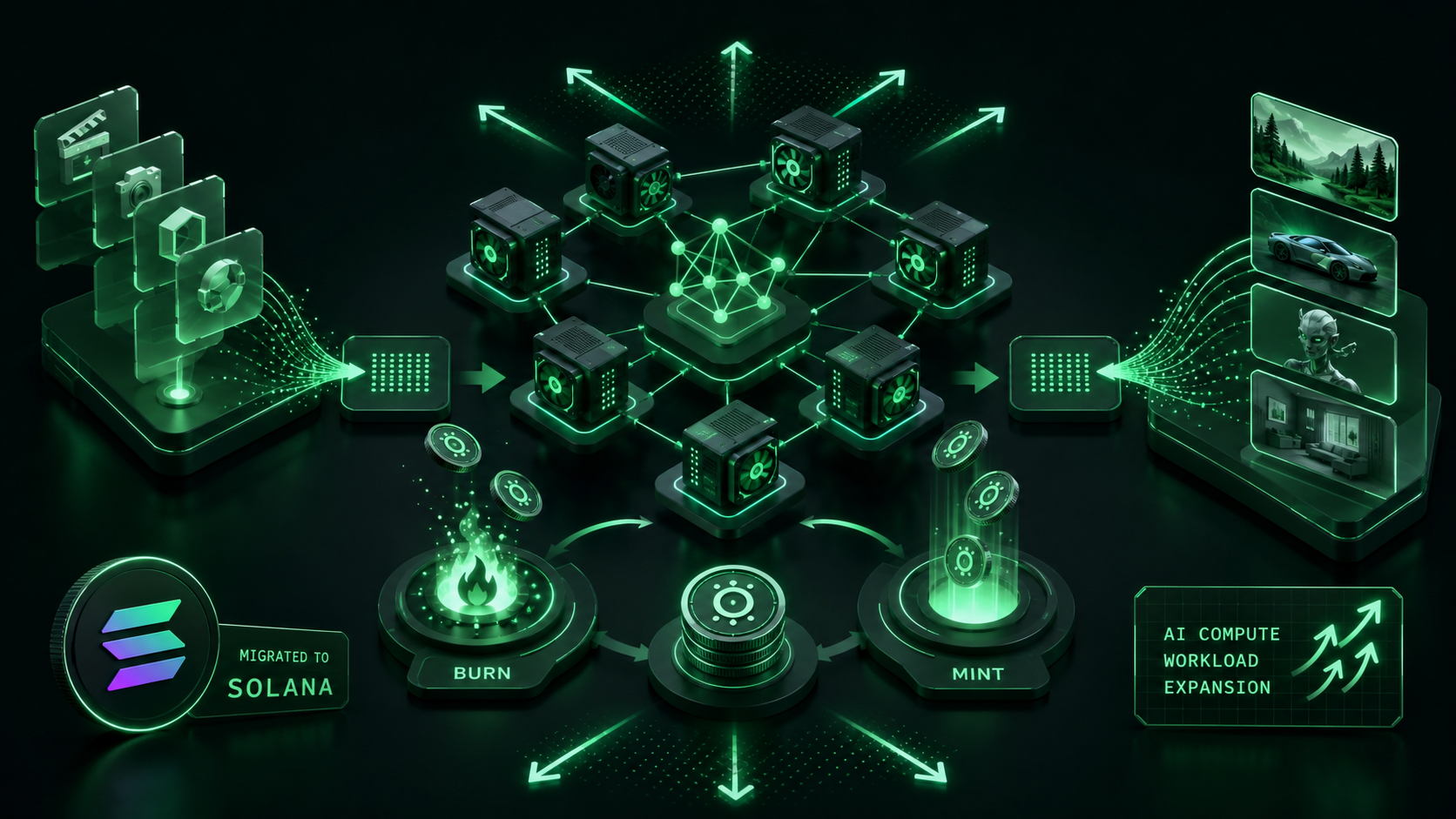
Render Network powers a global marketplace where creators tap idle GPU resources for 3D rendering and AI computation, while node operators monetize underutilized hardware. Running on Solana, the RENDER token coordinates a trustless, decentralized compute economy that rewards both sides of the marketplace through its innovative Burn-Mint Equilibrium model.
What Is Render Network?
Render Network is the world's first decentralized GPU rendering platform, launched in 2017 and designed to democratize access to high-performance computing resources. Rather than relying on centralized cloud providers like AWS or traditional render farms, the network connects creators (3D artists, VR/AR developers, AI researchers, and studios) with a distributed network of GPU providers who contribute their computing power.
The platform solves two critical problems: expensive, vendor-locked cloud rendering for creators, and idle GPU hardware for node operators. By tokenizing GPU compute, Render enables creators to pay only for the rendering time they use while giving GPU owners a way to generate passive income from hardware that would otherwise sit unused. According to Messari's comprehensive analysis, Render has grown to process rendering jobs from thousands of creators while supporting a network of GPU providers globally.
How Decentralized GPU Rendering Works
Render Network operates through a three-player ecosystem coordinated by the RENDER token:
Creators Submit Jobs
Creators (artists, developers, labs) submit rendering or compute jobs through the Render Portal, API integrations, or supported software plugins like Blender, Cinema4D, OctaneRender, and Redshift. Jobs are priced in USD equivalent and processed globally across hundreds of high-performance GPU nodes for lightning-fast completion.
Node Operators Provide Compute
GPU owners install Render Node software and make their hardware available to the network. Whether a single GPU or a data center's worth of capacity, node operators earn RENDER tokens proportional to the compute work they complete. The network handles job distribution, validation, and payment settlement automatically.
RENDER Tokens Enable Settlement
The RENDER token is the medium of exchange. Creators purchase RENDER to pay for rendering work; node operators earn RENDER as compensation. The token's economic design, covered in the section below, ensures stable pricing for creators while incentivizing sustainable GPU supply.
The Burn-Mint Equilibrium Model
In late 2024, the Render Network community voted to implement a revolutionary tokenomics shift called Burn-Mint Equilibrium (BME), transforming RENDER from a fixed-supply token to a managed emissions system tied directly to network activity.
Under BME, every rendering job processed creates a deflationary pressure on RENDER supply: creators pay for jobs in USD equivalent, which is then burned (destroyed) from total supply, minus a 5% operational fee retained by the network. Simultaneously, the network mints new RENDER tokens on a predefined declining schedule, distributing them as rewards to node operators who completed the work.
This dual mechanism creates three outcomes:
Price Stability for Creators. Jobs are always priced in USD, not token price. If RENDER price doubles, creators still pay the same dollar amount, and the network simply burns fewer tokens. This decouples job pricing from volatility.
Token Scarcity. High network utilization burns tokens faster than new ones are minted, creating deflationary pressure. Strong growth in rendering demand pulls RENDER supply downward, potentially driving long-term value accumulation for holders.
Supply Incentives. Node operators are rewarded with freshly minted RENDER on a declining schedule (approximately 9.13 million in 2024, declining to 5.90 million in 2025, and further declining over the next decade). This creates predictable incentives for GPU capacity expansion without explosive inflation.
The result is an economic model where network success (more rendering jobs) directly tightens supply, unlike many crypto projects where increasing adoption increases token supply and dilutes holders.
From Ethereum to Solana: The Network Migration
Render Network originally launched on Ethereum as an ERC-20 token (RNDR). For years, the ecosystem operated on Ethereum, but as the network expanded into AI and compute-heavy workloads, Ethereum's high gas fees and slower settlement times became a bottleneck. The network could not sustain rapid, cheap job submissions and payments at scale.
In 2023, the Render Foundation proposed moving the entire protocol to Solana. The community voted yes, and on November 2, 2023, the upgrade was completed. The token was renamed RENDER (the SPL token on Solana), and the Render Foundation operated an upgrade portal that converted RNDR (ERC-20) to RENDER (SPL) on a 1:1 basis. The Foundation subsidized gas fees for three months to encourage migration, then the portal remained open indefinitely for stragglers.
This move delivered immediate benefits: sub-second settlement, near-zero transaction costs, and the ability to process thousands of rendering jobs per second. The Solana blockchain's high throughput was essential for scaling Render's ambitions into AI compute, where latency and cost matter intensely.
Ecosystem Components and Use Cases
Render Network now operates as a three-part ecosystem, each serving distinct creator needs:
Rendering Subnet
The original core product distributes 3D rendering tasks to GPU providers. This remains the primary use case for professional studios, architectural visualization, VFX, motion graphics, and product visualization. Creators submit scenes in standard formats (OctaneRender, Blender Cycles, Cinema4D, Redshift) and receive rendered frames or sequences within hours.
Compute Subnet
Launched in 2024, the Compute Subnet extends Render's infrastructure to general AI workloads: model training, inference, fine-tuning, and machine learning pipelines. This positions Render as a competitive alternative to centralized cloud providers for researchers and AI labs with budget constraints.
Render API
Developers and platforms can programmatically submit jobs, retrieve outputs, and monitor network activity without using the web portal. This integration layer powers third-party platforms and enables rendering as a behind-the-scenes service within larger applications.
Each component uses the same RENDER token settlement and BME economics, creating network effects: more creators (and more GPU supply) in any component makes the entire network more valuable.
RENDER Tokenomics, Supply, and FAQs
The Render Network had a maximum supply of approximately 536.87 million RNDR under its original fixed-supply design. Following the Solana migration and BME adoption, the maximum supply increased to 644.25 million RENDER, with 107.38 million additional tokens scheduled to be issued on Solana over a ten-year declining emission schedule. Current market data on CoinGecko shows circulating supply at approximately 518.7 million tokens.
| Category | Allocation |
|---|---|
| Inflation and Incentives | 16.67% |
| RNDR Reserve | 8.61% |
| Escrow for Distribution | 6.52% |
| Partner Escrow | 26.60% |
| OTOY Treasury | 23.30% |
| Public and Private Sales | 18.29% |
Under the BME model, circulating supply fluctuates based on network activity: high rendering demand burns tokens faster than emissions, tightening supply, while low activity results in net emission. This dynamic supply reflects actual network health and utility.
What happens if network activity drops under the BME model? If fewer rendering jobs are submitted, fewer tokens are burned. The network will mint RENDER for node operators according to the emission schedule, resulting in net supply growth. This temporary inflation incentivizes node operators to lower prices or improve service quality to attract more work.
Can I use RENDER to stake or earn yield? RENDER is not a staking token. Rewards come exclusively from being a node operator (completing rendering/compute work) or from trading. There is no separate staking mechanism or yield farming.
Why did Render move to Solana instead of staying on Ethereum or choosing a different chain? Solana's high throughput (thousands of transactions per second), near-zero fees, and sub-second settlement made it uniquely suited for a high-frequency compute marketplace. The community voted on this migration, weighing Solana's technical advantages against other options.
What's the difference between the Rendering Subnet and the Compute Subnet? The Rendering Subnet handles 3D graphics rendering (visual output). The Compute Subnet handles general AI and machine learning workloads (model training, inference). Both use RENDER for settlement and rewards, but serve different creator communities.
Why Render Network Matters for Traders
Render Network represents a rare intersection of technical innovation and market timing. The project tackles genuine infrastructure scarcity (affordable, decentralized GPU access) at a moment when AI and 3D graphics demand is accelerating. The Burn-Mint Equilibrium model is one of the few tokenomics innovations that actually makes sense: token holders benefit when network activity increases, creating direct alignment between token value and protocol utility.
For traders, RENDER's appeal lies in its exposure to two massive growth trends simultaneously: the explosion in AI compute demand and the decentralization of cloud infrastructure. If rendering and compute workloads migrate meaningfully from centralized clouds to Render's network, the deflationary pressure from token burns could drive significant value accumulation.
The Solana migration removed the technical barriers that once held the network back, and the current ecosystem expansion into AI positions Render at the center of one of crypto's most productive debates: how do you build decentralized infrastructure that actually replaces centralized incumbents?
Ready to trade RENDER? LeveX offers spot trading and futures contracts with leverage up to 500x on BTC/ETH and up to 100x on altcoins. Explore more foundational token guides in our Crypto in a Minute category.