
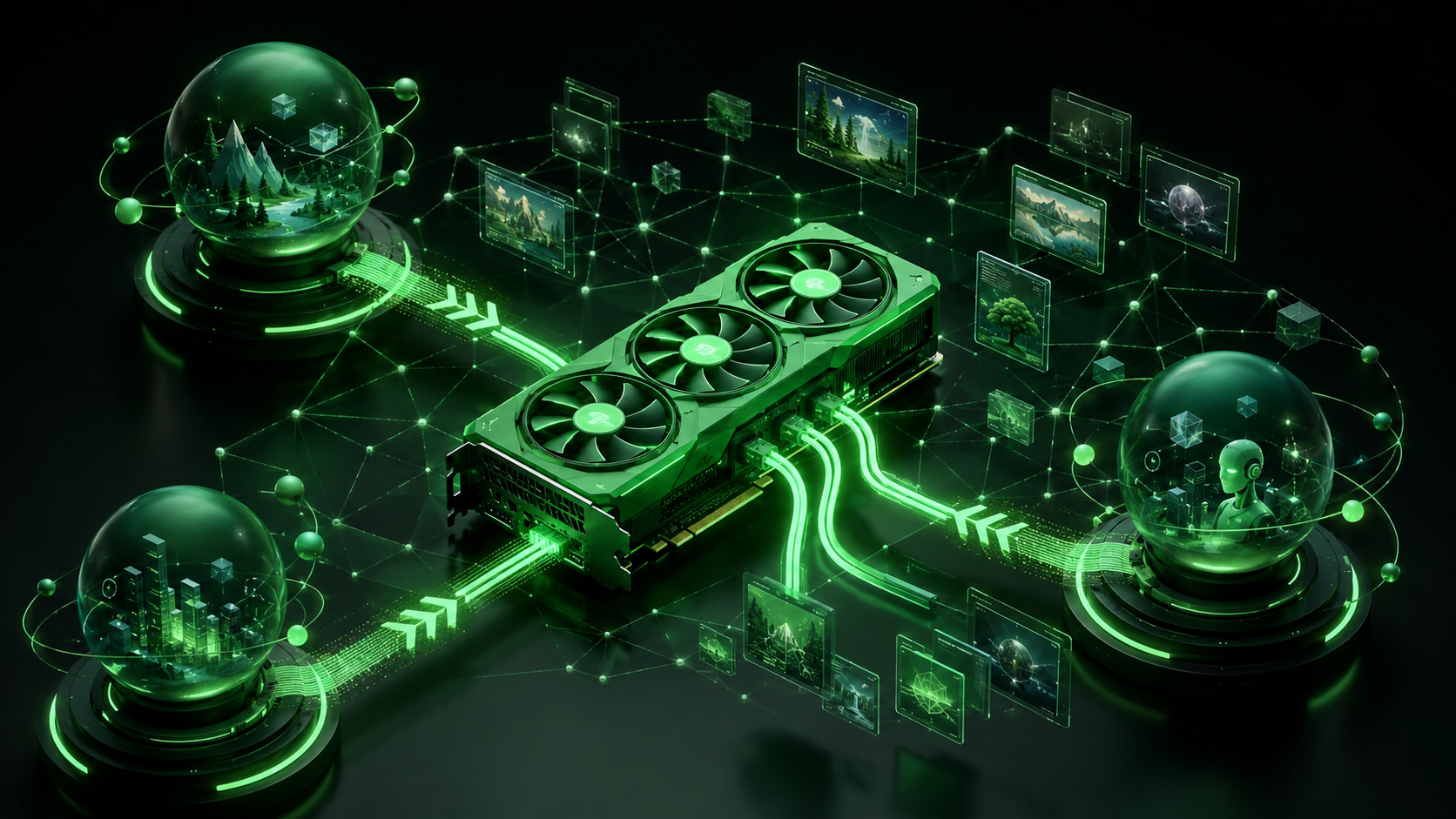
Render Network has evolved from a niche GPU-sharing platform into a hub for distributed computing that connects creative professionals, AI developers, and enterprise clients through a decentralized infrastructure layer. Unlike traditional centralized rendering services, Render Network operates as a peer-to-peer marketplace where node operators monetize idle GPU capacity while creators access world-class compute power without the overhead of proprietary cloud providers. The ecosystem's strength lies in strategic partnerships that integrate Render's infrastructure into tools and workflows already trusted by millions of creators worldwide.
How Render's Partnerships Shape the Ecosystem
The Render Network Foundation, spun out from OTOY Inc. in 2023, oversees protocol governance and drives adoption across the creative and AI sectors. This organizational structure separates the protocol layer from the for-profit services arm, creating clear incentives: the Foundation manages the token economy and strategic roadmap, while OTOY continues developing user-facing tools and optimizations. OTOY, Inc. remains the network's largest ecosystem partner despite the Foundation's independent governance structure. Jules Urbach, OTOY's founder and CEO, conceived of Render Network in 2009 as a solution to the economics of GPU rendering, demonstrating sustained commitment spanning 15+ years.
RENDER token holders participate in governance decisions through a decentralized autonomous organization (DAO) structure. Token holders can submit and vote on development proposals, directing the protocol's evolution toward use cases that drive demand for GPU resources. This alignment of incentives means that as more creators use the network, demand for RENDER increases, benefiting long-term token holders and node operators alike.
Hardware Integration: NVIDIA, Apple, and Enterprise Adoption
Node operators on Render Network predominantly rely on NVIDIA GPUs, which have become the de facto standard for AI training, inference, and 3D rendering. According to research from Messari, Render's architecture was optimized around CUDA-enabled GPUs with a minimum of CUDA 10.1 drivers and compute capability 3.0 or higher. This technical requirement reflects NVIDIA's dominance in the professional GPU market.
In May 2024, Render Network partnered with Apple to bring OctaneX, a GPU rendering platform, to Apple's latest hardware lineup including the M4 iPad Pro and MacBook Pro models. OctaneX was specifically optimized for Apple's silicon architecture and showcased during Apple's Worldwide Developers Conference (WWDC). This partnership represents major validation by one of the world's largest technology companies, opening Render to Apple's creative professional community: motion graphics designers, 3D artists, architects, and product designers who work with macOS and iPad. These users can now offload compute-intensive rendering tasks to the Render Network while remaining within Apple's ecosystem.
AI and Creative Tools Integration
In 2024, Stability AI partnered with OTOY and Render Network to develop next-generation AI models, IP rights systems, and open standards for generative AI workflows. This partnership addresses a critical gap: while Stability AI excels at creating generative models, Render Network provides the distributed compute infrastructure needed to run inference at scale.
Render Network integrates with 26+ mainstream 3D software tools, enabling creators to submit rendering jobs directly from their preferred applications. The following table shows the major tool integrations:
| Tool Category | Examples | Purpose |
|---|---|---|
| Rendering Engines | OctaneRender, Redshift, Blender Cycles | Photorealistic output, motion graphics, open-source rendering |
| Generative AI | Runway, Black Forest Labs, Luma Labs, Stability AI | Image generation, upscaling, 3D asset creation |
| 3D Creation | Cinema 4D, Houdini, Maya, 3ds Max | Professional content creation workflows |
Stability AI founder Emad Mostaque joined the Render Network Advisory Board, signaling long-term commitment to standardizing generative AI workflows on decentralized infrastructure. The partnership is developing open standards through the Immersive Digital Experiences Alliance (IDEA), ensuring that AI integration benefits the entire ecosystem rather than creating proprietary lock-in. Proof-of-Render creates immutable on-chain records of all GPU compute work, tracking which model versions, parameters, and inputs were used to generate outputs. This addresses IP rights concerns by enabling creators and enterprises to audit exactly which AI models contributed to specific media.
Why the Ecosystem Matters for Token Value and Trading
Understanding Render's ecosystem is essential for traders evaluating the token beyond speculation. The ecosystem depth demonstrates that decentralized GPU rendering has moved from theoretical to production-ready. Professional studios, content creators, and AI researchers are building pipelines that depend on Render's infrastructure. Partnerships with Apple, Stability AI, and NVIDIA signal that Render is evolving into genuine infrastructure.
For traders, this ecosystem depth translates to lower execution risk. Unlike tokens tied to a single product or feature succeeding, Render's value is distributed across multiple high-value integrations. Even if one partnership underperforms, the others continue generating network effects and token demand. Understanding Render's ecosystem also informs strategic analysis across different market conditions. As adoption metrics improve (more nodes, higher utilization, more paid rendering jobs), token price tends to follow. The partnerships detailed here are the mechanisms through which adoption actually occurs.
Ecosystem-aware traders monitor real metrics rather than pure speculation: node operator count, rendering job volume, AI inference requests, and partnership expansion announcements. These metrics lag price movements but lead them over longer timeframes, distinguishing between temporary volatility and genuine trend shifts. A 20% price drop during a bear market matters less if adoption metrics are accelerating. The integration with Solana in 2023, when RNDR (ERC-20) migrated to RENDER (SPL token), accelerated ecosystem development by tapping Solana's DeFi infrastructure and developer community.
Ecosystem as Sustained Competitive Advantage
Render Network occupies a unique position in the Web3 infrastructure layer. Unlike DeFi tokens focused on financial mechanics or Layer 1 blockchains competing on throughput, Render solves a real-world problem that large companies like Apple, Stability AI, and NVIDIA have already validated. This positioning makes RENDER's tokenomics meaningful: unlike tokens where demand is entirely speculative, RENDER demand is rooted in network usage. The ecosystem approach explains why Render Network has survived multiple market cycles with adoption metrics continuing to grow even during bear markets. During bull runs, speculative demand drives price. During bear markets, fundamental usage demand keeps the network alive.
The ecosystem transforms the token from "betting on GPU demand" into "betting on Render becoming the infrastructure layer for creator computing." This narrative shift differentiates Render from other AI and compute tokens in the market and is grounded in the partnerships and integrations detailed throughout this article. The competitive advantage of Render's approach is that it avoids zero-sum dynamics. Unlike proprietary cloud rendering services, Render benefits when any of its partners succeed because network effects multiply. More AI models mean more use cases. More rendering engines mean more creative professionals.
Trading Render Based on Ecosystem Fundamentals
The ecosystem context helps traders distinguish between temporary price volatility and genuine trend shifts. When professionals integrate Render's infrastructure into daily workflows, whether through OctaneX on iPad Pro or Stability AI model inference, that usage becomes baseline. Ecosystem growth at this scale drives sustained token demand across market cycles. Understanding this also helps evaluate Render's price trajectory as adoption metrics improve rather than relying on pure speculation.
For traders on LeveX, ecosystem development serves as a strategic lens for entry and exit decisions. Start trading RENDER on LeveX's spot markets to capitalize on ecosystem-driven growth, or explore perpetual contracts for leveraged exposure to long-term ecosystem trends. For deeper context on Render's fundamentals, explore more Crypto in a Minute guides and sister articles on tokenomics mechanics, GPU computing architecture, wallet selection, and how it compares to Akash Network.