
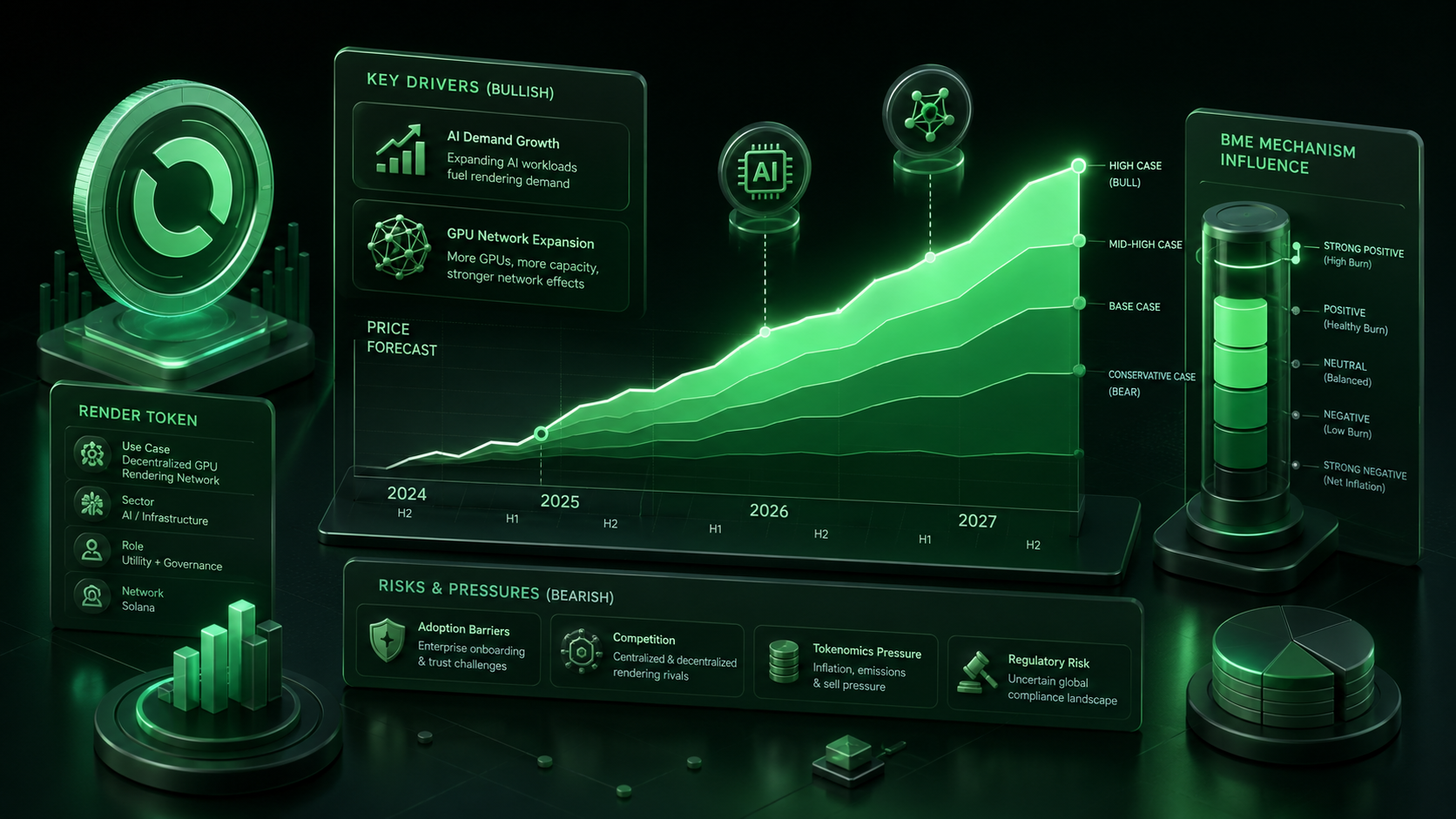
Render has emerged as one of the most utility-focused assets in the decentralized compute space, with its price increasingly driven by real network usage rather than pure speculation. As AI adoption accelerates and Render Network scales its Compute Subnet (branded as Dispersed), analysts and traders are reassessing long-term price targets and the fundamental drivers behind RENDER's value proposition.
Current Market Position and Network Growth
Render Network's GPU marketplace achieved 87% year-over-year growth in 2025, cementing its position as Solana's largest DePIN project. More significantly, the network onboarded 40% more computing power and burned over 1 million RENDER tokens through its Burn-Mint Equilibrium mechanism, indicating a shift from theoretical utility to measurable on-chain activity.
The broader market context makes this expansion timely. GPU infrastructure is projected to grow from $83 billion in 2025 to $353 billion by 2030, while AI spending is expected to surge from $184 billion in 2024 to $826 billion by 2030. This structural tailwind positions decentralized GPU networks like Render not as speculative plays but as infrastructure benefiting from secular demand growth.
Render's strategic pivot into AI workloads through Dispersed represents the network's most significant expansion since its Solana migration. Early customer onboarding and GPU capacity expansion are now the primary growth vectors, with the community evaluating proposals to integrate additional computing sources (such as Salad's ~60,000 consumer-grade GPUs) to meet exploding AI demand.
Analyst Price Forecasts for 2026 and 2027
Price predictions for RENDER vary across analyst forecasts, reflecting uncertainty about adoption speed and broader market conditions. The following table summarizes analyst ranges across major forecasting platforms:
| Year | Low | High | Mid-Range | Key Assumption |
|---|---|---|---|---|
| 2026 | $4.04 | $15.00 | $9.50 | Continued network growth, modest AI adoption |
| 2027 | $9.00 | $20.00 | $14.50 | Accelerating AI workloads, expanded capacity |
| 2030 | $20.00 | $80.00 | $50.00 | Mature AI compute market, significant real-world usage |
These forecasts underscore a critical reality: analyst predictions for crypto assets remain speculative, and price outcomes depend heavily on whether Render achieves its adoption roadmap. Conservative estimates ($4–$6 by 2026) assume modest network expansion. Bullish scenarios ($12–$15 by 2026) assume faster AI integration and real competition with centralized cloud providers.
Importantly, CoinCodex and other major forecasters highlight that these projections are not investment advice and volatility remains substantial across all timeframes.
Key Drivers of RENDER's Price Action
RENDER's price is increasingly decoupled from general crypto sentiment, instead tracking network fundamentals. Understanding these drivers is critical for longer-term price outlook.
GPU Compute Demand and Adoption Velocity
The primary bull case for RENDER rests on exponential growth in GPU demand. AI model training, inference, and generation are computationally intensive tasks, and the cost advantage of decentralized GPU networks over hyperscale cloud providers (AWS, Google Cloud, Azure) is becoming material at scale. Messari's research on Render Network documents how on-chain activity reflects genuine utility: token transfers correlate tightly with rendering service usage, not speculation.
The Dispersed platform represents the monetization of this demand. Each client workload creates demand for RENDER tokens (to pay node operators), creating a structural price floor independent of broader market cycles.
Tokenomics and the Burn-Mint Equilibrium
Render's Burn-Mint Equilibrium model creates a unique tokenomic structure. When clients pay for compute, 5% is collected as a transaction fee while the remaining USD-equivalent value is burned. Simultaneously, the protocol mints new tokens to reward node operators. This creates a potential supply compression if demand growth outpaces minting.
The network's 2025 financial overview showed over 1 million tokens burned, a metric that will become increasingly visible as AI adoption accelerates. If GPU utilization continues to grow, the burn rate could exceed new minting, creating deflationary pressure on the token. Understanding this dynamic is essential, and the detailed mechanics are covered in RENDER tokenomics.
Competition and Differentiation
Render faces competition from other decentralized compute platforms and, more importantly, from centralized providers with massive capital and infrastructure scale. The network's ability to differentiate via technology reliability, cost efficiency, and community-driven development will determine whether it captures meaningful market share.
Comparing Render to similar infrastructure projects reveals distinctions in adoption and roadmap. For traders analyzing competitive positioning, Render vs Akash provides a detailed breakdown of how these networks differ in architecture, pricing, and market positioning.
Risks and Headwinds to Price Growth
While the fundamental case appears strong, several material risks could constrain price appreciation.
Price Volatility. RENDER, like other mid-cap crypto assets, experiences significant volatility. Historical data shows 30-day volatility ranges of 45–80%, with the token prone to rapid corrections. The 90% collapse in 2022 following the FTX implosion demonstrates how contagion can override fundamentals. Traders implementing leverage or concentrating capital in RENDER should account for this volatility profile.
Regulatory Uncertainty. AI compute, data handling, and decentralized infrastructure remain subject to evolving regulatory frameworks globally. Policy changes could impact adoption, compliance costs, or the competitive positioning of decentralized vs. centralized providers.
Adoption Risk. Render's price thesis depends on sustained acceleration in AI workload adoption. If centralized cloud providers improve pricing, upgrade infrastructure, or offer superior developer tooling, adoption growth could slow. The network's success hinges on whether early integrations (Salad's consumer GPUs, enterprise partnerships) translate into sustained revenue.
Supply Inflation. While the BME creates burn dynamics, the network is scheduled to increase maximum supply to 644.25 million tokens (from the original ~536.87 million) through issuance on Solana. Managing token dilution while scaling the network remains an operational challenge.
The Role of Tokenomics in Long-Term Value
Render's price trajectory will ultimately be determined by whether increasing network utility outpaces token supply growth and broader market volatility. The BME model is elegant in theory: demand creates burn, burn creates supply compression, supply compression supports price. But this dynamic only materializes if usage actually accelerates.
The network's expansion into AI compute is the critical inflection point. If Dispersed achieves meaningful customer adoption by mid-2026, RENDER's burn rate could accelerate sharply, providing tailwind to price. If adoption stalls, the token faces additional supply headwinds without corresponding demand, pressuring valuations.
For traders exploring Render's ecosystem more broadly, the Render ecosystem and its partnerships provides context on integrations and strategic initiatives that support adoption. Understanding these partnerships, from Salad's consumer GPU network to enterprise AI clients, is essential for assessing adoption risk.
Additionally, for those focused on token storage and security, the best wallets for RENDER tokens covers options for securing holdings through various market cycles.
Why RENDER's Long-Term Potential Hinges on Scaling Adoption
Render Network's price story is unusual in crypto: it's fundamentally about infrastructure adoption rather than speculation. The 2026–2027 price range will be shaped less by Bitcoin volatility or retail sentiment and more by whether the network can execute its AI compute roadmap and sustain meaningful client demand.
RENDER sits at the intersection of two powerful secular trends: AI's explosive growth and the economics of decentralized compute. The analyst forecasts referenced earlier ($9–$15 by 2026) reflect optimism that this execution is plausible. But execution risk is real, and the token remains volatile. For context on how Render's utility-focused model differs from purely speculative tokens, explore how Render Network GPU computing works to understand the technical foundation underlying price assumptions.
The network's recent migration to Solana consolidated RENDER on a single chain, improving liquidity and accessibility, a necessary step before larger institutional adoption.
Ready to trade RENDER? Explore RENDER spot markets for immediate exposure, or access RENDER perpetual futures on LeveX for leveraged price positions. For broader token research and comparisons, browse Crypto in a Minute to explore other infrastructure and AI-focused networks.