
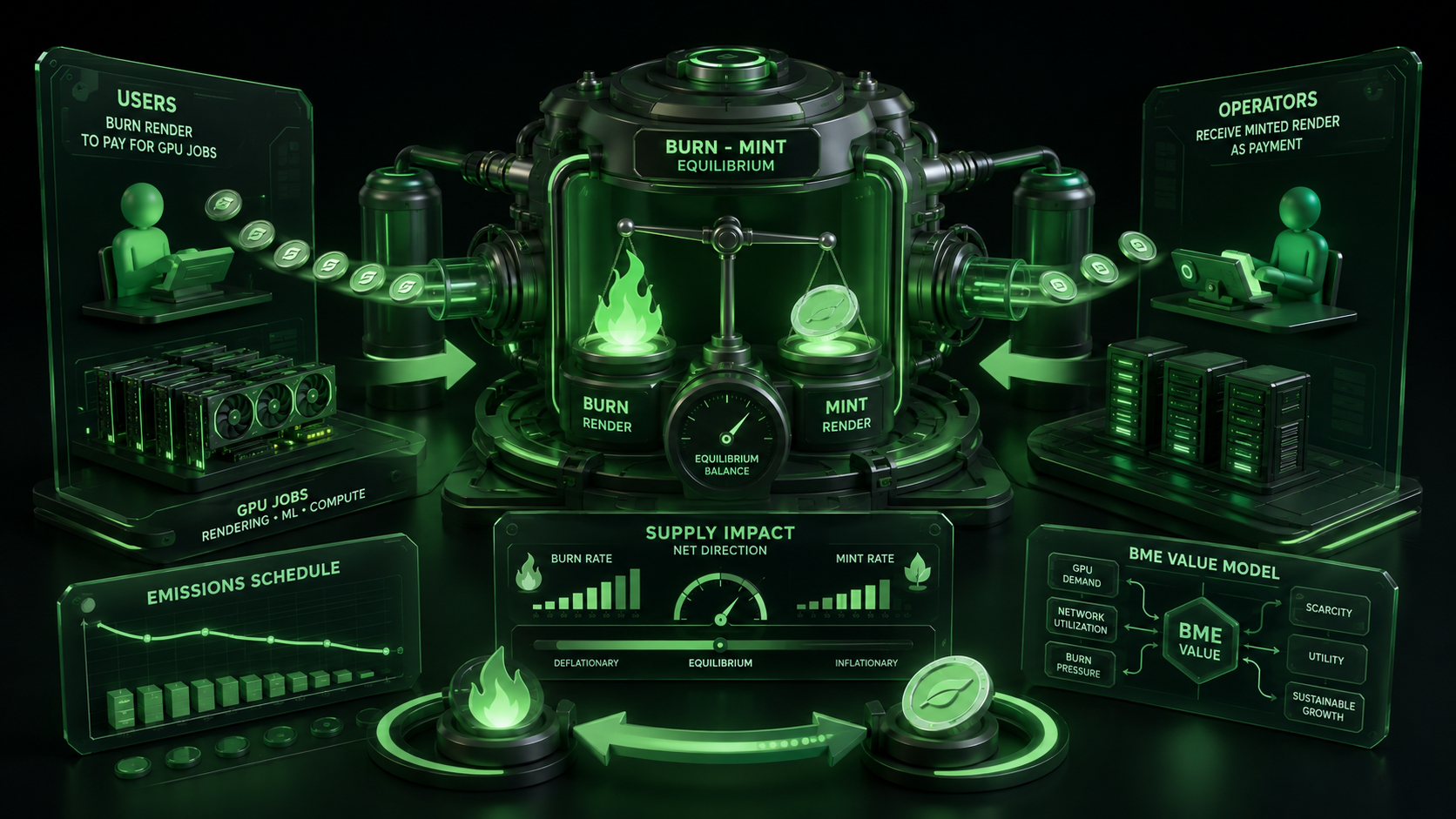
Render Network's tokenomics rely on a unique mechanism called Burn-Mint Equilibrium (BME), which fundamentally changes how token supply responds to network demand. Unlike traditional cryptocurrency models where inflation is fixed or governance-determined, BME ties token issuance directly to actual usage. Every job processed on the network burns tokens, and the protocol mints new tokens to compensate node operators, creating a self-regulating supply that responds to real-world demand for GPU compute.
This article explores the architecture of Render Network's tokenomics, the mechanics of the BME model, token supply allocation, and how these elements combine to influence the token's long-term value proposition. Understanding these dynamics is essential for traders evaluating RENDER as both a utility token and a store of value.
How the Burn-Mint Equilibrium Model Works
The Burn-Mint Equilibrium model is the centerpiece of Render Network's tokenomics. It replaces traditional fixed-emission schedules with a dynamic system that ties token supply directly to network activity.
The Burning Mechanism: Users who submit jobs to render 3D assets or run AI computations must pay in USD-denominated fiat. At the time of payment, those fiat amounts are converted to RENDER tokens and immediately burned. This mechanism creates a direct cost to using the network: every job consumes tokens from the supply. A 5% service fee is retained by the protocol for operational costs, while the remaining 95% is burned. This ensures that as the network processes more jobs, token supply is actively reduced.
The Minting Mechanism: Simultaneously, the network mints RENDER tokens to reward node operators who provide GPU compute capacity. These operators earn rewards based on work completed, GPU utilization, and reputation scores. The protocol mints on a per-epoch basis, with 90% of new emissions allocated to node operator rewards and 10% to availability incentives. This ensures that operators have sufficient token incentives to stay online and provide quality service.
The Equilibrium: The balance between burning and minting creates a feedback loop. When network demand is high, more tokens are burned. The protocol then mints proportionally to satisfy node operator rewards. Conversely, when demand is low, fewer tokens are burned, and the minting rate adjusts downward. This dynamic prevents the system from experiencing runaway inflation during periods of low use or sudden scarcity when usage spikes. The equilibrium is not fixed; it adjusts continuously based on network economics.
Tokens are burned for value creation (jobs processed), not arbitrarily. RENDER's supply expands and contracts based on real network utility, making it responsive to actual demand rather than a fixed issuance curve.
Token Supply and Maximum Allocation
Render Network originally launched on Ethereum with an RNDR token. Following the Solana migration in 2024, the token moved to the RENDER ticker on Solana, with meaningful implications for supply allocation.
| Metric | Value |
|---|---|
| Maximum Supply (Post-Migration) | 644.25 million RENDER |
| Original Maximum Supply (RNDR/Ethereum) | 536.87 million RNDR |
| Additional Issuance (Solana) | 107.38 million RENDER over 10 years |
| Circulating Supply (Current) | ~518.7 million RENDER |
These metrics are sourced from Render Network's official token metrics documentation, which tracks both legacy and current supply data.
The historical allocation breakdown prior to full migration reveals how the network structured its supply at launch:
Allocation Categories:
- Inflation Reserve (16.67%): Designated tokens for future protocol incentives
- RNDR Reserve (8.61%): Reserve pool for ecosystem development
- Escrow for Distribution (6.52%): Tokens held in escrow for future releases
- Escrow for Partners (26.60%): Allocated to strategic partnerships and integrations
- OTOY Treasury (23.30%): Founder treasury for operations and development
- Public & Private Sales (18.29%): Distributed to early investors and public buyers
This allocation emphasizes ecosystem growth (33.12% across escrows and reserves) and incentive programs (16.67%), with significant treasury holdings (23.30%) to fund long-term development.
Emissions Schedule and Supply Dynamics
RENDER's emissions are capped and declining, a critical feature of BME. Rather than a fixed annual issuance, the network implemented a governance-approved emissions schedule with explicit yearly limits.
Year 1 Emissions (post-implementation): 9,126,804 RENDER allocated across network operations and foundation activities. This provided substantial liquidity for node operators during the early BME phase.
Year 2 Emissions (RNP-018 governance approval): 5,905,580 RENDER, representing a 35% reduction from Year 1.
Long-Term Supply Halving: After the initial two-year period, the supply allocation halves every five years. This creates a known, predictable supply schedule that edges toward a fixed maximum over time.
The significance of this design is that it creates predictability while remaining responsive. Early stages have higher emissions to incentivize node operators and network growth. Over time, as the network matures and more tokens are burned through job processing, emissions naturally decline. This prevents sudden scarcity shocks while maintaining long-term deflationary pressure.
Importantly, the Solana migration introduced an additional 107.38 million tokens issued over a ten-year period specifically for Solana-based network activity. This represents a one-time supply expansion tied to cross-chain operations, not an ongoing increase to the Ethereum-era maximum. Research from Messari's Render Network analysis confirms this distinction, noting that the Solana-era emissions represent a deliberate, capped expansion designed to support multi-chain operations.
How RENDER Token Value is Maintained
Token value in the RENDER ecosystem flows from three mechanisms: utility demand, scarcity through burning, and governance rights.
Utility Demand: Every user who wants to render 3D content or run AI jobs must acquire RENDER. This creates inelastic demand, especially as the network scales. The cost of compute is quoted in USD, so as GPU costs fluctuate, the number of tokens burned adjusts proportionally. This demand is not speculative; it comes from active content creators and AI service consumers.
Scarcity Through Burning: The BME model's burning mechanism is the key to long-term scarcity. Unlike tokens that inflate indefinitely, RENDER's circulating supply can actually contract during periods of high network activity. A major render farm processing thousands of jobs daily burns significant RENDER, reducing available tokens. Over years, this creates cumulative scarcity that opposes the declining emissions schedule. The interplay between these forces determines whether RENDER trends toward or away from its maximum supply.
Governance: RENDER holders vote on protocol changes, emission schedules, and network parameters. This governance function grants token utility beyond pure payment, incentivizing long-term holding and participation in ecosystem decisions.
The infrastructure for GPU computing required for network operation is the foundation of this value. Unlike speculative tokens, RENDER derives value from the scarcity of GPUs and the willingness of creators and AI developers to pay for distributed access.
Why BME Changes the Value Narrative
The Burn-Mint Equilibrium model distinguishes RENDER from both traditional fixed-supply tokens and inflationary alternatives. Traditional cryptos with fixed supplies (like Bitcoin) become scarcer over time, but provide no mechanism to adjust supply based on utility. Inflationary models that mint proportionally to demand can suffer from supply shock if demand suddenly drops.
RENDER's approach is hybrid: it mints in response to operator rewards, but burns in response to actual job demand. This creates a self-correcting mechanism. If the network becomes less useful, burning decreases and supply stabilizes. If the network becomes dramatically more useful, burning increases and supply contracts relative to original projections.
For traders, this means RENDER's value is partially decoupled from speculative narrative and partially anchored to network activity. A price spike without corresponding use-growth will not lead to sustained emissions increases. Sustained utility growth will lead to token scarcity. Over multi-year horizons, this mechanism aligns token value with network health rather than hype cycles.
The comparison with Akash's approach to decentralized GPU computing reveals that tokenomics design is a key differentiator in compute infrastructure projects. RENDER's BME model prioritizes scarcity maintenance and demand responsiveness, while other approaches emphasize different trade-offs.
The Self-Regulating Token Economy
RENDER tokenomics represent a bet that utility-driven burning will outpace programmed inflation over time, creating a deflationary asset despite initial supply growth. The Burn-Mint Equilibrium model makes this dynamic transparent: you can observe whether the network is burning more tokens than it mints. If burning consistently exceeds minting, the token becomes structurally scarce. If minting dominates, inflationary pressure persists.
This transparency benefits valuation models. RENDER's metrics are directly observable through public dashboards, allowing traders to track token economics in real time. For traders evaluating RENDER as a long-term hold, the key metrics are: (1) Are job volumes growing? (2) Is the burn rate trending upward? (3) Are emissions declining as scheduled? If all three trend positive, RENDER's supply tightens.
Explore RENDER price forecasts and analyst predictions to see how analysts model these tokenomic factors into long-term value. Compare RENDER's approach with the best wallets for storing RENDER tokens to understand custody options. Review Render Network's ecosystem partnerships and integrations to evaluate which partnerships drive demand.
Trade RENDER on spot markets for simple buys and sells, or explore RENDER futures on LeveX for leveraged positions. For foundational context on the Render Network protocol, browse Crypto in a Minute for additional token guides.