
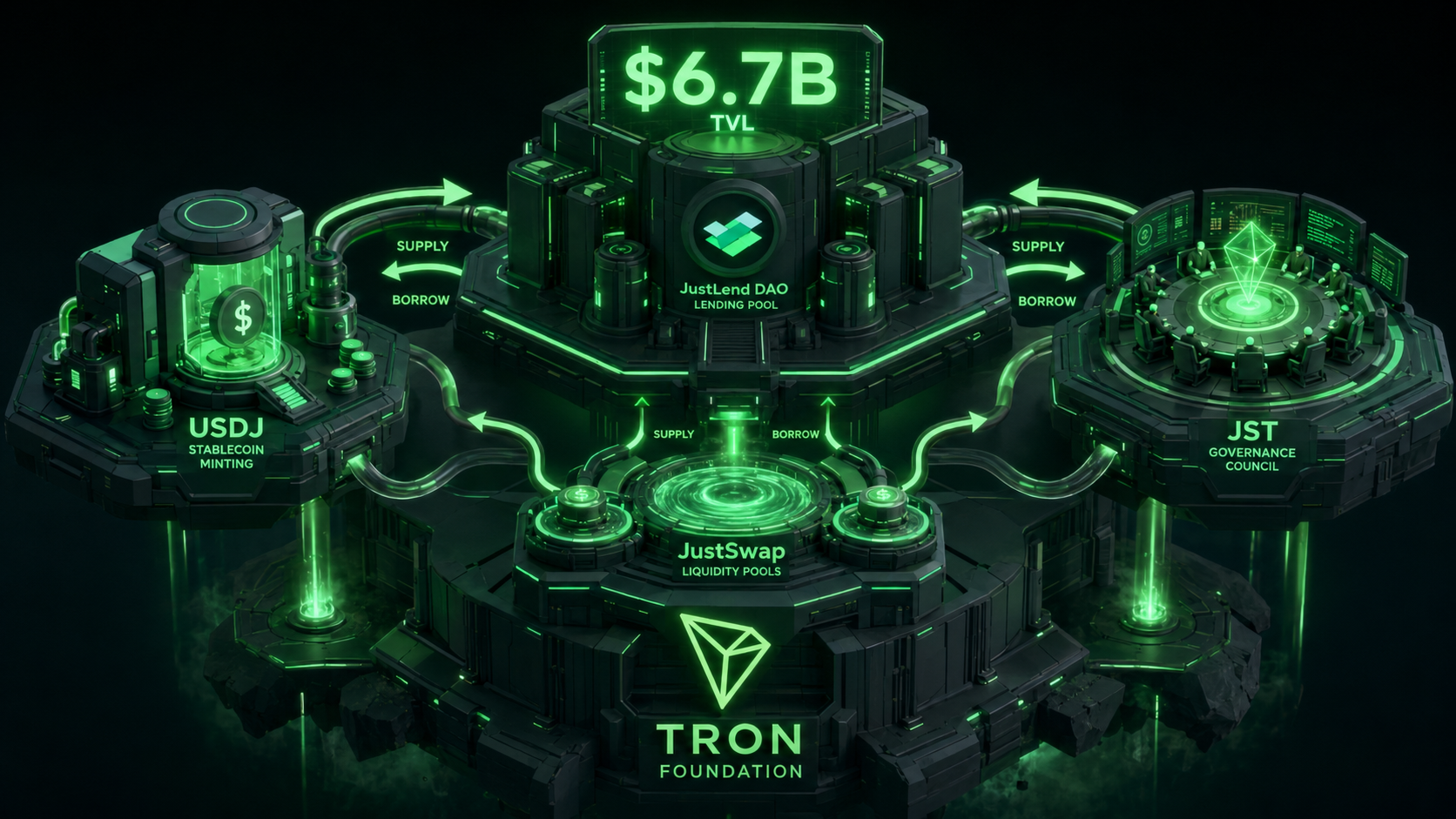
JustLend DAO is the largest decentralized lending protocol on TRON, with over 480,000 active users and more than $6.7 billion in total value locked (TVL). Ranked 11th globally among all DeFi lending platforms, JustLend operates a transparent, community-governed lending system where users earn interest by supplying assets and borrowers access capital against crypto collateral, all without intermediaries. The protocol is powered by JST, the governance token that ties together the entire JUST DeFi ecosystem.
How Supply, Borrowing, and Interest Rates Work
JustLend's core mechanism mirrors other major lending protocols like Aave and Compound, but optimized for TRON's unique chain economics. According to Nansen's research, the protocol operates a liquidity pool system where users can take on either role.
Suppliers deposit assets into liquidity pools and earn interest on their holdings. The interest rate they receive is algorithmically determined based on supply and demand for each asset. When demand for borrowing is high and available liquidity is low, interest rates rise to incentivize more deposits. When deposits exceed demand, rates fall. This creates a self-balancing market without manual intervention.
Borrowers lock collateral into the protocol and take loans against it. Their collateral must exceed the borrowed amount by a specific ratio to account for price volatility and protect the protocol from undercollateralization. If a borrower's collateral falls below the minimum threshold due to price movement, liquidators step in to repay the loan in exchange for a portion of the collateral as a liquidation reward. This mechanism prevents cascading defaults that could threaten the protocol's solvency.
Interest Rate Mechanics: The effective interest rate on any asset is determined by a utilization rate, the percentage of supplied assets currently borrowed. This creates a natural equilibrium. If utilization climbs toward dangerous levels (say, 90% of all supplied ETH is borrowed), interest rates spike, making borrowing expensive and incentivizing fresh deposits or loan repayment.
The JUST Ecosystem: Products Beyond Lending
JustLend is the anchor product, but the JUST ecosystem spans multiple interconnected products that reinforce each other.
JustStable and the USDJ Stablecoin
JustStable is the protocol's stablecoin minting platform. Users deposit collateral (primarily TRX) and mint USDJ, a multi-collateral stablecoin algorithmically pegged to the US dollar. To reclaim their collateral, borrowers repay the USDJ plus a stability fee. This design allows users to access USD-denominated liquidity without selling their TRX holdings, a powerful feature for traders who believe in TRX's long-term value but need stablecoin exposure for trading or hedging. USDJ has transitioned to a fixed exchange rate model with TRX, simplifying its mechanics and improving reliability.
Governance Through JST
JST functions as the governance core of the entire ecosystem. JST holders vote on critical parameters: stability fees on USDJ minting, collateral ratios, acceptable collateral types, and risk management thresholds. This decentralized decision-making allows the protocol to adapt as market conditions change without waiting for a centralized team to act.
JustSwap (Now Part of SunSwap)
The ecosystem historically included JustSwap, an automated market maker (AMM) for token swaps. Today, these liquidity functions are integrated into the broader SunSwap platform, allowing users to swap between assets without fragmented liquidity.
JST Tokenomics and the Buyback-Burn Model
Understanding JST's value proposition requires understanding how protocol revenue directly fuels token deflation. JustLend DAO generates revenue from interest paid on borrowed assets and from other ecosystem operations. Rather than locking this revenue away or distributing it as diluting rewards, the protocol commits a percentage directly to JST token buybacks and destruction.
In Q4 2025 and early 2026, JustLend DAO executed its largest buyback and burn operations to date. On January 15, 2026, the protocol burned 525 million JST (5.3% of total supply) using revenue exceeding $21 million. According to CoinMarketCap, more than 1 billion JST tokens have been permanently removed, reducing supply by nearly 11%. The DAO has earmarked an additional $31 million in revenue specifically for future quarterly buybacks through the end of 2026.
This deflationary model fundamentally changes how JST accrues value. Instead of representing a diluting claim on future protocol governance, JST becomes a direct beneficiary of protocol profitability. As JustLend DAO grows and earns more fees, JST supply shrinks, creating a reinforcing cycle where token holders benefit from protocol success independent of speculative trading.
Revenue and Energy Rental: TRON's Unique DeFi Advantage
Every blockchain has its own economic model, and TRON's energy system creates a unique revenue stream unavailable on Ethereum or other chains. On TRON, executing transactions requires either burning TRX (paid to validators as energy cost) or renting energy from the network.
JustLend leverages this feature through energy rental programs. When users delegate TRX to earn energy, JustLend shares revenue generated from lending that energy back to users and protocols that need it. This creates a profitable feedback loop: TRX delegators earn staking rewards plus a percentage of energy rental revenue, while borrowers of energy pay less than they would by burning TRX outright. According to the CoolWallet energy rental guide, JustLend DAO lowered its benchmark energy rental rate to 8% to further reduce barriers to participation.
For protocols like JustLend, energy rental becomes an additional revenue stream beyond lending spreads. This extra revenue directly funds larger buyback programs, meaning TRON-native DeFi protocols can return more capital to token holders than competitors on single-revenue chains.
JustLend's Global Standing and Why It Matters
With $6.7 billion TVL and 480,000 active users, JustLend dominates TRON's DeFi ecosystem and ranks among the top lending protocols globally. This scale signals something important: users trust JustLend to manage their capital. Large TVL also improves capital efficiency: lower slippage on supply and borrow rates, better prices during liquidations, and reduced volatility in interest rates due to a deeper liquidity pool.
Competing protocols on Ethereum like Aave and Compound pioneered decentralized lending, but TRON's lower transaction costs and energy efficiency have allowed JustLend to attract massive user bases without the gas fees that constrain Ethereum-based alternatives. This isn't a contest; it reflects different audiences. Ethereum users are comfortable with higher fees in exchange for network security. TRON users prioritize capital efficiency and accessibility, and JustLend delivers on that promise.
Getting Started with JustLend on LeveX
JustLend's ecosystem reveals how modern DeFi protocols compound value across multiple products and revenue streams. Lending is the anchor, but stablecoin minting, governance participation, and energy rental create a flywheel where protocol success directly deflates the governance token. For traders interested in JST price movements, understanding this underlying mechanism provides critical context beyond speculative catalysts.
Learning more about JST itself is essential. Explore how to stake JST to participate in governance and earn rewards, or review the best JST wallets to secure your holdings. For comparative analysis, the JST vs MKR comparison shows how JustLend's governance model differs from other DeFi protocols using governance tokens.
Trade JST on spot markets or explore JST futures contracts on LeveX to engage with the token directly. For deeper dives into similar tokens and projects, browse Crypto in a Minute for foundational guides across the DeFi space.