
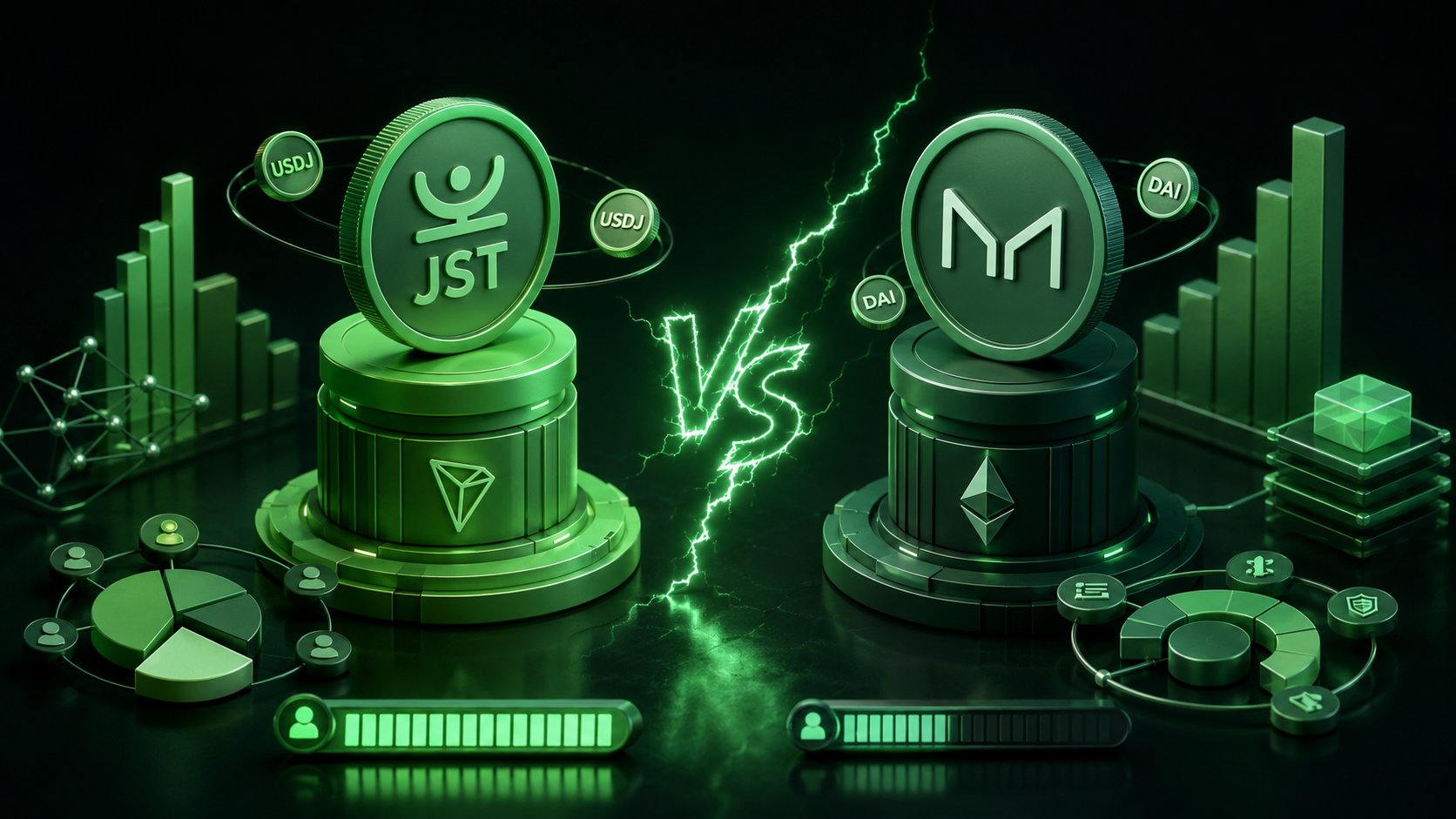
Both JST and MKR serve as governance tokens for major decentralized finance protocols, but they operate in different ecosystems with distinct trade-offs. JST powers the JUST ecosystem on TRON, which includes JustLend DAO and the USDJ stablecoin. MKR governs MakerDAO, an older, more established protocol on Ethereum that issued DAI, one of the most widely adopted decentralized stablecoins. Understanding the differences between these tokens helps traders evaluate which ecosystem aligns with their strategy and risk tolerance.
JST and MKR at a Glance
| Metric | JST | MKR |
|---|---|---|
| Network | TRON | Ethereum |
| Primary Protocol | JUST ecosystem (JustLend DAO, USDJ) | MakerDAO (DAI stablecoin) |
| Current Price | ~$0.065 | ~$1,779 |
| Market Cap | ~$580 million | ~$1.3 billion |
| Max Supply | ~9.9 billion | ~1 million |
| Primary Use | Governance, stability fees, staking | Governance, voting, protocol participation |
| Launch Year | 2020 | 2015 |
The Governance Models Behind Each Token
JST holders control key parameters of the JUST ecosystem, including stability fees charged on loans, collateral types accepted for borrowing, and protocol risk management. Unlike many governance tokens, JST also serves a utilitarian function: it can be used directly to pay interest on loans within JustLend DAO. This dual-purpose design creates intrinsic demand beyond governance voting.
The JUST ecosystem includes a revenue-sharing mechanism where a portion of protocol fees is used to buy back JST from the market and permanently burn it. JustLend DAO has burned over 560 million JST using protocol revenue, with another $41 million earmarked for phased burns through 2026. This deflationary mechanism rewards long-term token holders as the supply continuously contracts.
MKR governance operates through MakerDAO's voting system, where MKR holders propose and vote on updates affecting the protocol. Key governance decisions include adjusting stability fees (interest rates charged on DAI-generating positions), adding new collateral types, and managing the DAI Savings Rate. MKR has been governing a major protocol for nearly a decade, giving it a longer track record of decentralized decision-making than JST.
Like JST, MKR is designed to capture value through token burning. When MakerDAO generates surplus revenue (from stability fees and liquidation penalties), the protocol uses that revenue to buy back and burn MKR, creating deflationary pressure. This mechanism has proven durable through multiple market cycles, though governance changes over time have adjusted how and when burns occur.
Network Differences: TRON vs Ethereum
The choice between JST and MKR often comes down to blockchain choice. TRON is designed for low transaction costs and fast settlement, making JustLend DAO an appealing lending platform for smaller positions and frequent traders. With transaction fees often under $0.01 and block times of seconds, TRON enables high-frequency trading and frequent collateral adjustments without excessive gas costs.
Ethereum, by contrast, offers deeper liquidity, broader ecosystem integration, and longer security history. MakerDAO has benefited from Ethereum's network effects: DAI is integrated across hundreds of protocols, DeFi platforms, and major exchanges. However, Ethereum's higher gas fees (often $5-$50+ per transaction) make small transactions less practical. This trade-off means MKR appeals more to serious DeFi participants managing large positions, while JST can serve retail traders and those optimizing for low fees.
Stablecoin Systems: USDJ and DAI
Both JUST and MakerDAO power stablecoins, but they differ in approach and scale. USDJ is collateralized by a basket of assets on TRON, primarily through the JustLend protocol. When users deposit collateral (like TRX, USDC, or other assets), they can mint USDJ at a collateralization ratio of at least 150%. The USDJ system relies on stable governance via JST holders to ensure collateral ratios remain healthy and the peg to the US dollar holds during market stress.
DAI, issued by MakerDAO, operates similarly but with broader collateral types, including Ethereum, wrapped Bitcoin, wrapped ETH liquid staking tokens, and various stablecoins. According to protocol documentation, DAI's system has survived multiple bear markets and governance challenges, demonstrating resilience. However, DAI's success also means complexity: managing collateral types, adjusting risk parameters, and handling liquidations requires more governance overhead than smaller protocols.
The key difference in scale: DAI is backed by billions in collateral and integrated into hundreds of protocols, while USDJ focuses on TRON's ecosystem where JustLend's $6.7 billion TVL provides the foundation.
Choosing Between JST and MKR: Economics and Risk
JST and MKR both use token burning to align incentives, but their mechanics differ. JST's deflationary design is aggressive, with approximately 9.9 billion tokens outstanding and over 560 million already burned through protocol revenue. MKR's supply is intentionally scarce at only about 1 million tokens. JST's recent price outlook models vary widely because the token's value is tightly linked to JustLend's growth, while MKR's market cap of approximately $1.3 billion reflects both governance utility and a decade of protocol stability. Understanding JST's tokenomics and buyback-burn model helps evaluate whether protocol adoption growth can outpace supply.
The decision between JST and MKR depends on several factors beyond just price potential. MKR represents the lower-risk, more established choice: MakerDAO has been operational since 2015 and DAI is used across the broader Ethereum ecosystem. JST is higher-growth but higher-risk because JustLend, while established on TRON, is newer and more dependent on TRON's growth. MKR voters have encountered and resolved protocol crises; JST governance is still proving itself through various market cycles.
Network alignment matters too. If you're active in TRON trading, JST offers network-native benefits—low fees and fast transactions that align with TRON's strengths. If you're using Ethereum-based DeFi, DAI and MKR are more integrated into your existing positions and platforms. Comparing JST to lending protocol competitors like Aave or Compound can help if you're evaluating governance tokens more broadly.
For traders exploring how to stake and earn from governance tokens, how to stake JST offers a concrete entry point into the JUST ecosystem. If you're looking for wallets optimized for holding governance tokens safely, comparing options through best JST wallets helps ensure your holdings are properly secured. Both JST and MKR require careful wallet management since governance participation sometimes depends on token accessibility.
Why Governance Token Choice Matters
Both JST and MKR represent different answers to the question of how decentralized finance should be governed. JST emphasizes low fees, rapid iteration, and emerging-market expansion. MKR emphasizes security, decentralization track record, and ecosystem depth. Neither is objectively better; the right choice depends on your trading style, risk tolerance, and which ecosystem you're most active in.
Trade JST on spot markets or explore JST futures on LeveX to gain exposure to JUST governance. You can also browse Crypto in a Minute for more in-depth token guides and compare governance models across other DeFi protocols.