
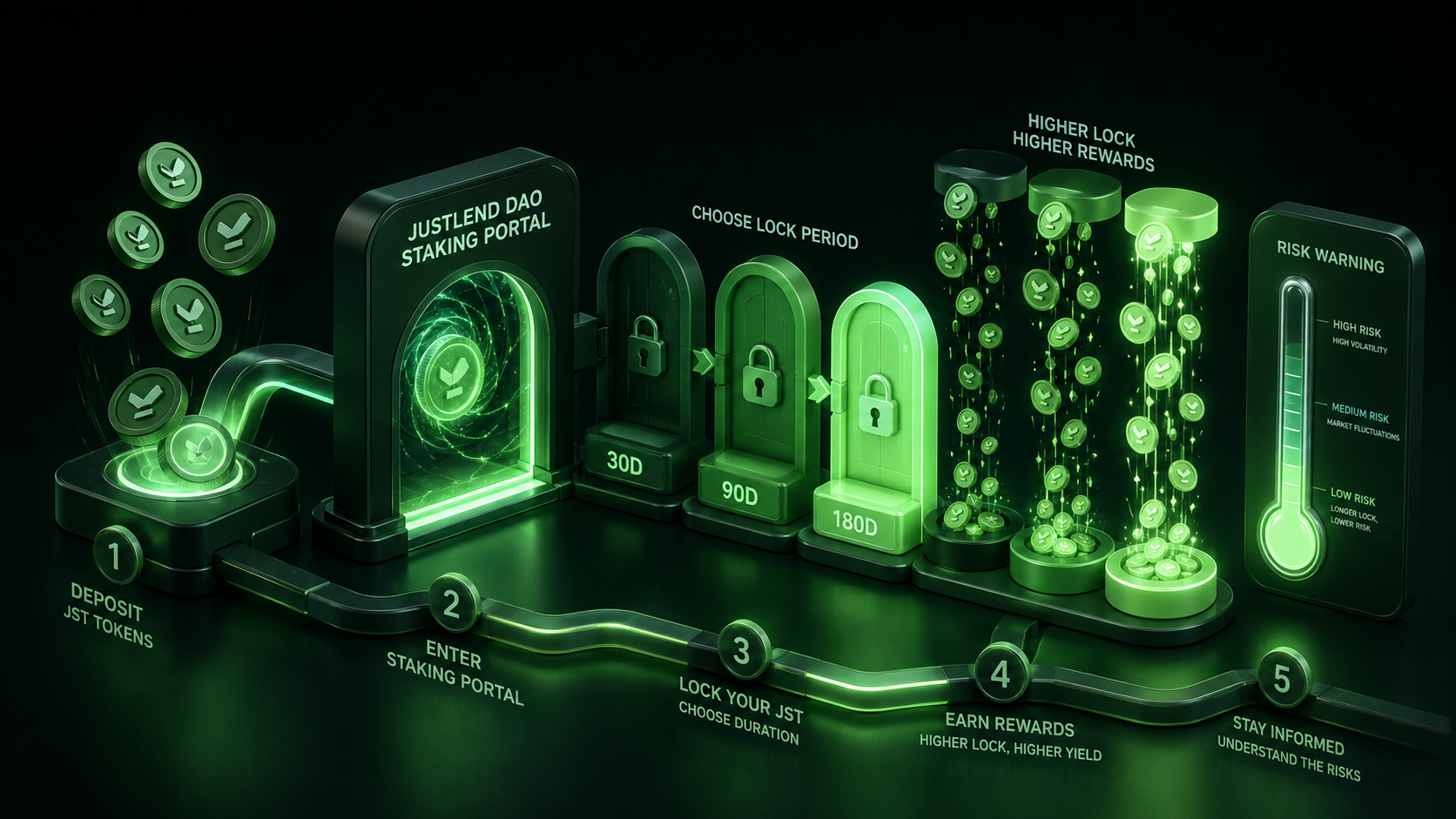
Staking JST tokens on the JUST (JST) network offers traders and DeFi participants a way to earn passive income while contributing to protocol security. Unlike proof-of-work blockchains where validators compete to solve computational puzzles, JST staking integrates directly into the JustLend DAO ecosystem on TRON, where your locked tokens participate in governance and generate daily rewards. This guide walks through everything you need to know about staking JST, from choosing a platform to understanding lock-period penalties.
JST staking isn't a single mechanism but a collection of options across multiple platforms, each with different reward structures and lock arrangements. Whether you hold just 100 tokens or substantial amounts, this guide covers the mechanics, the platforms, and the risks you should evaluate before committing capital to staking.
Staking Methods and Platforms
JustLend DAO Staking
JustLend DAO operates the primary staking platform for JST on the TRON network. By staking your tokens directly on the JustLend staking interface, you access the full range of lock periods and APY tiers. The platform charges no deposit fees and distributes rewards daily, with longer lock periods delivering higher yields. According to CoinGecko's JUST Network guide, JustLend DAO has accumulated over 480,000 active users and manages the protocol's lending, borrowing, and staking functions in a single interface.
Centralized Exchange Staking
Major centralized exchanges offer JST staking to their users. These platforms handle the custody and lock-in mechanics for you, making staking simpler for traders who already maintain exchange accounts. The tradeoff is that centralized staking typically yields lower APY than direct protocol staking and removes your direct participation in governance. If convenience matters more than yield optimization, exchange staking works for passive holding.
Decentralized Liquidity Staking
PancakeSwap and similar liquidity protocols on the Binance Smart Chain also support JST staking through yield farming and liquidity pools. These venues appeal to advanced traders comfortable managing smart contract interactions and liquidity provisioning. Yields vary based on pool depth and trading activity, and impermanent loss can occur if token prices diverge significantly during the lock period.
Staking Rewards, APY, and How to Stake on JustLend DAO
JST staking rewards are calculated as annual percentage yield (APY) applied to your staked principal, with the network distributing rewards daily rather than in lump sums. The exact APY you receive depends on which lock period you select. The JustLend DAO protocol generates fees from lending interest, borrowing charges, and stability mechanisms, channeling a significant portion of this revenue to JST stakers. Longer lock periods consistently yield higher APY. A 30-day lock might deliver 5% APY, while a 12-month lock could reach 20% or more, depending on protocol revenue and staking participation rates. Flexible staking options exist on many platforms, allowing withdrawal at any time, but with substantially lower yields.
To begin earning rewards, follow these steps to stake JST on JustLend DAO:
- Visit the JustLend staking interface at justlend-stake.netlify.app and connect your TRON wallet (such as TronLink or a hardware wallet supporting TRON).
- Approve the JST token contract by signing the transaction that grants JustLend permission to move your JST tokens. This one-time approval is required for all future staking actions.
- Select your lock period from the available options (typically 30 days, 90 days, 6 months, or 12 months), with longer periods offering higher APY.
- Enter the amount of JST to stake, ensuring you have at least the 100-token minimum. There is no maximum stake limit.
- Confirm the staking transaction in your wallet, paying the TRON network fee (typically less than 1 TRX, or approximately $0.10).
- Monitor your rewards through the JustLend dashboard, where daily accrual is visible. Rewards accumulate and can be claimed during or after your lock period, depending on platform rules.
The APY figures fluctuate based on total staked value and protocol economics. When fewer tokens are staked, each staker captures a larger share of protocol fees. As more users stake, APY dilutes accordingly. Before staking, check the current APY on the JustLend DAO platform or your chosen staking venue, since these rates update continuously.
Risks and Lock Period Considerations
Price Volatility During Lock-Up
Staking locks your tokens for a fixed period, during which you cannot sell them if the market price declines. Understanding JST price prediction analysis can help inform your lock-period decision. If JST falls 30% while your stake is locked, your staking yield (even at 20% APY) won't recover that loss. Staking locks you in, so evaluate whether you can afford the opportunity cost of illiquidity.
Early Unstaking Penalties
Withdrawing JST before your lock period expires triggers a penalty that reduces your total return. The penalty structure varies by platform; some charge a percentage of accrued rewards, others a percentage of principal. Verify the exact penalty terms on your chosen platform before committing, as surprise penalties can wipe out weeks of rewards.
Smart Contract Risk
JustLend DAO's staking contracts are audited and established, but all DeFi protocols carry residual smart contract risk. A critical vulnerability could lock or expose staked funds. Use only platforms with transparent audit reports and established track records. JustLend DAO's integration into the broader TRON ecosystem and its 480K+ user base provide some reassurance, but no protocol is risk-free.
Governance Token Dilution
JST's value is partly tied to the protocol's success and earnings. If JustLend DAO's revenue declines, fewer fees flow to stakers and APY falls. Additionally, according to CoinMarketCap's JST analysis, JustLend DAO completed a major buyback and burn of JST tokens in January 2025, purchasing over 525 million tokens to reduce supply. This directly links the token's long-term value to protocol profitability and sustainable staking yields.
Why Staking Matters for JST Holders
Staking JST combines yield generation with active participation in TRON DeFi ecosystem governance, aligning your holdings with protocol success. Stakers receive voting rights on key protocol decisions, from fee structures to new feature deployments. Unlike passive token holders, stakers have a direct say in the platform's future.
The JST tokenomics reflect a deliberate deflationary structure. A significant portion of protocol fees fund JST buybacks and burns, which increase scarcity. Stakers benefit from this structure through higher APY as the fee pool remains constant while the total token supply shrinks. This mechanism has proven effective; JustLend DAO's buyback and burn program demonstrates the protocol's commitment to token value preservation.
Staking JST for Protocol Participation
Staking JST bridges yield generation and governance participation in a unified mechanism. Whether you stake on JustLend DAO directly, through a centralized exchange, or via a decentralized liquidity pool, the underlying economics remain the same: your locked tokens earn a share of protocol revenue while granting you influence over the network's direction. The choice of platform affects convenience, APY, and the level of control you retain.
To maximize staking returns, evaluate lock periods carefully against your liquidity needs and market outlook. Longer locks offer higher APY but expose you to token price volatility. Flexible staking reduces risk but sacrifices yield. For traders comfortable with TRON's direction and confident in JST's long-term fundamentals, staking represents a practical way to extract value from holdings while shaping the protocol's future. Begin staking JST on the spot market or explore JST futures on LeveX. Browse Crypto in a Minute for more guides to tokens and trading strategies.