
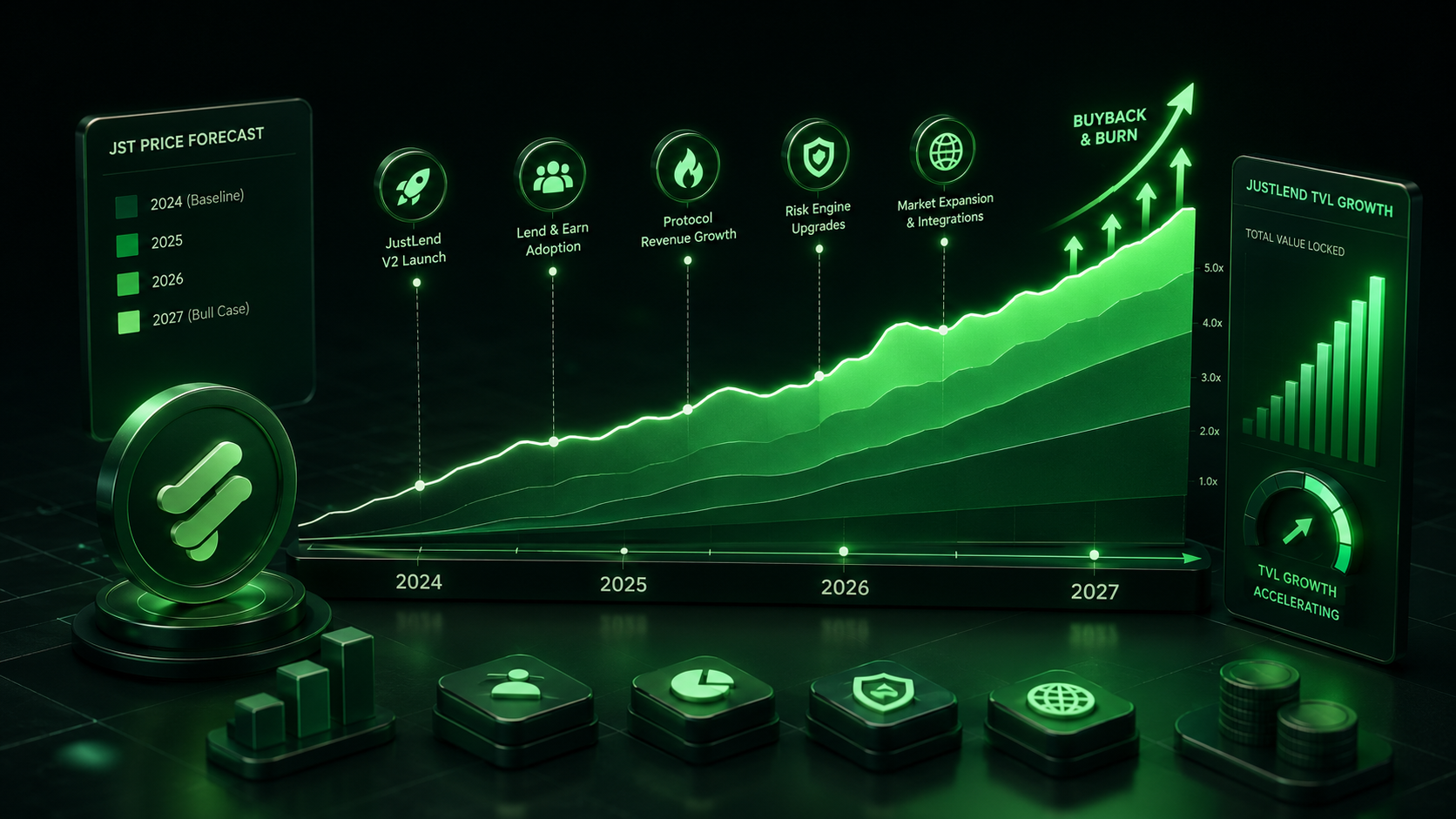
Predicting the price of any cryptocurrency involves weighing technical analysis, market sentiment, and fundamental drivers, and JUST (JST) is no exception. As the governance token of JustLend, the dominant lending protocol on the TRON blockchain, JST's value depends on both broader crypto market cycles and the specific health of the TRON DeFi ecosystem. Current trading near $0.065 with a market cap around $570 million, JST has attracted analyst attention for its deflationary token economics and the backing of an active protocol generating billions in total value locked.
JST's Current Market Position
JUST launched as a governance and utility token for the JustLend lending protocol, which has grown into one of the largest DeFi platforms by TVL (total value locked). At current levels, JST trades with low volatility relative to many mid-cap tokens, reflecting steady protocol adoption rather than speculative rallies. The token's fundamentals are rooted in the TRON ecosystem, where JustLend serves a critical function: lending and borrowing against multiple collateral types, generating fees that fund the token's deflationary mechanism. Market data from CoinGecko shows JST typically trades in the $0.055–$0.075 range during calm markets, with directional moves tied to TRON network growth and crypto sentiment cycles.
2026 Price Forecasts from Major Analysts
Analyst forecasts for JST in 2026 are wide-ranging, reflecting uncertainty about adoption trajectories and macroeconomic factors. Here's how the major forecasting sources compare:
| Analyst/Source | 2026 Forecast Range | Outlook |
|---|---|---|
| CoinCodex | $0.032–$0.036 | Bearish; expects consolidation |
| DigitalCoinPrice | $0.066–$0.079 | Moderate bullish; steady growth |
| Changelly | $0.062–$0.071 | Cautiously bullish; range-bound |
| Other conservative models | ~$0.043 | Conservative; expects pressure |
The lack of consensus among analysts reflects fundamental disagreements about TRON's competitive position in the broader DeFi market and JST's utility value independent of speculative interest. CoinCodex's pessimistic scenario assumes reduced adoption, while DigitalCoinPrice's bullish case leans on continued TRON ecosystem strength. Most forecasters agree JST is unlikely to see dramatic rallies absent a major bull market in crypto assets broadly.
2027 and Long-Term Outlook
Looking beyond 2026, analyst predictions extend further out and generally show modest upside. DigitalCoinPrice projects JST could reach $0.09–$0.11 by 2027, assuming steady protocol growth. Changelly forecasts a similar range of $0.089–$0.108, also assuming no major market disruptions. More conservative models estimate $0.045 by 2027, suggesting limited price appreciation from current levels.
The multi-year narrative depends almost entirely on whether TRON's DeFi ecosystem continues expanding and whether competing lending protocols gain traction. JST has no hard cap on supply, but the token incorporates an aggressive buyback mechanism that could create scarcity if the protocol's revenue grows faster than the token supply.
What Drives JST's Value: The Buyback-and-Burn Strategy
JST's primary value driver is its deflationary mechanics, funded directly by JustLend's revenue. The protocol commits 30% of lending fees and staking yields to quarterly buyback-and-burn cycles. In Q1 2026 alone, JustLend executed a $21 million buyback and burn, removing JST from circulation permanently. This program has already eliminated over 1.08 billion JST tokens (10.96% of total supply) since inception.
Unlike tokens that promise buybacks without a reliable funding source, JST's buyback has direct linkage to protocol revenue. Every dollar of lending fees generated by JustLend users creates a fraction of buyback pressure on JST. As the TRON lending market scales, the buyback program scales with it, creating a mechanical support floor for the token's price. This deflationary structure appeals to traders holding JST long-term, since the token count declines even if new tokens are minted for incentives. However, the program only supports JST's price if TRON DeFi adoption continues accelerating. In a contracting market, even a strong buyback cannot offset broad-based selling.
JustLend TVL and Protocol Revenue as Price Support
JustLend's TVL had reached $6.95 billion as of early 2026, making it the largest lending protocol on TRON by far. Total deposits exceed $4.2 billion, generating substantial fee revenue. This scale matters because protocol revenue directly funds the buyback program. Larger TVL and higher borrowing activity mean higher fees, which means more JST purchased from the open market each quarter.
TRON's position as a low-fee blockchain with fast finality makes JustLend cost-effective for both lenders and borrowers compared to equivalent protocols on Ethereum. The protocol has absorbed significant market share because of execution quality and UX, not mere hype. JST holders benefit from this directly: as TRON users lend or borrow on JustLend, fees accumulate, and those fees convert to JST buybacks. This creates a tangible link between JST's price and TRON's fundamental health. If TRON stagnates or if Aave launches a competing TRON instance, JustLend's fee revenue could decline, weakening the buyback program and JST's price support.
Why JST's Price Trajectory Hinges on Adoption
JST's price in 2026 and beyond will ultimately be determined by whether TRON's DeFi ecosystem continues to attract users and capital, and whether the buyback-and-burn program successfully creates scarcity that outpaces any token inflation from incentives. Analyst forecasts range from bearish ($0.032) to moderately bullish ($0.079) for 2026, with no consensus. The absence of agreement reflects genuine uncertainty about adoption and fundamental disagreement on technical analysis.
The strongest case for higher prices requires both continued TRON adoption and the buyback program to operate at scale, generating consistent pressure to remove JST from circulation. The weakest case, conversely, relies on TRON stagnating or a broader crypto bear market overwhelming the token's fundamental support. Most likely, JST trades in a wider range tied to sentiment cycles while the buyback creates a structural floor that prevents sharp downside below the protocol's utility value.
Ready to trade JST with real leverage and access to LeveX's trading tools? Trade JST on spot markets or explore JST perpetual futures to capture price moves across timeframes. Browse Crypto in a Minute for more foundational guides to tokens and blockchain projects.