
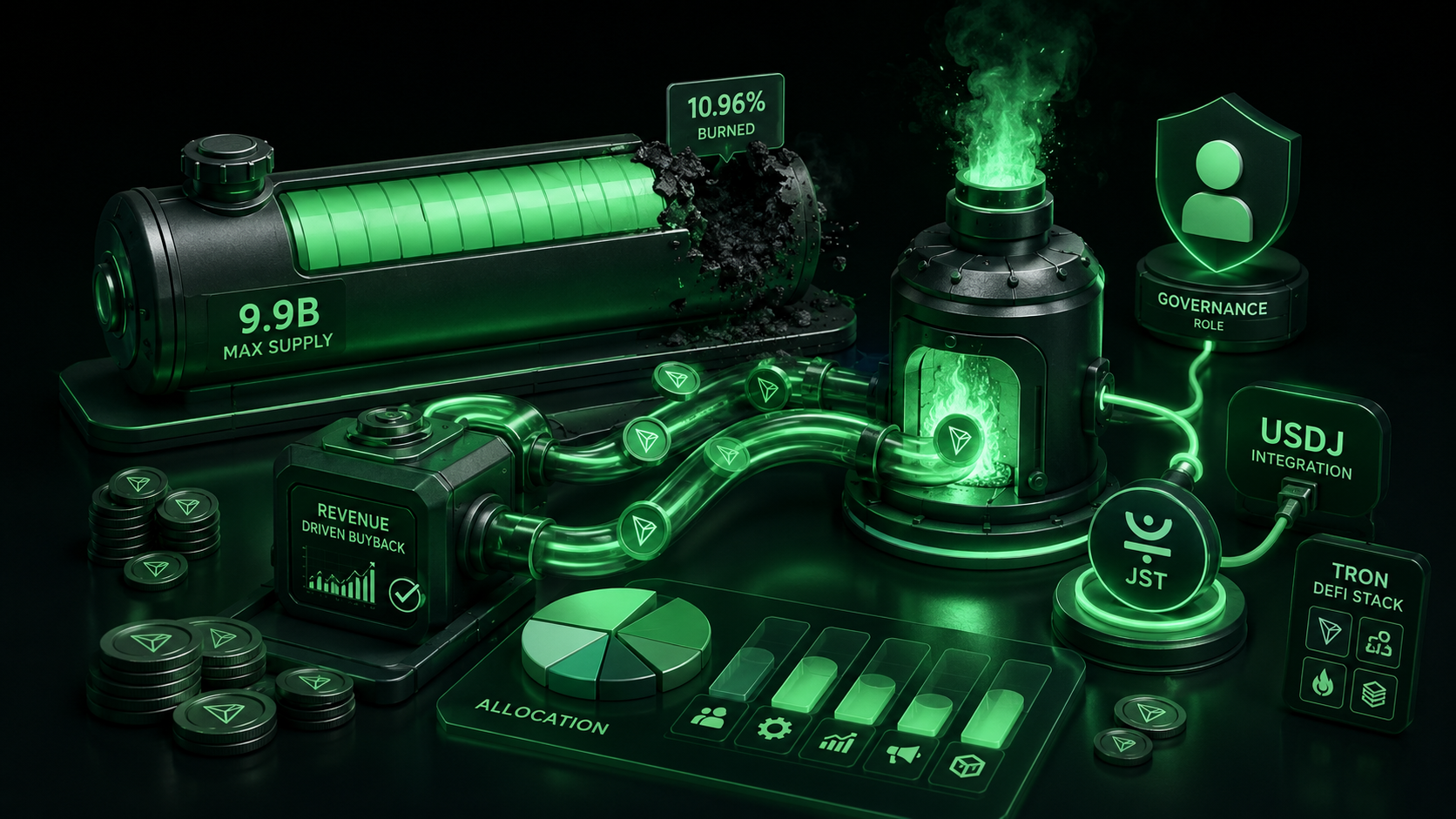
JUST's governance token, JST, operates within a carefully engineered deflationary model designed to align protocol revenue with token scarcity. With a fixed maximum supply of 9.9 billion tokens and over 1.08 billion JST permanently burned through buyback-and-burn operations, the tokenomics reflect a fundamental shift toward treating governance tokens as equity-like assets tied directly to ecosystem cash flow rather than speculative vehicles.
Understanding JST Token Supply and Current Allocation
JST's total supply structure is fixed at 9.9 billion tokens, with approximately 8.8 billion in circulation as of early 2026. This represents a circulating supply ratio of roughly 89%, with the remaining tokens either locked under vesting schedules or permanently removed through burns according to CoinMarketCap market data. The phased introduction of tokens over time, combined with scheduled deflationary mechanisms, means the effective available supply will continue declining.
| Metric | Value |
|---|---|
| Maximum Supply | 9.9 billion JST |
| Circulating Supply | ~8.8 billion JST |
| Burned Tokens (Cumulative) | 1.08+ billion JST |
| Percentage of Supply Burned | 10.96% |
| Circulation Ratio | ~89% |
The supply allocation originally distributed tokens across ecosystem growth, protocol development, private investors, and community access. Protocol development allocations fund ongoing team operations and platform maintenance. Ecosystem growth tokens support user incentives, liquidity mining, and expansion initiatives. The fixed maximum supply ensures no additional tokens can be created beyond 9.9 billion, establishing hard scarcity relative to demand growth.
Revenue-Driven Buyback and Burn Mechanism
JST's deflationary engine operates through a revenue-funded buyback and burn program that has become the primary mechanism for aligning token economics with protocol success. According to JustLend ecosystem documentation, JustLend DAO allocates 30% of quarterly protocol revenue toward purchasing JST tokens from open markets and permanently destroying them through on-chain burn transactions.
This creates a direct feedback loop: increased lending volumes and fees generate higher protocol revenue, which increases the quarterly buyback allocation, accelerating token scarcity. In January 2026, JustLend DAO completed a major burn event, removing 525 million JST (approximately $21 million at the time) in a single transaction. This followed an earlier, larger burn program where a previous $70 million buyback-and-burn initiative fueled a 100% price surge, demonstrating the market's responsiveness to supply contraction.
The burn mechanism operates transparently on-chain. All buyback and burn transactions are publicly verifiable via the JUST ecosystem's blockchain explorer, with governance token holders voting to approve burn schedules and allocation percentages. This transparency reinforces community confidence that burns are happening as committed rather than as speculative claims. Revenue sources funding the burns include lending fees from active loans, interest charges on borrowed assets, staking yields from governance participation, and stability fee payments from USDJ stablecoin minting operations.
JST's Role in Governance and Platform Maintenance
Beyond its deflationary design, JST functions as the core governance token for protocol decisions and operational costs. Token holders participate in voting on critical parameters including interest rate adjustments for lending pools, collateral ratio requirements for borrowers, approval of new assets to be added as collateral, and upgrades to protocol features or smart contracts.
Governance voting follows a stake-weighted model where larger JST holders exert proportional influence over ecosystem direction. Proposals move through phases including submission, community discussion, voting period, and execution once quorum and approval thresholds are met. This structure mirrors models used in established protocols like Compound governance, where token concentration and voting participation directly determine protocol evolution.
JST also pays stability fees on USDJ stablecoin positions. When users mint USDJ by depositing collateral, they pay ongoing stability fees denominated in JST. These fees serve dual purposes: they generate platform revenue that funds the buyback-and-burn program, and they create constant demand pressure for JST as an active fee-paying asset rather than a passive governance token.
USDJ Stablecoin and the Broader Ecosystem Revenue
The two-token design linking JST governance to USDJ stablecoin creates a symbiotic relationship where stablecoin adoption directly enhances the token's value proposition. USDJ operates as a multi-collateral stablecoin pegged to the US dollar, accepting assets from TRON and other blockchains as collateral. Users mint USDJ by depositing collateral worth 150% or more of the intended USDJ amount, paying stability fees and borrowing interest in JST.
The ecosystem's total value locked (TVL) exceeded $6.71 billion as of early 2026, with over 480,000 active users according to CoinGecko ecosystem data. This scale generates substantial revenue from stability fees, liquidation incentives, and lending activity. The protocol's primary earnings flow back into JST buybacks, creating a revenue-to-scarcity cycle. Strong USDJ adoption (driven by demand for a decentralized stablecoin in the TRON DeFi ecosystem) increases protocol revenue, which increases JST burn intensity, which theoretically increases JST's long-term value as a scarcer asset.
This positions JST as an equity-like asset where holders benefit from protocol growth not through fee distributions (as in many traditional DeFi designs) but through declining supply and the resulting scarcity premium as a fixed-supply token in a growing ecosystem. JST's design directly ties token value to JustLend DAO's operational performance and fee generation, creating a feedback loop where ecosystem success compounds token scarcity.
How Deflationary Tokenomics Shape Market Dynamics
The deflationary model creates a feedback loop with multiple entry points for value creation. When protocol revenue grows, the buyback allocation increases, accelerating JST scarcity. When token supply contracts, scarcity premiums may rise, creating secondary price upside beyond the fundamental revenue benefit. However, the model's success depends on three linked conditions:
Revenue Growth: Sustained increases in lending volumes, stability fees, and USDJ adoption fuel buyback funding. Flat or declining revenue reduces burn intensity and removes a key value driver.
Market Expectations: The market must believe that burns represent genuine protocol performance rather than speculative gestures. Token holders need confidence that future burn schedules will execute as committed.
Token Price Appreciation: Supply contraction only creates value if underlying demand remains stable or increases. If the market becomes indifferent to scarcity improvements, price compression can offset burn benefits.
Previous large-scale burn programs have demonstrated market-responsive price behavior. The $70 million buyback-and-burn initiative resulted in a 100% price appreciation, suggesting markets price in supply reduction when funded by genuine revenue. For traders evaluating JST price momentum, understanding whether price movements are driven by deflationary scarcity or by fundamental protocol growth is essential context.
JST Tokenomics and Long-Term Sustainability
JST tokenomics embody a deliberate choice to subordinate token issuance to protocol performance. By fixing the maximum supply and continuously burning tokens funded by revenue, the design aligns holder incentives with ecosystem success. This contrasts with governance tokens that offer utility only through voting power or protocols that rely on yield farming and emission schedules to incentivize usage.
The model's sustainability depends on three pillars: continued revenue generation from lending, borrowing, and stablecoin fee activity; market willingness to pay price premiums for deflationary tokens as circulating supply contracts; and community governance commitment to executing buyback schedules even during revenue downturns. If any pillar weakens, the entire mechanism faces stress.
JST holders benefit when lending volumes grow, USDJ adoption expands, and the DAO executes disciplined burn programs. For traders on LeveX, understanding JST's embedded link to JustLend DAO's operational success—rather than viewing it as a standalone token—is the key to evaluating its long-term value. Trade JST on spot markets or explore JST futures on LeveX. Browse Crypto in a Minute for more token guides.