
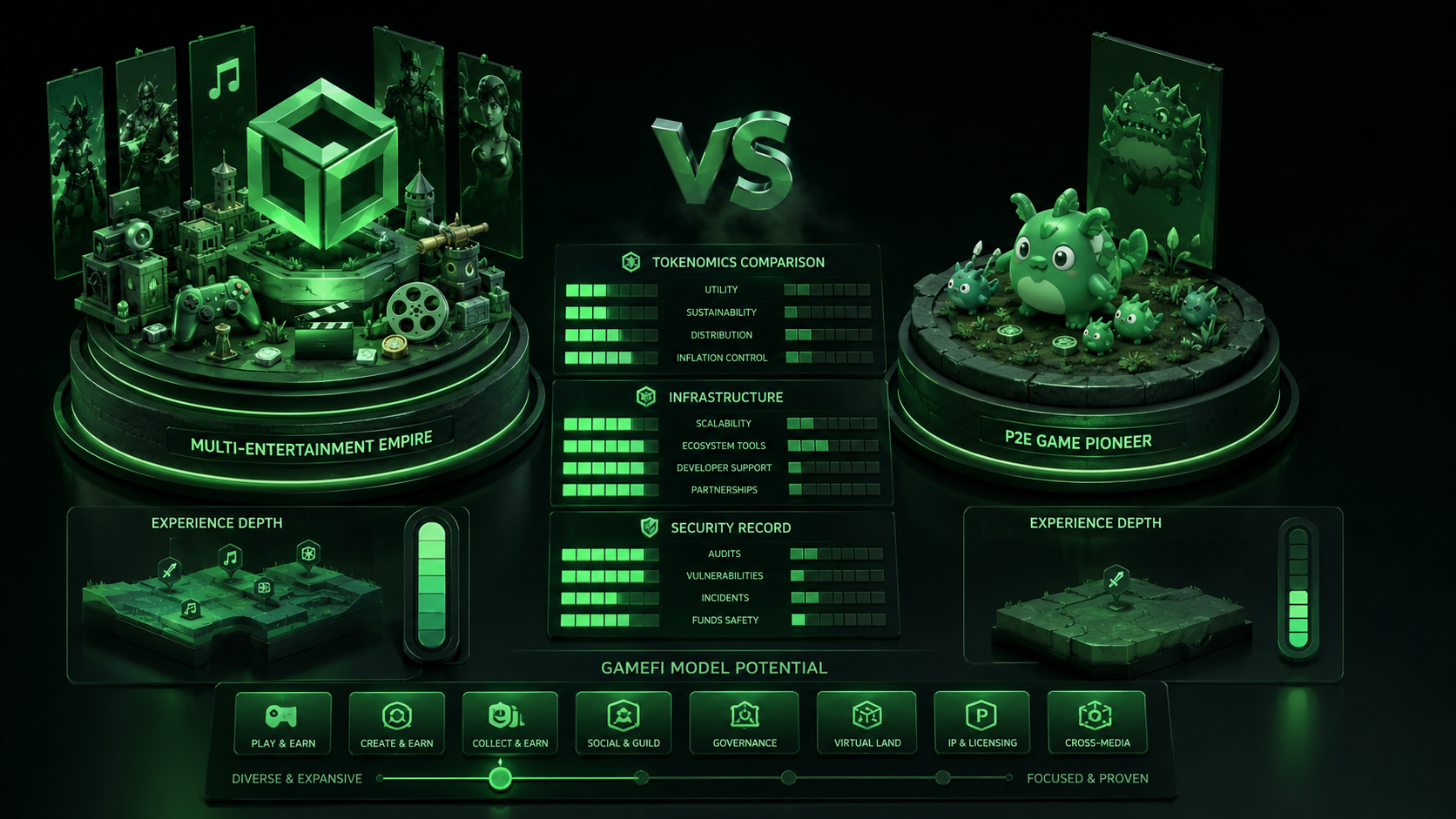
Two projects dominate discussions about blockchain gaming's potential and pitfalls: Gala Games and Axie Infinity. Both launched during Web3's formative years, attracted millions of users, and experienced brutal market corrections. Yet they represent fundamentally different approaches to building blockchain entertainment ecosystems.
Understanding these differences helps traders evaluate which model might prove more resilient as the GameFi sector matures beyond its speculative origins.
The Core Philosophy Divide
Axie Infinity pioneered the play-to-earn model with a singular focus: breeding, battling, and trading creatures called Axies. This concentrated approach drove explosive growth, reaching 2.8 million daily active users at peak in January 2022. The simplicity made onboarding straightforward, and the economic model briefly transformed gaming into income for players in the Philippines and Venezuela.
Gala Games took the opposite approach, building a multi-game platform spanning genres from farming simulators to competitive shooters. Rather than betting everything on one title, Gala functions as a publisher and infrastructure provider, with GalaChain powering games, music, and film distribution simultaneously.
| Aspect | Axie Infinity | Gala Games |
|---|---|---|
| Model | Single game ecosystem | Multi-game platform |
| Primary Blockchain | Ronin (Ethereum sidechain) | GalaChain (Hyperledger Fabric L1) |
| Token Structure | Dual token (AXS + SLP) | Single token (GALA) |
| Peak Daily Users | 2.8 million (Jan 2022) | 1.3 million monthly |
| Price Decline from ATH | ~86% | ~99% |
Blockchain Infrastructure Comparison
The technical foundations reveal different priorities. Ronin, built by Axie developer Sky Mavis, launched as an Ethereum sidechain optimized for fast, cheap gaming transactions. The network processed billions in NFT trades before experiencing a devastating $625 million hack in March 2022, attributed to North Korean hackers.
Sky Mavis responded by transitioning Ronin from proof-of-authority to delegated proof-of-stake consensus, increasing decentralization. The team fully refunded affected users, though the security breach permanently affected confidence in the platform.
GalaChain emerged from different priorities entirely. Built on Hyperledger Fabric, the enterprise blockchain framework used by Walmart and Honeywell, GalaChain offers horizontal scalability through independent channels for different applications. The permissioned architecture provides customizable environments for each game while maintaining shared security through Gala's Founder's Node network of 50,000 operators.
Neither approach has proven definitively superior. Ronin offers Ethereum compatibility and a familiar development environment. GalaChain provides enterprise-grade customization but requires developers to learn different tools and frameworks.
Token Economics Breakdown
Axie Infinity operates a dual-token system that created both its early success and later challenges. AXS serves governance and staking functions while SLP (Smooth Love Potion) rewards gameplay and enables breeding. The unlimited SLP minting led to hyperinflation, with prices crashing as more tokens entered circulation than the economy could absorb.
Subsequent updates introduced burning mechanisms to reduce SLP supply, but the inflationary damage contributed to the platform's decline from mainstream relevance. Current AXS price trajectories reflect ongoing uncertainty about sustainable tokenomics.
GALA operates as a single utility token across Gala's entire entertainment ecosystem. Burned as gas fees on GalaChain and distributed to node operators, the token's value derives from actual network usage rather than speculative breeding mechanics. However, GALA's price performance has mirrored the broader GameFi collapse, with questions remaining about whether utility justifies current valuations.
User Experience and Accessibility
Early Axie Infinity required significant upfront investment. In February 2020, starting costs exceeded $400 for three Axies needed to play. By 2022, floor prices dropped to around $20, but the pay-to-play-to-earn model remained a barrier. The scholarship system, where established players lent Axies to newcomers in exchange for earnings splits, partially addressed accessibility but created dependency relationships.
Gala Games varies by title. Some games offer free-to-play entry points while others require NFT purchases for full participation. The multi-game structure means players can choose engagement levels across different experiences, though this diversity can also create confusion about where to start.
Both platforms have seen dramatic user declines. Axie dropped from 2.7 million daily players to approximately 350,000, according to industry tracking data. The sector-wide contraction affected all blockchain games, with funding down 55% in 2025 and over 300 gaming dApps shutting down in Q2 alone.
Development and Roadmap Progress
Sky Mavis continues expanding the Axie universe with new gameplay modes, land features, and third-party studio partnerships. Axie Infinity 3.0 introduced improved battle mechanics, enhanced graphics, and more sustainable tokenomics. The team's track record includes recovering from the Ronin hack and maintaining development through the bear market.
Gala's approach involves launching multiple titles while building infrastructure for external developers. The platform's recovery prospects depend partly on flagship launches like Mirandus, an ambitious fantasy RPG that has experienced repeated delays. The China TCC partnership targeting 600 million potential users through a gaming bridge represents a significant upcoming catalyst.
Both teams face the fundamental challenge plaguing all GameFi: creating games people want to play regardless of earning potential. Industry observers note that 2025 represented a necessary reset after the 2021-2022 hype cycle, when billions flowed into projects with little lasting value.
Security Track Records
The Ronin hack remains blockchain gaming's most significant security failure. North Korean hackers exploited vulnerabilities in the bridge connecting Ronin to Ethereum, stealing $625 million. The concentrated validator structure that enabled fast transactions also created the single point of failure attackers exploited.
Post-hack improvements include delegated proof-of-stake consensus, increased validator diversity, and enhanced monitoring. Sky Mavis demonstrated commitment by fully reimbursing affected users despite the massive loss.
GalaChain has avoided comparable incidents, though its permissioned architecture means fewer attack vectors exist by design. The tradeoff involves accepting more centralized control in exchange for reduced security risks. Neither approach eliminates all concerns: even enterprise blockchains face potential vulnerabilities as complexity increases.
Trading Considerations
For traders, these projects represent different risk profiles within the struggling GameFi sector. AXS offers exposure to blockchain gaming's most recognized brand with proven ability to recover from crises but faces ongoing questions about user retention and tokenomics sustainability.
GALA represents a bet on platform diversification, with potential upside from any of multiple games or entertainment verticals succeeding. The downside involves diluted focus and dependence on successful launches that have repeatedly missed timelines.
Both tokens trade on LeveX spot markets and futures, enabling positions based on your assessment of each platform's recovery trajectory. Technical analysis of gaming tokens often correlates with broader crypto sentiment and sector-specific catalysts like major game launches.
Which Model Wins?
Neither platform has definitively proven its approach superior. Axie demonstrated that blockchain gaming could achieve mainstream scale but struggled to maintain it. Gala showed that diversification provides resilience but hasn't produced breakout successes yet.
The more relevant question may be whether either model can deliver what gamers actually want: fun experiences that happen to include ownership benefits, rather than investment schemes disguised as games. Projects achieving that balance, regardless of infrastructure choices, will likely outperform those still optimizing for speculation.
Both Gala and Axie Infinity pioneered concepts that future successful projects will build upon, even if neither platform returns to previous heights. Understanding their different approaches provides framework for evaluating the entire GameFi sector as it matures beyond its speculative origins. Track GALA price movements through LeveX trading pairs and explore our Crypto in a Minute guides for deeper analysis of blockchain gaming's evolving landscape.