
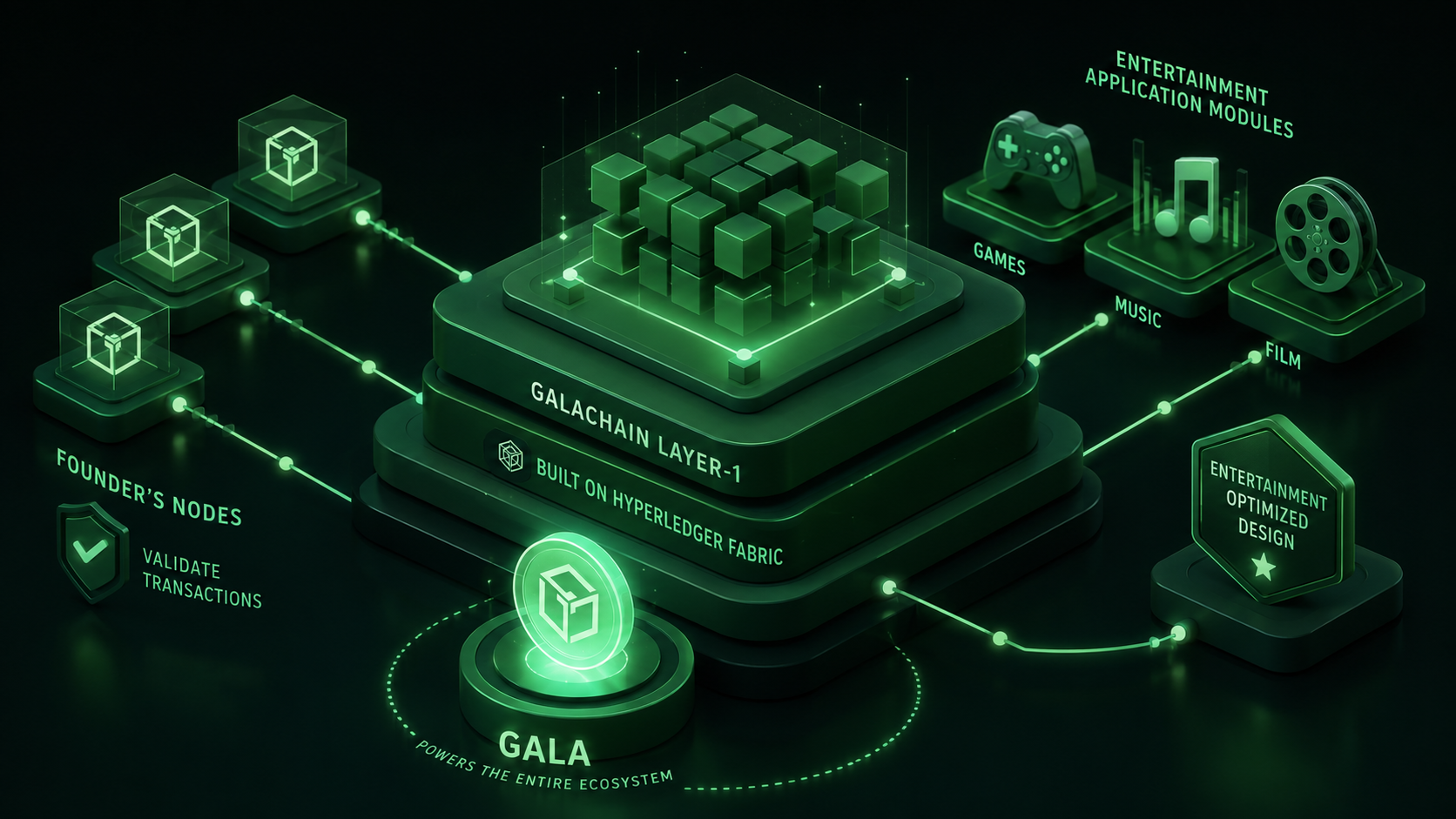
Most blockchain projects promise to revolutionize gaming. Gala Games actually built dedicated infrastructure for it. GalaChain represents a Layer-1 blockchain specifically engineered for entertainment applications, constructed on Hyperledger Fabric rather than the typical Ethereum-derived architectures that dominate Web3 gaming.
The technical choices behind GalaChain reveal priorities different from general-purpose blockchains: enterprise-grade throughput, customizable permissions, and horizontal scalability designed for demanding game environments.
Why Hyperledger Fabric?
GalaChain's foundation on Hyperledger Fabric distinguishes it from nearly every other gaming blockchain. Developed by the Linux Foundation in 2015, Hyperledger Fabric powers enterprise solutions for Walmart, Honeywell, and Bosch. This enterprise heritage brings capabilities that general-purpose chains lack.
The key advantages include:
Modular Architecture: Components like consensus mechanisms and membership services can be swapped without rebuilding the entire network. This plug-and-play approach allows GalaChain to customize environments for specific game requirements.
Deterministic Consensus: Unlike Ethereum and Bitcoin's probabilistic models that can produce temporary forks, GalaChain uses deterministic finality. Transactions either succeed or fail immediately, eliminating the ambiguity that frustrates gaming applications requiring instant feedback.
Permissioned Flexibility: The blockchain operates as a permissioned network where access control can be granularly managed. Publishers maintain control over their game environments while players retain ownership of assets. This balance addresses a fundamental tension in blockchain gaming.
Horizontal Scalability: Independent channels allow different projects to scale according to their specific needs without affecting other applications on the network. A high-traffic game doesn't bottleneck unrelated projects sharing the same infrastructure.
Technical Architecture
GalaChain processes transactions with sub-second latency and supports up to 1,500 transactions per second. These specifications matter because gaming demands responsiveness that many blockchains simply cannot deliver.
| Specification | GalaChain | Typical L1 |
|---|---|---|
| Transaction Finality | Deterministic | Probabilistic |
| Latency | Sub-second | Seconds to minutes |
| Throughput | ~1,500 TPS | Variable |
| Consensus | Pluggable | Fixed |
| Gas Token | GALA | Various |
The channel-based organization proves particularly valuable for entertainment. Each game, music platform, or film distribution system operates within its own channel with customized parameters. Gala Film's Theater Nodes, for example, manage decentralized HD video content delivery with specific access controls that wouldn't make sense for a casual mobile game.
Developers interact with GalaChain using TypeScript rather than Solidity, lowering barriers for Web2 developers unfamiliar with blockchain-specific languages. The GalaChain SDK provides open-source tools and chaincode templates that reduce development time by approximately 40% compared to building from scratch.
The Founder's Node Network
Fifty thousand Founder's Nodes power GalaChain's decentralized infrastructure. These nodes represent the only mechanism for generating new GALA tokens, distributed daily to active operators. This design creates strong incentives for maintaining network health.
Node operators handle more than basic transaction validation. Specialized node networks support specific workloads: game-specific nodes for titles like Common Ground World and Last Expedition, Theater Nodes for film content distribution, and Music Nodes for the streaming platform. This specialization allows the network to optimize for diverse entertainment applications simultaneously.
The node architecture bypasses traditional ICO funding models. Projects can launch specialized node networks that monetize directly through operational participation rather than speculative token sales. This approach has proven effective for existing Gala applications while reducing centralization risks associated with conventional fundraising.
Beyond Gaming: The Entertainment Ecosystem
GalaChain powers three distinct entertainment verticals:
Gala Games currently features 17 titles across browser, mobile, Windows, and Mac platforms. Twelve games including Champions Arena and Legacy have migrated to GalaChain infrastructure, benefiting from reduced transaction costs and improved performance. The platform's recovery trajectory depends partly on successfully shipping flagship titles like Mirandus.
Gala Music operates as a decentralized streaming platform with over 78,000 tracks. Artists convert songs into NFTs and sell directly to fans, bypassing traditional producer intermediaries. Digital signatures record on GalaChain while content distributes via IPFS.
Gala Film launched in April 2025 with its first feature release. The platform uses Theater Nodes for decentralized content delivery, creating a fundamentally different distribution model than centralized streaming services.
GalaSwap and DeFi Integration
The ecosystem includes GalaSwap, a decentralized exchange launched in February 2024 for token trading within the Gala environment. The platform supports swaps across multiple tokens and accommodates all currencies developed on GalaChain.
GalaPump, introduced in December 2025, enables pre-sale launches and creator tools for building token economies. These DeFi components transform GalaChain from pure entertainment infrastructure into a more comprehensive blockchain ecosystem.
For traders monitoring GALA's price dynamics, understanding GalaChain's utility expansion matters. Increased DeFi activity generates transaction fees burned as GALA, creating deflationary pressure that could influence token economics over time.
Decentralization Roadmap
GalaChain began as Gala's internal blockchain but has evolved toward broader decentralization. The July 2025 White Paper outlined a four-phase strategy to transform the permissioned Hyperledger Fabric implementation into a fully decentralized ecosystem.
The transition involves shifting control mechanisms while maintaining the performance characteristics that make GalaChain suitable for entertainment. Security and compliance features enhance rather than replace existing capabilities, with decentralized auditing mechanisms ensuring data integrity.
Gala's membership in the Linux Foundation Decentralized Trust signals commitment to open collaboration. The GalaChain SDK opened development to external creators, and community-built blockchain explorers and indexing tools have already emerged.
Developer Accessibility
GalaChain prioritizes developer experience through several mechanisms:
The Creator Portal simplifies launching projects without deep blockchain expertise. Customizable chaincode templates accelerate development cycles. Open-source SDK documentation reduces the learning curve for developers transitioning from Web2 environments.
TypeScript support proves particularly significant. Most Web2 game developers lack Solidity experience, creating friction when building on Ethereum-derived chains. GalaChain's familiar language environment removes this barrier while maintaining smart contract functionality comparable to other platforms.
Trading GalaChain's Native Token
GALA serves dual functions as the gas token for all GalaChain transactions and the reward mechanism for node operators. Every transaction burns GALA as fees while daily emissions flow to active Founder's Node participants.
Spot markets offer direct exposure to GALA's utility value within the entertainment ecosystem. As GalaChain adoption grows across gaming, music, and film applications, transaction volume directly impacts token demand.
Futures trading enables leveraged positions on GalaChain's development trajectory. Major milestones like successful game launches, China TCC bridge activation, or significant developer adoption could drive volatility in either direction.
The Infrastructure Thesis
GalaChain represents a bet that entertainment applications require purpose-built blockchain infrastructure rather than adapted general-purpose chains. The Hyperledger Fabric foundation enables capabilities that gaming and media specifically demand: deterministic finality, horizontal scalability, and customizable permissions.
Whether this thesis proves correct depends on execution. Technical capabilities exist, but attracting developers and users to build on GalaChain rather than established alternatives remains the core challenge. The expanding SDK tools and third-party projects suggest momentum, though competition from other gaming-focused chains intensifies.
For traders and investors, GalaChain's success or failure determines much of GALA's fundamental value proposition. The token's utility ties directly to network activity, making infrastructure adoption the primary metric to monitor. Access GALA through LeveX spot trading or futures contracts to position around GalaChain's development milestones. Explore our Crypto in a Minute guides for deeper understanding of blockchain infrastructure projects.