
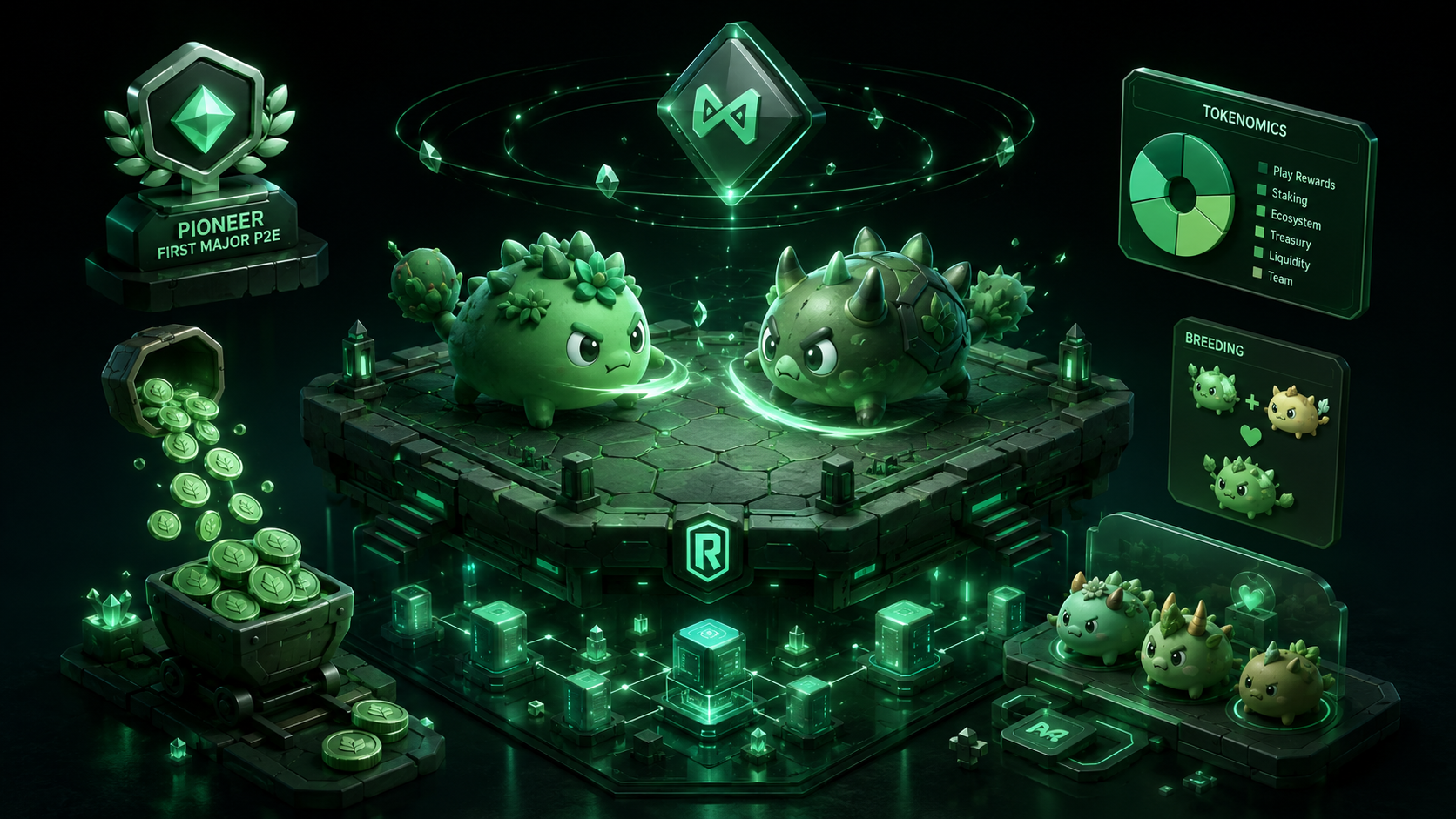
Axie Infinity launched a gaming revolution by proving that players could earn real money from virtual worlds. At its peak in 2021, the blockchain game attracted 2.7 million daily users and generated more revenue than Ethereum itself during certain weeks. Though the initial hype has cooled significantly, the project remains a foundational case study in how game economies can leverage tokens and NFTs.
Built on the Ronin sidechain, Axie Infinity lets players collect, breed, and battle fantasy creatures called Axies. The game's governance token, AXS, gives holders voting rights over the ecosystem's future while providing staking rewards for long-term participants.
What is Axie Infinity?
Axie Infinity is a blockchain-based game where players own digital creatures represented as NFTs. Created by Vietnam-based Sky Mavis in 2018, the game drew inspiration from Pokémon's battle mechanics and CryptoKitties' breeding system. Each Axie possesses unique genetic traits that determine its strengths, weaknesses, and rarity in combat.
The game operates on a dual-token economy. AXS serves as the governance and value accrual token, while Smooth Love Potion (SLP) functions as an in-game currency earned through gameplay and spent on breeding new Axies. This separation allows the ecosystem to reward active players with SLP while preserving AXS for governance and long-term alignment.
Core gameplay elements include:
- Collecting and training Axies with various body parts and abilities
- Battling other players in ranked PvP matches to earn rewards
- Breeding Axies to create offspring with potentially rare trait combinations
- Trading creatures on the marketplace for profit
- Participating in governance votes that shape the game's development
The Axie universe, called Lunacia, also features tokenized land plots where players can farm resources and build structures, adding another layer of economic activity to the ecosystem.
The Rise and Fall of Play-to-Earn
Axie Infinity became a cultural phenomenon during 2021, particularly in developing nations where daily earnings from the game exceeded local minimum wages. The Philippines saw the most dramatic adoption, with approximately 40% of all players coming from the country at peak activity.
| Metric | Peak (2021) | Current (2026) |
|---|---|---|
| Daily Active Users | 2.7 million | ~280,000 |
| AXS Price | $165.37 | ~$1.03 |
| Weekly NFT Volume | $214 million | Significantly reduced |
| Market Cap | $10+ billion | ~$170 million |
The economic model worked while new players continued entering, purchasing Axies from existing users, and adding fresh capital to the system. Critics correctly identified this dynamic as resembling a pyramid structure where sustainability depended on perpetual growth. When player acquisition slowed, SLP inflation outpaced demand, and token values collapsed.
The lesson proved valuable for the entire blockchain gaming industry: pure play-to-earn mechanics tend toward unsustainability without deeper utility or genuine fun driving engagement beyond financial incentives.
The Ronin Hack: A $625 Million Lesson
In March 2022, Axie Infinity suffered one of crypto's largest security breaches when hackers stole approximately 173,600 ETH and 25.5 million USDC from the Ronin bridge. The attack went undetected for six days until a user reported withdrawal issues. According to Chainalysis and FBI investigations, North Korea's Lazarus Group orchestrated the heist through a sophisticated social engineering attack.
The breach occurred after attackers compromised five of nine validator nodes controlling the bridge. A fake job offer targeting a senior Sky Mavis engineer delivered malware that granted access to internal systems. The hackers exploited a never-revoked permission that allowed Sky Mavis to sign transactions on behalf of Axie DAO, providing the fifth signature needed to authorize fraudulent withdrawals.
Sky Mavis responded by raising $150 million in emergency funding led by Binance Labs to reimburse affected users. According to the official Ronin postmortem, the company increased validator nodes from 9 to 21, implemented enhanced monitoring, and spent years strengthening security infrastructure. The incident accelerated industry-wide discussions about bridge security and validator decentralization.
Understanding AXS Tokenomics
AXS has a fixed maximum supply of 270 million tokens, with the full allocation expected to enter circulation by early 2026. The distribution prioritizes gameplay rewards and ecosystem development over early investor allocations.
Token Distribution:
- 29% for staking rewards
- 21% for the team (subject to vesting)
- 20% for play-to-earn rewards
- 11% for public sale participants
- 8% for ecosystem development
- 7% for advisors
- 4% for private sale investors
The staking mechanism allows holders to lock AXS and receive newly issued tokens as rewards. Unlike simple staking protocols, Axie requires participants to also play and vote to claim maximum rewards, creating alignment between passive holders and active community members.
Recent tokenomics updates include the January 2026 halt of automated SLP emissions, designed to reduce inflation and redirect rewards toward sustainable ecosystem growth.
The Ronin Network: Purpose-Built Infrastructure
Ronin is an EVM-compatible sidechain developed specifically for Axie Infinity. The network uses Delegated Proof-of-Stake consensus, with 22 validators securing transactions. This dedicated infrastructure eliminates the gas fees and congestion issues that plagued early blockchain games built directly on Ethereum.
Key Ronin features include the Katana decentralized exchange for token swaps, native NFT marketplace integration, and the RON token for network gas fees. The architecture enables sub-second transaction finality and supports the high-frequency operations required for real-time gaming.
Sky Mavis has expanded Ronin's scope beyond Axie Infinity, attracting third-party game developers to build on the network and leverage its existing user infrastructure.
Current State and Future Development
The Axie team continues building despite the market decline. Atia's Legacy, an MMO expansion inspired by games like Eve Online and Guild Wars, entered its second playtest phase in 2026. The update introduces squad-based exploration, open-world dynamics, and revamped combat mechanics designed to attract players seeking deeper gameplay experiences rather than pure earning opportunities.
Governance has also evolved, with the Axie Infinity Foundation overseeing a community treasury holding approximately 23 million AXS as of late 2025. Token holders vote on funding proposals through the AIP (Axie Improvement Proposal) system, including initiatives for new staking models and ecosystem experiments.
The shift from "play-to-earn" toward "play-and-own" reflects broader industry maturation, emphasizing genuine entertainment value while maintaining blockchain-based ownership benefits.
Trading AXS on LeveX
LeveX provides access to AXS through both spot and futures markets, accommodating different trading strategies and risk profiles.
Spot Trading allows direct ownership of AXS tokens. This approach suits traders interested in long-term exposure to blockchain gaming's evolution or those wanting to participate in Axie governance. Holding actual tokens enables staking and voting on ecosystem proposals.
Futures Trading provides leveraged exposure to AXS price movements without token custody requirements. Perpetual contracts work well for traders focused on shorter-term opportunities around game updates, token unlocks, or broader gaming sector momentum.
The Multi-Trade Mode on LeveX enables sophisticated position management, allowing traders to maintain multiple AXS positions simultaneously with independent leverage and risk parameters.
Risks and Considerations
Several factors warrant careful consideration before trading AXS.
Competition in blockchain gaming has intensified dramatically since Axie's peak, with hundreds of projects competing for player attention. Maintaining relevance requires continuous innovation and compelling gameplay updates.
Token unlock schedules mean significant supply continues entering circulation. Traders should monitor emission rates and their potential impact on price dynamics, particularly as staking rewards and team allocations fully vest.
Regulatory uncertainty around NFTs and play-to-earn models remains unresolved in many jurisdictions. Policy changes could affect how players interact with blockchain games and the tokens they generate.
User growth dependency remains a structural challenge. The ecosystem's health depends on attracting and retaining active players who generate demand for AXS through breeding, marketplace activity, and governance participation.
The Play-to-Own Evolution
Axie Infinity demonstrated that blockchain technology could transform gaming economics, giving players genuine ownership over their in-game progress and assets. The project's dramatic rise and subsequent decline provided invaluable lessons about sustainable tokenomics, security requirements, and the importance of gameplay quality beyond financial incentives.
As the team rebuilds with Atia's Legacy and enhanced governance systems, the question shifts from whether play-to-earn can work to whether play-to-own can deliver lasting value. The answers will shape how future blockchain games approach the balance between entertainment and economics.
For traders seeking exposure to blockchain gaming's continued evolution, AXS offers direct participation in one of the sector's most influential projects. Start trading AXS on LeveX spot or futures markets, and explore our Crypto in a Minute series for deeper insights into blockchain ecosystems.